
Hyundai Ioniq 6 N 2026: Our exclusive 600 km test on roads and racetracks!
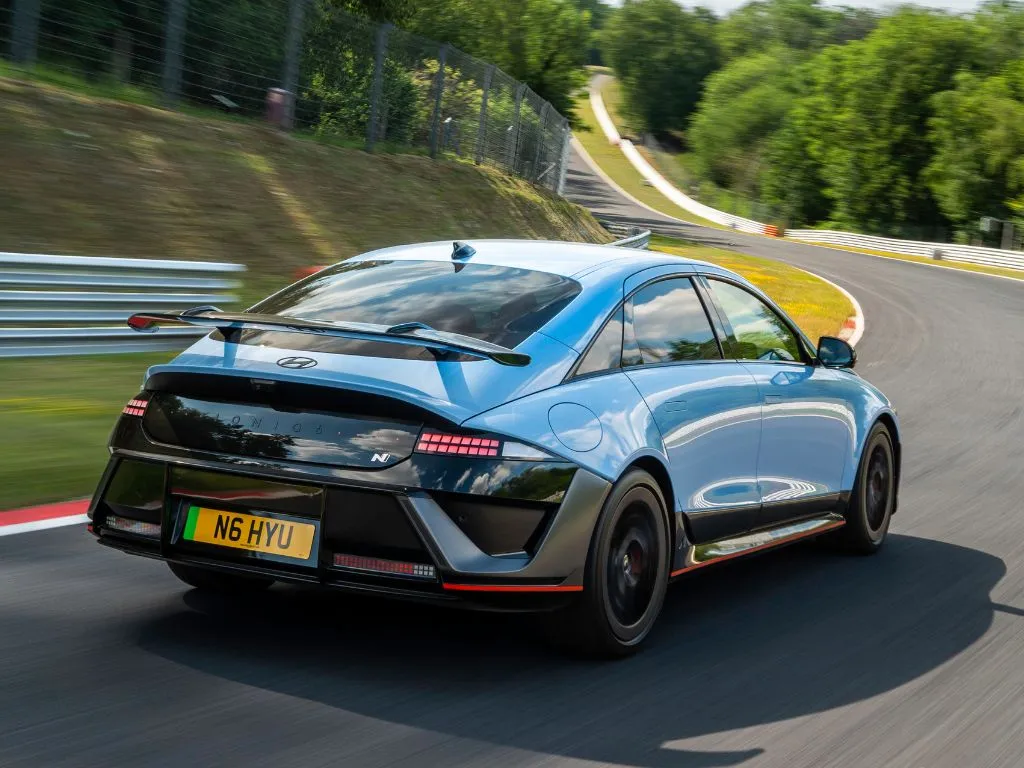
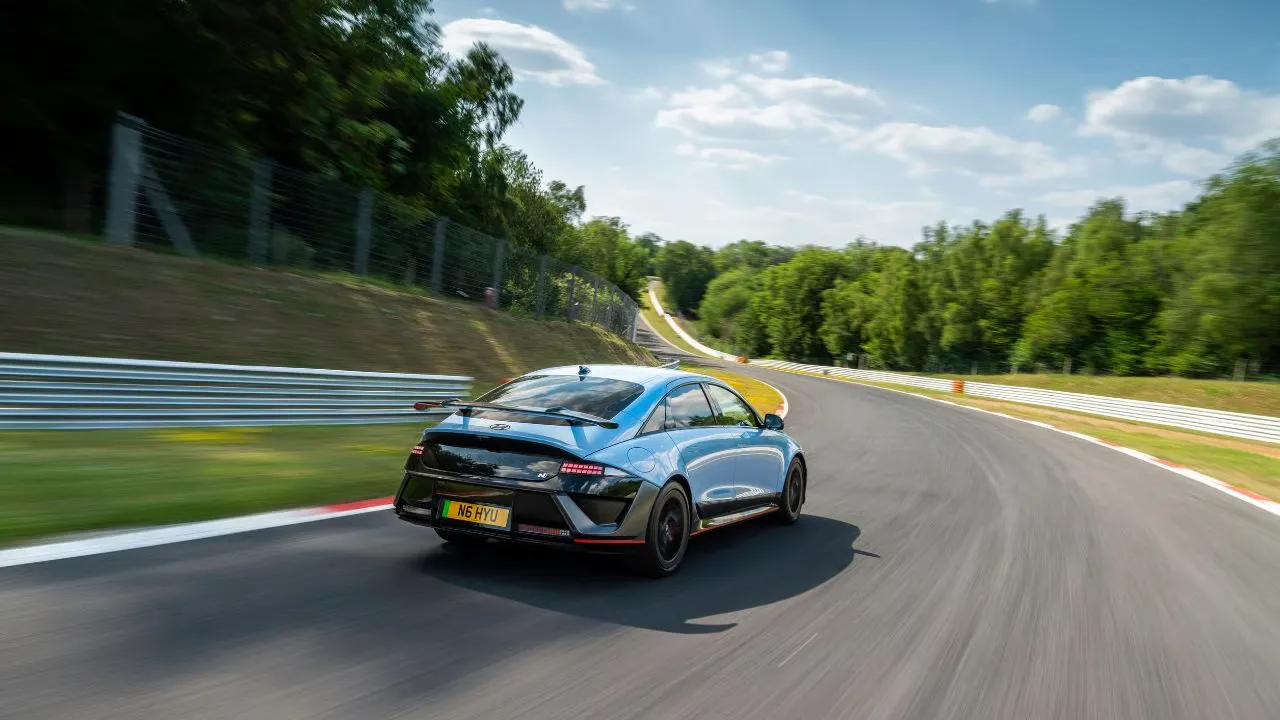
With 650 horsepower, a 0 to 100 km/h acceleration time of 3.2 seconds, and electronics capable of simulating a gearbox and clutch, the Hyundai Ioniq 6 N is packed with features. But behind the spectacle lies a true electric sports car, just as comfortable on the road as it is formidable on the track. We took it to Brands Hatch to see if the magic of the Ioniq 5 N still holds.
It was no longer expected. But here it comes. The Hyundai Ioniq 6 N, the ultra-sporty version of the electric “aero” sedan, will indeed be available in the French market. Its specifications are similar to those of the Ioniq 5 N, which we have covered extensively here. Expect 650 horsepower, 770 Nm of torque, all-wheel drive, and the famous virtual gearbox connected to artificial sound effects. To test it out, we left Paris for the United Kingdom via Calais, a ferry ride, and the Brands Hatch circuit. Here are our impressions.
The Hyundai Ioniq 6 N on the road
This car leads a double life. On one hand, it’s a relatively sleek sedan. On the other, it’s a sporty and entertaining vehicle. Even though we’re not yet out of the Paris metropolitan area, this long sedan moves silently. Sharp turns are difficult due to its large turning radius (over 12.0 meters) and limited rear visibility. As usual with Hyundai, blind spots are displayed on the instrument cluster, compensating for the small windows and mirrors. At the front, things are better: the short hood helps keep the car pointed in the right direction. It also offers the smooth operation of a hassle-free electric vehicle. On bumpy roads, the 20-inch tires remind you regularly of their large diameter through their firmness, but the adaptive suspension reduces discomfort.
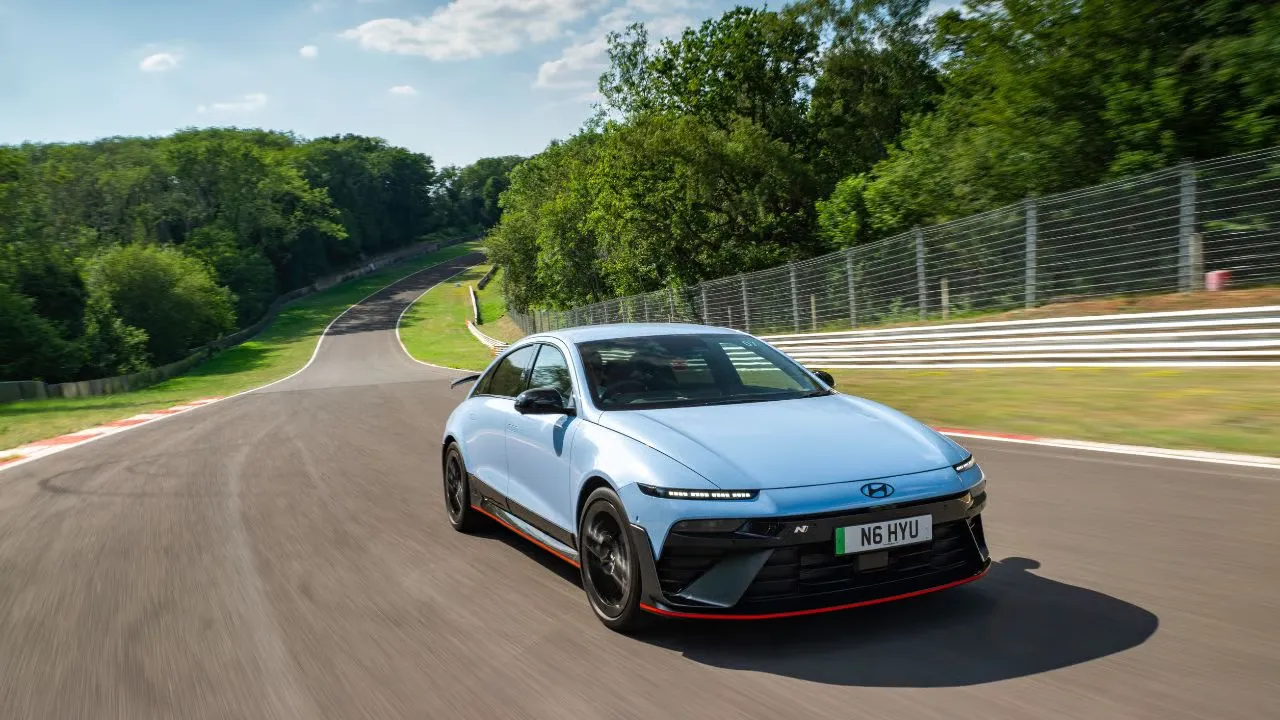
Let’s now head north on the A16 highway. The sedan handles well there, remaining stable though road and wind noise are less controlled than elsewhere. The large tires probably don’t help much. We take a road in the Boulonnais region, sometimes used for the Rallye du Touquet. In fact, when the front camera detects an A1c or A1d sign indicating a series of turns, the car suggests switching to the most fun driving modes... This is pure provocation.
Of course, you press the two large buttons on the steering wheel to put the sedan into its fun modes. The highlight is undoubtedly N-Shift. The harsh sound remains artificial, but it’s entertaining. You shift gears quickly using the usual paddles located behind the steering wheel. In fact, the virtual gearbox seems to be “shorter” (I put it in quotes) compared to that of the crossover. The surprise factor of the Ioniq 5 N has worn off, but your mind is still stunned by the effects of the simulated gear shifts or the jolts from the fake clutch.
Also read
New Hyundai Ioniq 3: here’s the range and prices
The front and rear engines combined deliver 609 horsepower (or 650 horsepower with the Grin Boost button on the steering wheel). The latter rotates up to 21,000 revolutions per minute. Only Ferrari or BYD can achieve higher rotation speeds. On dry roads, its driving performance is excellent. We must praise the adaptive suspension here, as it limits body movement at high speeds. The steering is responsive, and the gear ratio is direct.
If you sit lower than in the Ioniq 5 N, the thick battery blocks your view of the road slightly. There’s probably not much that can be done about this. Unless an unconventional design is adopted, like the future Alpine A110, which places its batteries in front of and behind the passengers rather than under their seats. This minor inconvenience doesn’t detract from the fun at all...
Power: 609 horsepower (650 with Grin Boost mode)
Torque: 770 Nm
Transmission: all-wheel drive, 1 gear ratio + reverse gear
Battery: lithium-ion NMC,
Weight: 2,201 kg
0 to 100 km/h: 3.2 s.
Top speed: 257 km/h
Interior space
Let’s briefly discuss the cabin and practical aspects here. The powered trunk opens onto the cargo area. 371 liters is sufficient, but the trunk lacks a bit of height. Anti-collision bars prevent using it for long items.
The rear seats are very spacious, especially in the knee area. The nearly 3-meter wheelbase certainly contributes significantly to this. The lack of a glass roof doesn’t greatly affect headroom, which remains quite good for a modern sedan. The seat allows for a natural sitting position, but the backrests lack sufficient lateral support and have a slightly short seat depth. Logically, rear passengers will find armrests.
Let’s move to the front. The star feature is, of course, the steering wheel. It features additional buttons for activating the various driving modes. The grip is pleasant thanks to the not-too-thick rim and reduced diameter. A shortcut button allows turning off the beeping sounds, which are particularly common in Korean vehicles.
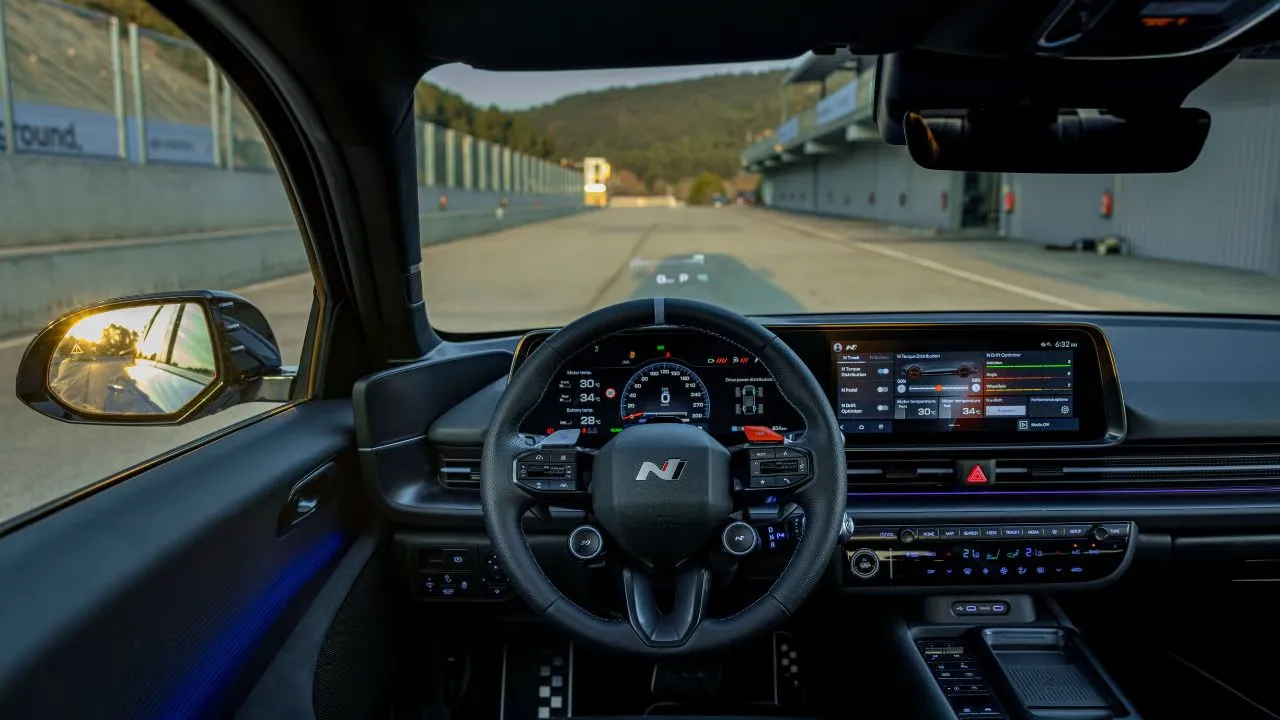
Otherwise, it features the same interior layout as the Ioniq 5 and Ioniq 6 with its two screens. The dashboard displays plenty of information in sport modes (oh, the battery temperature!), which seems appropriate given the vehicle’s intended use. However, the central tablet isn’t a strength of this car. For navigation/planning, the graphics are poor and response times are slower than those of other vehicles. Then there are the specific “N” menus that allow full customization—quite complex.
The “N”-marked semi-bucket seats are ventilated (which is useful) and provide excellent lateral support. However, they can feel a bit stiff if you sit there for long periods counting the road markers on the highway.
The Hyundai Ioniq 6 N on the track
Brands Hatch has the charm of a wooded English garden along with the unadorned atmosphere of an old-school circuit. Laid out in a natural amphitheater, it features long, winding curves. It is one of Britain’s sacred sites for motorsport, having hosted Formula 1 from 1964 to 1986. You exit the pits by switching to the most sporty driving mode, making sure not to cross the white line, before diving into the turns. The Hyundai immediately feels at home, its front end handling corners without excessive understeer. Even better, the Ioniq 6 N remains neutral and well-balanced throughout.
The steering also provides us with excellent feedback about the car’s previous movements. The absence of complex, trendy features like torque vectoring or active rear wheels gives the driving experience a natural feel. Along with a slight roll that is well-controlled, reminding us we’re not (quite) in a race car. Further on, the endless right-hand turn at Clearways highlights the outstanding grip offered by the Pirelli PZero tires. They make almost no noise and allow impressive speeds at the tightest corners.
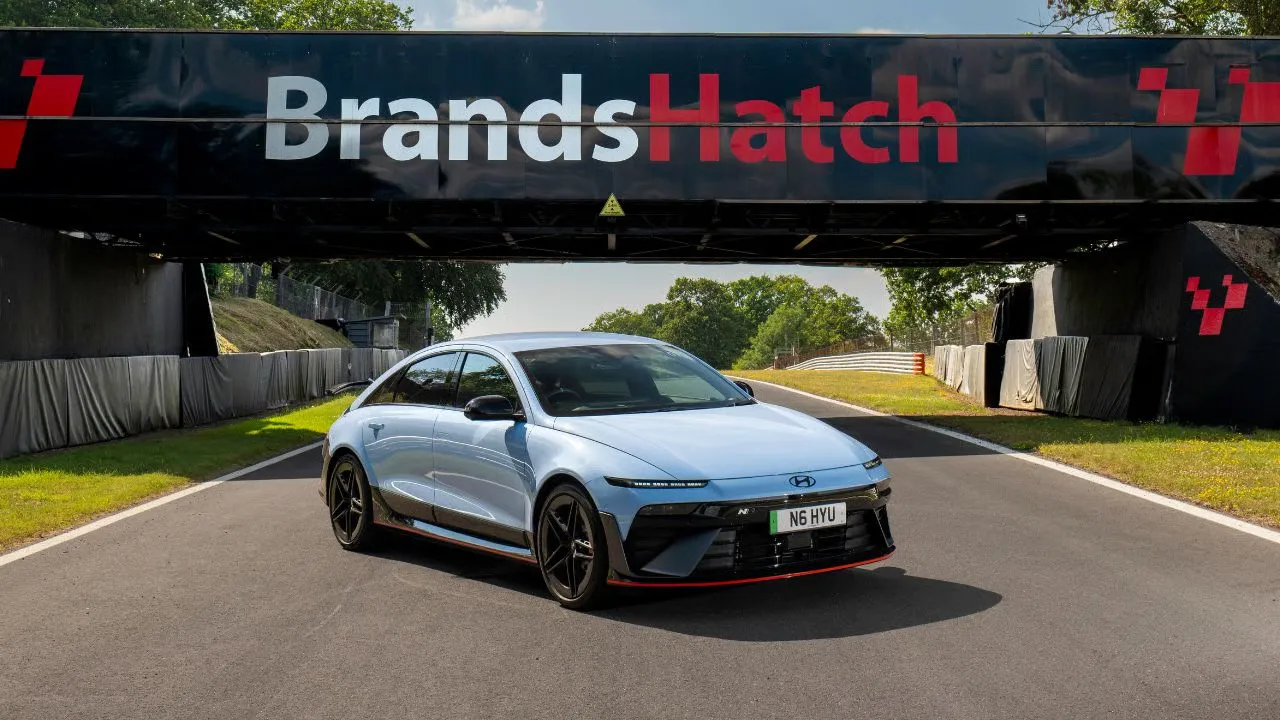
3rd gear, 4th gear, 5th gear… The handling, controlled by the N-Shift and the two motors, is impressive. Not shifting gears might be faster, but less fun. On the five hundred meters of straight track (which is actually curved) near the pits, speeds reach 180 km/h already. This straight section is far from flat either. As you approach the first turn (Paddock Bend), the asphalt rises and then drops again. Here, you can still feel the weight of the Ioniq 6 N. The suspension can’t prevent the car from lifting, causing it to “fall back” onto its wheels at exactly the moment braking would be needed… Technical.
I forgot to mention. At this point, you already start turning the steering wheel to dive into the valley in 4th gear, with the outer lane not being that far away… When you press the left pedal at the entrance to the 180-degree Druids turn, the brakes engage immediately.
The large discs (400 mm at the front, 360 mm at the rear) work together with the regen system without transmitting their performance nuances to the pedal. However, we haven’t driven long enough to assess the brake’s durability over the medium term. It’s very enjoyable at high speeds. Brands Hatch features long curves rather than sharp sequences of turns. On a more bumpy track, those who prefer extreme handling might be disappointed to learn the rear differential is electronic. They can probably compensate by adjusting the torque distribution to the rear wheels via the central screen to give the Ioniq 6 N a more “propulsive” character. The off-road capabilities are also extensive, including a drift mode for example.
During our two rounds of testing, we were mainly relieved to see that the battery temperature didn’t rise too quickly. The reading displayed on the instrument panel (yes!) never exceeded 40°C, well below the dangerous level for insulation materials. The work done on cooling systems (vents, chillers, etc.) is excellent.
This Ioniq 6 N is incredibly efficient anyway. Our German colleagues recorded a time of 7’35” at the Nürburgring. These times are comparable to those of the Alpine A110 R and BMW M5 Competition… and it’s about ten seconds faster than the Ioniq 5 N.
Hyundai Ioniq 6 N Fuel Consumption and Charging
We know that the Ioniq 5 and 6 are somewhat fuel-intensive by nature. The same is true here. On paper, the WLTP fuel consumption is 18.7 kWh/100 km. During our road trip—mostly on highways—we were closer to 23 kWh/100 km. This results in an actual range of around 350 to 400 km, compared to 487 km according to the WLTP cycle. As usual, this figure varies greatly depending on the route and driving style.
Manufacturer’s claimed range: 487 km
WLTP fuel consumption: 18.7 kWh/100 km
Powered by an 800-volt system, this sporty version still offers excellent charging performance. During a stop at a fast charger, our car gained 62 kWh with an average power output of 180 kW—I emphasized average, not peak.
Charging from 10% to 80% (manufacturer): 18 minutes
We went from 10% to 81% in 21 minutes. This is also fast, although under these specific conditions it was a bit slower than what the theoretical specifications suggest. It still compensates for the car’s somewhat high fuel consumption… Especially if driving on a circuit, where fuel usage soars.
Price and Features of the Hyundai Ioniq 6 N
The price remains to be discussed. The Ioniq 6 N is priced at 79,000 euros in France. It includes all the features designed for sporty driving mentioned above. This is a substantial amount of money, and it’s more than 20,000 euros higher than a Tesla Model 3 Performance. Yet the latter is less powerful and less finely tuned. This price is still far below that of German 800-volt electric sports cars like the Porsche Taycan and Audi e-Tron GT. The Mercedes-AMG CLA 45 4 MATIC will soon join this list, though its price has not yet been determined. As for the new AMG-GT 4-door model, it costs almost twice as much… while adopting many of the same technologies developed by Hyundai.
Also read
Electric cars: why official range and consumption figures don’t match reality
Ultimately, it’s all a matter of perspective. I won’t bother explaining to you that sports cars are expensive… and that in this market, rationality isn’t always at play. It’s the senses rather than logic. This might be good news for the Ioniq 6 N.
In summary
The pleasures of the Ioniq 5 N, but at a slightly lower price and with slightly better efficiency.