
Hyundai and LGES launch battery storage pilot using repurposed EV batteries
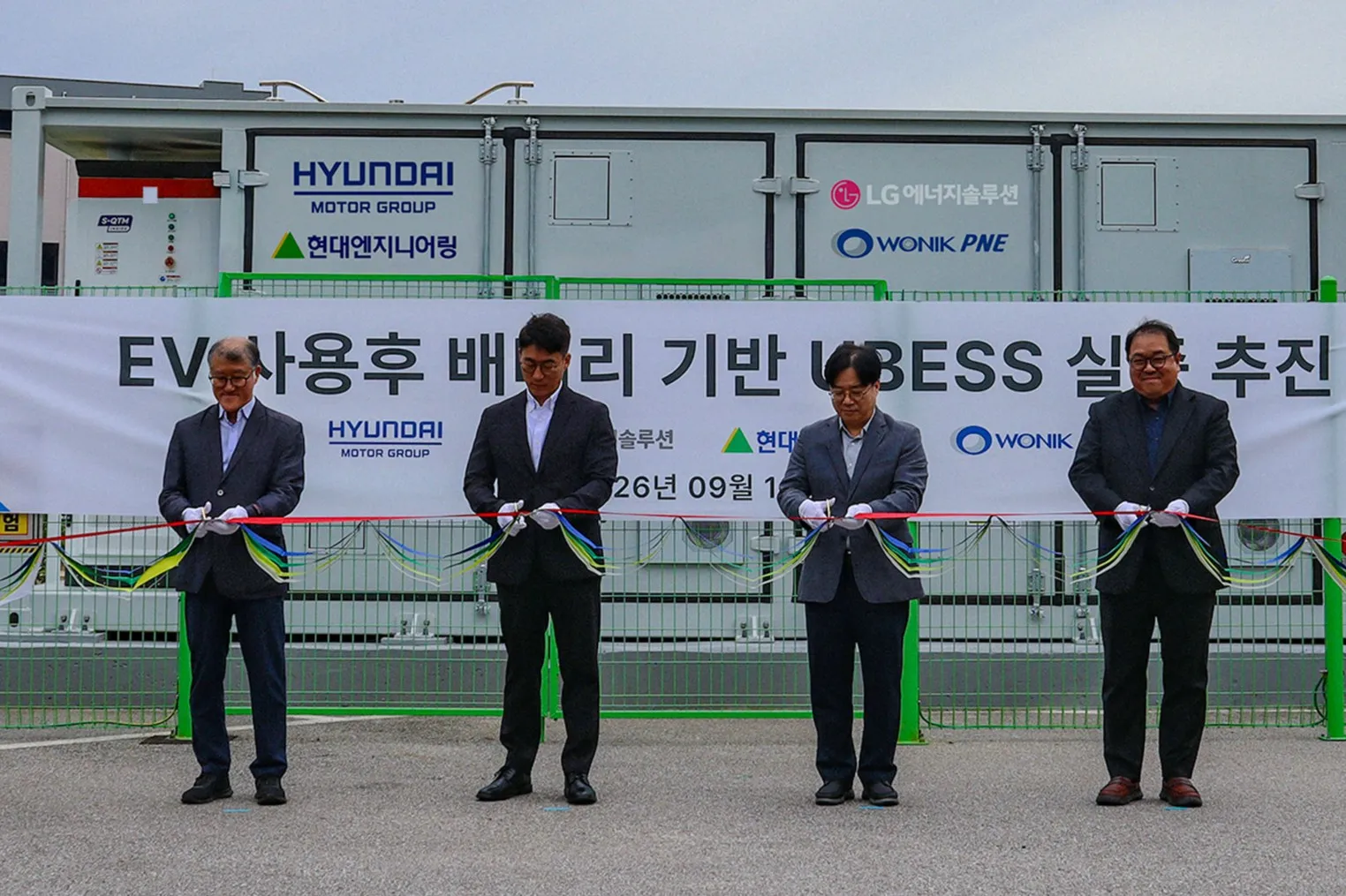
Hyundai and Kia are collaborating with LG Energy Solution on a large-scale demonstration project for charging stations with battery storage systems as an external buffer, using second-life batteries from EVs on the E-GMP platform.
The goal of the pilot project in South Korea is to determine whether batteries decommissioned from EVs can find a profitable second life as energy storage systems for charging electric vehicles – i.e. second-life applications. The project utilises battery packs from EVs based on Hyundai Motor Group’s E-GMP platform. According to the companies, this marks the first such demonstration in South Korea to employ decommissioned E-GMP battery packs.
The system, installed at Wonik PNE’s plant in Dongtan, Hwaseong, south of Seoul, has a storage capacity of 200 kWh. The UBESS (Ultra-Burned Energy Storage System) is connected to DC fast chargers for EVs. The installation primarily stores energy in the UBESS during off-peak hours, when electricity prices are low, and then uses the fast chargers to charge electric vehicles during peak demand periods.
Hyundai and Kia aim to develop a business model
As part of the UBESS project, sister brands Hyundai and Kia are working to develop a business model for establishing a system that enables the safe and efficient use of repurposed batteries. LG Energy Solution manufactures UBESS systems using used battery packs from Hyundai Motor and Kia, and supports the verification of system performance and safety through its battery diagnostics and operational technology.
Drawing on its experience in operating EV charging infrastructure, Hyundai Engineering is evaluating business development in real-world commercial environments and the integration with the business of building EV charging infrastructure. Meanwhile, Wonik PNE, a manufacturer of charging stations, is responsible for stable system operation and technical verification based on its expertise in charger manufacturing and infrastructure construction.
Leveraging their respective expertise, the participating companies plan to comprehensively evaluate charging/discharging control algorithms, system safety and reliability, battery performance retention characteristics, charging quality, and operational efficiency. They will also test the feasibility of reusing repurposed batteries and the implementation of a circular battery economy in real-world commercial environments, according to Hyundai.
The use of repurposed EV batteries in stationary energy storage systems is not new. For example, Porsche established a stationary energy storage system two years ago to power its Leipzig plant, utilising used batteries from the Taycan. Additionally, there are already DC fast chargers with integrated battery storage, such as those from ADS-Tec or ELMI Power. However, what sets Hyundai and its partners’ project apart is the combination of repurposed batteries in a stationary storage system connected to a DC fast charger.