
How much do the cars cost?
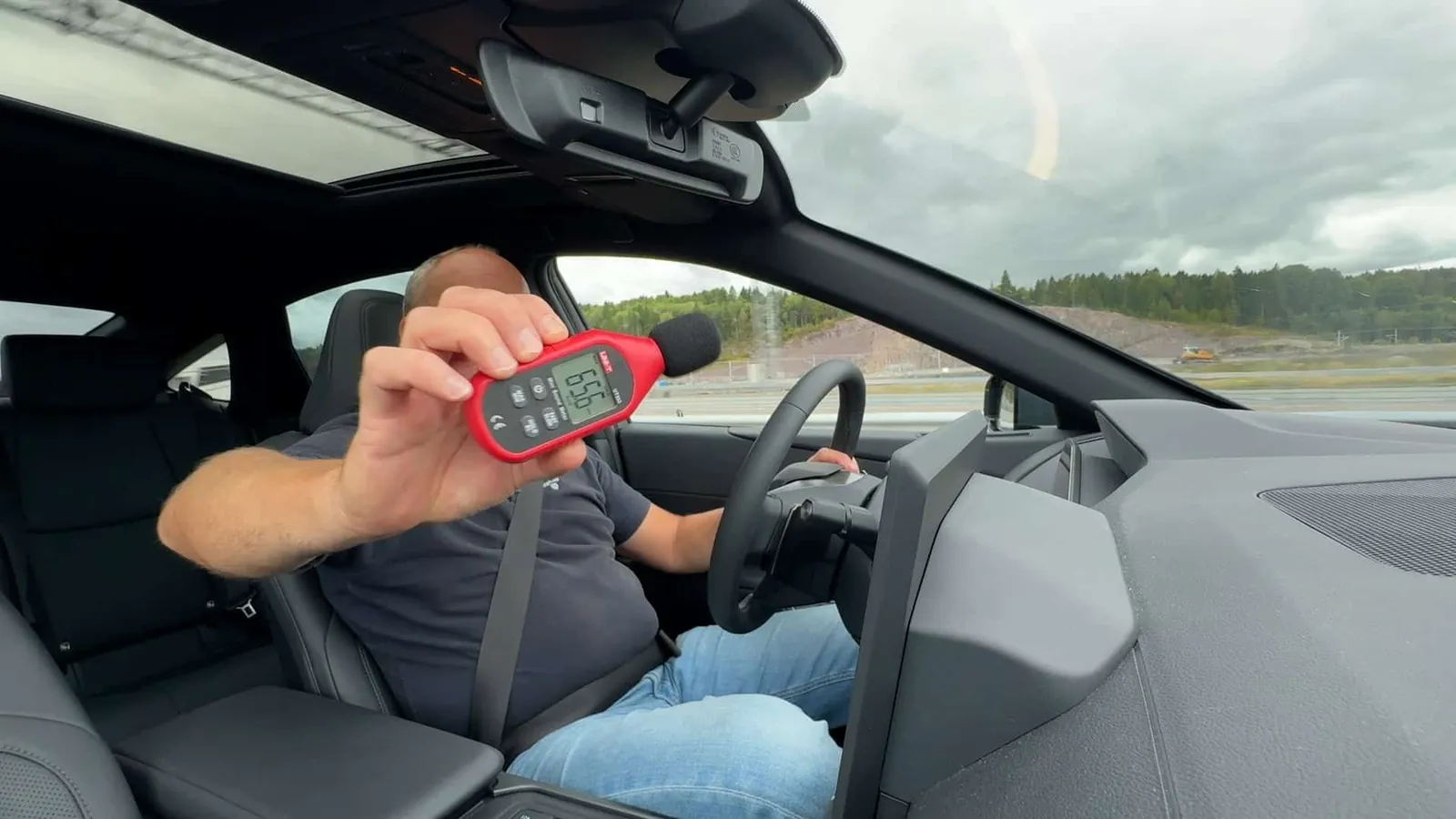
We have measured noise levels inside the cabin of 36 cars. Check whether your car produces more or less noise compared to others.
16.09.2026 07:02 | Updated 15.09.2026 13:49
Electric cars are naturally quieter than gasoline cars, but they’re not completely silent. That’s why we measure cabin noise on the vast majority of cars we test during the summer.
More Noise Sources
Engine: One of the biggest differences you notice when switching to an electric car is the absence of noise and vibrations from the engine.
Together with the elimination of gear shifts, this reduced noise contributes significantly to the improved driving comfort in electric cars—both for the driver and those sitting in the car.
Air: But the faster you drive, the more air needs to flow around the car as well. Air resistance increases with the square of speed, generating noise both inside and outside the vehicle. And the trend toward larger SUVs doesn’t necessarily help reduce noise.
Touring vehicles have large gaps between the wheels and fenders, high ground clearance, large mirrors, spoilers, and other elements that create turbulence and generate noise.
Tires: Increasingly larger, heavier, and stronger vehicles require even bigger tires. They produce noise, especially on Norwegian asphalt, which contains a much higher percentage of stones compared to European asphalt.
Lower rolling resistance often requires stiffer tires. They wear out faster than softer tires, but softer tires tend to degrade more quickly as well. Wider tires generate more noise than narrower ones. Many manufacturers have started using shock-absorbing materials inside tires.
Solutions
There are various ways to address noise problems. Noise-absorbing materials on body panels, textiles in the interior, wheel wells lined with carpets, removal of mirrors and door handles, improved aerodynamics, lower ground clearance, and tires with internal shock absorption are some of the effective solutions.
The more expensive the car, the more measures can be taken, but it’s not always the most expensive cars that are the best at reducing noise.
How we test
We measure the noise level at 80 km/h and 100 km/h.
We position the noise meter midway between the driver and front passenger at head height, and we use a simple noise meter from Clas Ohlson, so our measurements shouldn’t be considered scientific but rather as a rough guide.
So far, we have only measured the noise level on summer tires, with one car exception. The noise is lower on softer winter tires.
We have only measured the noise level when the asphalt is dry to obtain comparable results.
Remember that even small differences in decibels can mean a significant increase in noise. The decibel scale is logarithmic, so an increase of 3 dB corresponds to roughly doubling the sound energy, while 10 dB is perceived as about twice as loud.
Many quiet Chinese car models
On our unofficial list below, there are many Chinese cars that stand out as the least noisy among the 36 models we have tested for noise levels so far.
It’s also pleasing to see a European family car, the Skoda Elroq, high on the list of least noisy car models.
Check the noise level of all the cars we have tested so far in the list below:
Join us as a member!
Get the Norwegian Electric Vehicle Association charging card, which gives you access to charging stations in Norway and Europe, expert assistance with charging, and premium roadside assistance. Join 120,000 other electric vehicle owners!
Read more
The post How much do cars cost? appeared first on Norwegian Electric Vehicle Association.