
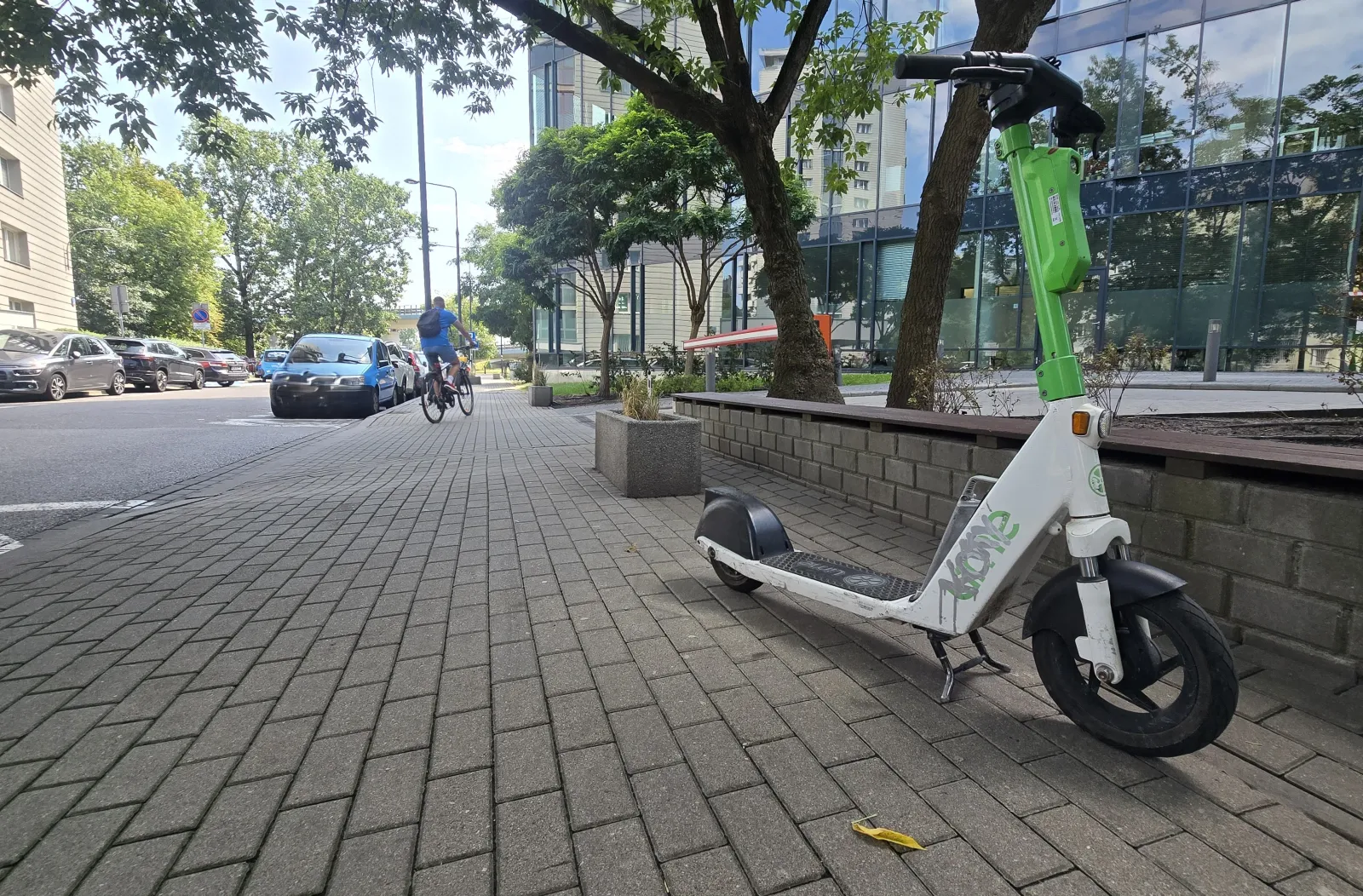
Electric scooters are being removed from parks. The council members were unanimous. Is this just the beginning of changes?
In the article
What exactly has Kolobrzeg banned and who are the new rules applicable to
Why the agreement with rental companies didn’t solve the problem
What is the gap in the regulations regarding road signs
How many accidents involving e-scooters are reported by the police
What regulations apply to scooter users in 2026
How do other cities in Poland and Europe handle scooters
The resort focuses on pedestrian safety
The new regulations apply to urban green spaces, such as parks, gardens, and plazas. Electric scooters can only move through them on designated bike paths. The amendment also covers bicycles—both traditional and multi-wheeled—that travel on paths meant for pedestrians.
Kołobrzeg has the status of a health resort, and its parks, promenades, and seaside walkways are visited daily by thousands of patients, seniors, tourists, and families with young children. It is their safety that the city authorities cite as the main reason for the changes. According to Mayor Mieczkowska, the increasing number of electric scooters in urban areas requires regulation, and green spaces must remain places where pedestrians can walk without worry. The new rules are also intended to give the city police a clear basis to enforce the ban.
Rental Scooters
The resort is not trying to regulate e-scooter traffic for the first time. Previously, the city reached an agreement with rental operators: minute-based vehicles were banned on the seaside promenade and in the city center, while designated parking areas were set up in the resort and urban zones.
However, this solution only worked partially. Geofencing restrictions apply only to the operators’ fleets, not to private scooters, whose owners — as the city authorities emphasize — routinely ignore basic regulations. It is against this group that the authorities need effective legal tools.
New road sign
The main issue is the lack of appropriate signage. The regulation on road signs and signals does not provide a sign dedicated exclusively to electric scooters. Road authorities wishing to ban them from traffic must use sign B-1 “no traffic in either direction” or solutions that apply to all single-wheel vehicles, which also affects cyclists. Signs indicating “not applicable to bicycles” are often interpreted differently when it comes to scooters.
Kołobrzeg has therefore submitted an application to the Union of Polish Cities, asking it to urge the infrastructure ministry to urgently amend the regulation. This is not the first such initiative — in February 2026, a request to introduce a vertical sign reading “No entry for electric scooters” was already submitted to the ministry. The resort authorities hope that other local governments will support this appeal, increasing the chances of changing the rules at the national level.
Accidents Involving Scooters
Police data show that this problem is widespread across the country. In 2025, there were 1,158 accidents involving electric scooters, compared to 752 the previous year — a rise of about 54 percent. The number of fatalities more than doubled, from five in 2024 to 11 last year.
The involvement of the youngest users is particularly concerning. According to 2025 data, scooter users aged 7–14 were responsible for 243 accidents, resulting in three deaths and 265 injuries. In this context, e-scooters stand out negatively — they are one of the few groups of road users whose accident rates are rising, while overall road safety in Poland is improving.
Rules for electric scooters
The Road Traffic Act requires drivers of electric scooters to use bicycle lanes or bike paths primarily, at a speed not exceeding 20 km/h. Driving on the road is allowed when bicycle infrastructure is unavailable, and the permitted speed for cars does not exceed 30 km/h. Pedestrian paths are an exception — allowed only along roads with a speed limit above 30 km/h and without bicycle lanes, at a speed similar to that of pedestrians while giving them priority.
2026 brought further tightening of rules. Starting March 3, the minimum age for operating an electric scooter rose from 10 to 13 years, and as of June 3, those under 16 must wear a protective helmet. A guardian who allows a child to ride without a helmet faces a fine of up to 100 zł. There is also a speed violation fee starting at 50 zł for exceeding the limit by up to 10 km/h. The government also plans to grant the city police broader powers, including the ability to check scooter speeds and power levels.
Prohibitions in Other Cities
Kołobrzeg is not alone in this regard. Białystok has imposed bans on electric scooters in places such as Branickich Park, Starego Park, Planty, and Z. Kościałkowskiego Boulevards. In Kraków, discussions have taken place about restrictions in Planty and Błonia areas, as well as a ban on rental services—though the latter idea was deemed too extreme by Mayor Aleksander Miszalski.
In Europe, Paris went the farthest, banning rental scooters in 2023. Madrid and Prague have also made similar decisions. However, Polish local governments, including Kołobrzeg, do not advocate for eliminating this mode of transportation but rather for clearly separating scooter traffic from pedestrian zones. Whether a new sign will appear on roads now depends on the Ministry of Infrastructure.
Editorial team of elektromobilni.pl