
HUK-E-Barometer: Switching to electric cars has reached a record level in the private sector
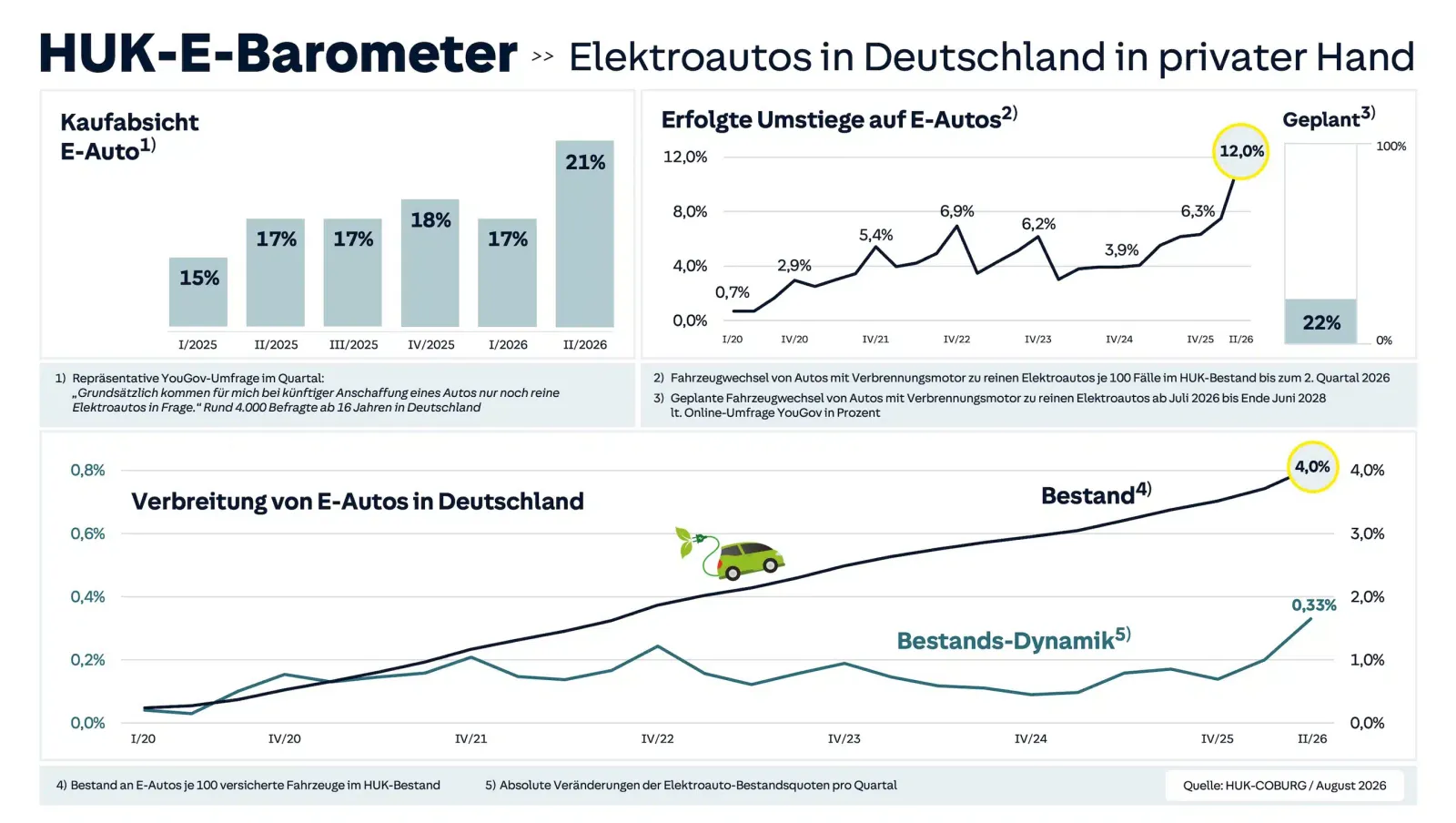
Image: Tesla (illustrative)
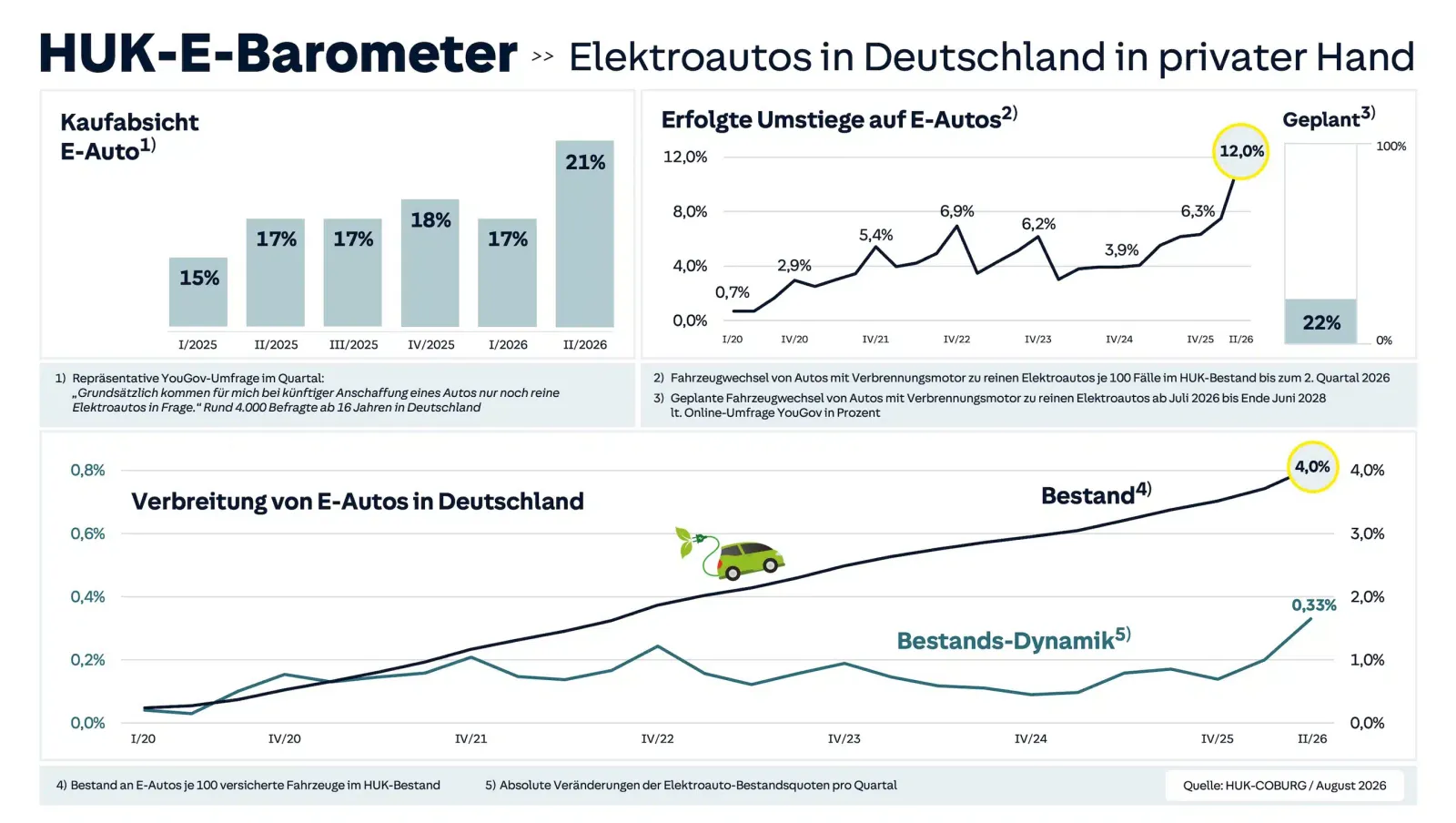
According to HUK-Coburg’s latest “HUK-E-Barometer,” the frequency of switching to electric vehicles among private individuals in Germany rose sharply again in Q2 2026, reaching record levels. One in every eight vehicle replacements (12.0%) among HUK’s insured fleet now involves switching from a gasoline-powered car to a fully electric one. Before the Iran war and the subsequent sharp rise in fuel prices, this rate was only about half as high (6.3% in January and February 2026).
The HUK-E-Barometer is based on insurance data from HUK-Coburg and an online survey. According to this, the frequency of switching to used electric cars increased more sharply in the second quarter of 2026 than the switch to new fully electric vehicles. Drivers who travel over 12,000 kilometers per year are now switching to electric cars at a much higher rate than those with lower annual mileage, resulting in a record gap between the two groups (14.7% to 8.0%). This difference is even larger when it comes to switching to used electric cars (10.7% to 4.5%).
Almost one in four drivers with a license (24%) said they first considered buying an electric car “only because of the rise in diesel and gasoline prices since the start of the Iran war,” or that they are now more likely to proceed with such a purchase as a result.
Jörg Rheinländer, head of vehicle insurance at HUK-Coburg: “The growth of electric mobility in Germany has reached a new level, driven also by sharply rising fuel prices. Used electric cars seem poised to become game-changers in this regard. This trend could potentially be further strengthened if buyers of used electric cars, in addition to those purchasing new ones, could also benefit from government incentives for electric vehicles.”
Acceptance of electric cars is rising
Social approval for electric cars has also reached new highs. For the first time since HUK-E-Barometer began its quarterly surveys in 2024, more than half of Germans (52%) now say they consider electric cars “good” or “very good.”
Over time, however, there have been differences between men and women. Men have always held far more positive views of fully electric cars than women. But in the second quarter of 2026, women narrowed this gap significantly. Their approval of electric cars as good or very good rose from 37% in the previous quarter to 45% now. This increase was two-thirds higher than that among men (from 54% to 59%).
Tesla Makes a Comeback
According to the analysis, automobile manufacturers benefited very differently from the electric vehicle boom in the first half of 2026. When it comes to new car purchases, cheaper foreign manufacturers are in the spotlight. The Chinese manufacturer BYD can increase its share among those switching from internal combustion engines to pure electric new cars relatively the most—though starting from a low level in 2025 (from 0.8% to 3.3%). A similar situation exists with the also Chinese brand Leapmotor (from 1.8% to 3.4%). Tesla also saw a comeback: after its share in the U.S. dropped from 15.5% to 5.6% last year, it rose almost by the same amount in the first half of this year to 12.2%.
All German brands except Opel lost market share when switching from gasoline vehicles to new electric cars. However, the situation is different if used electric cars are purchased as part of such transitions. In these cases, one in six vehicles involved is a VW. This share even increased slightly in the first half of the year to 17.1 percent. Other brands within the Volkswagen Group also saw rises in the proportion of used electric cars (Audi from 5.4% to 6.8%, Skoda from 2.7% to 5.0%, and Cupra from 2.2% to 3.0%).
Significantly different dynamics across federal states
In regional comparisons, during the first part of 2026, Schleswig-Holstein and Niedersachsen have shown the greatest momentum in increasing the number of private electric cars, ahead of Bavaria in third place. In contrast, Saxony and Berlin, which are at the bottom, have market momentum only about half of their top-performing regions’ levels. Even Baden-Württemberg, known as Germany’s car state, now performs below average in terms of market momentum—except for its capital city, Stuttgart. Among Germany’s 15 largest cities with over 500,000 inhabitants, Stuttgart has shown the greatest change in electric car ownership so far in 2026. With 5.3 percent, it has by far the highest proportion of electric cars in private ownership among these metropolitan areas.
But even Stuttgart is far behind in electric vehicle development compared to some more rural communities. For example, the private electric vehicle ownership rate in Germany’s leader—Starnberg district—is 7.4 percent, much higher. At the bottom of the rankings among districts and independent cities are Frankfurt/Oder (1.4 percent) as well as the Görlitz and Vogtlandkreis districts (both at 1.5 percent). Even in West Germany, there are areas lagging behind in electric vehicle adoption. Currently, Gelsenkirchen has the lowest market momentum nationwide. By 2026, its growth rate will be less than one-sixth of the leading districts’ rates in Cloppenburg (Niedersachsen) and Schweinfurt (Bayern).
Plug-in hybrids gain ground, mild hybrids lose ground
Since the beginning of the year, buyers of plug-in hybrids can also benefit from government subsidies. According to the study, there has been a greater shift toward plug-in hybrids with charging cables, particularly among drivers of gasoline and diesel vehicles, as well as those using mild and full hybrids. Compared to the previous year, this is especially true for purchasing used plug-in vehicles. Although these transitions are less frequent than those to pure electric cars, HUK data shows that, unlike the increasingly popular plug-in hybrids, shifts to mild and full hybrids—those without external charging capabilities—are declining by 2026. Additionally, evidence suggests that plug-ins’ role as a transitional technology is growing: 39.4 percent of current plug-in hybrid drivers switched to a pure electric car when purchasing a new vehicle in the second quarter of 2026. This is more than those who switched to plug-in models.
-Those that remained hybrid (38.1 %).Also interesting
About the author
Thomas Langenbucher is an expert in electromobility with professional experience in the automotive industry and finance sector. Since 2011, he has been covering electric vehicles, sustainable technologies, and mobility solutions on ecomento.de. Learn more.
Reader interactions