
Honda’s wireless in-road charging system means EVs can charge up to 150kW while on the move

News
Honda has teamed with Taisei to to develop e-HGV friendly wireless charging roads.
GE
George East
23 October 2026 · 3 min read
Honda is co-developing a wireless EV charging system that keeps a vehicle’s battery topped up while it’s on the move.
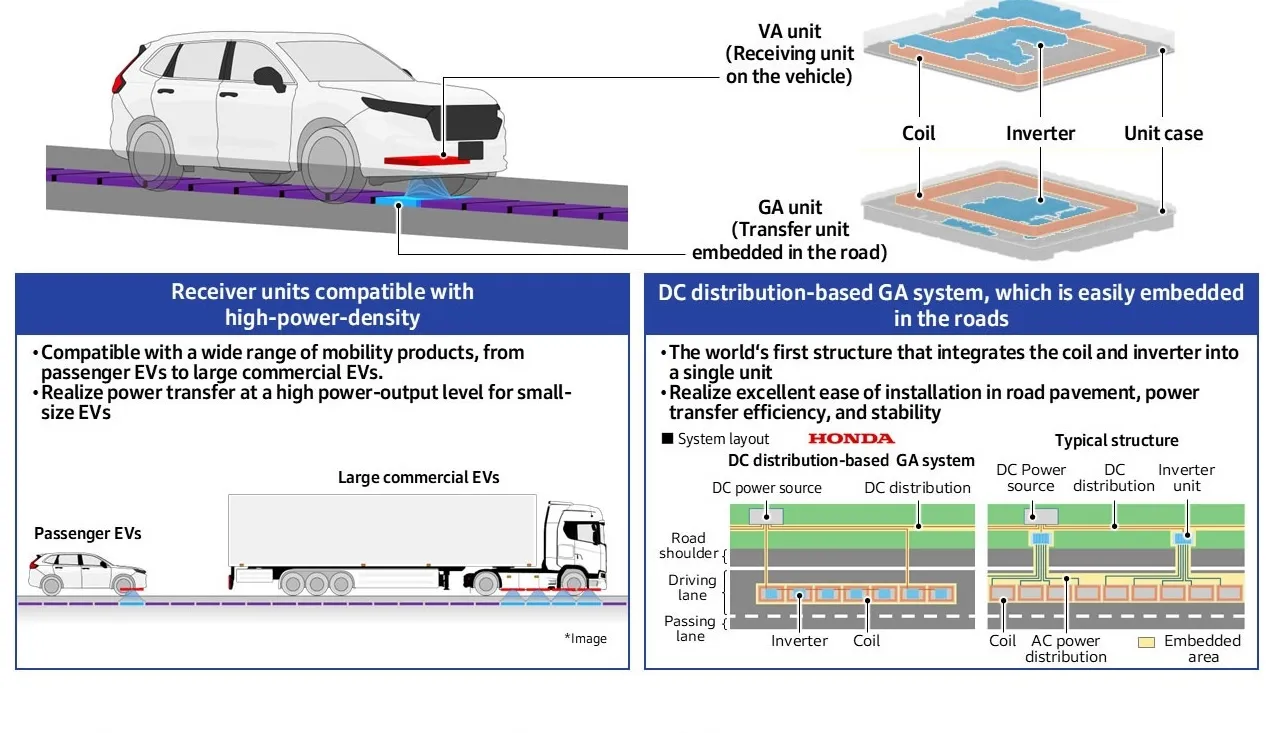
The setup is made up of a unitary DC coil and inverter transmitter embedded centimetres beneath the road surface, a roadside DC supply system, and an in-built vehicle receiver that picks up charge from the coil/inverter system.
This isn’t a new idea in principle. At the start of 2025, Electreon told EV Powered that it’s introducing electric charging roads across several global locations from Paris to Tokyo, and working with several car manufacturers to make their vehicles compatible with the technology.
However, the system Honda is co-developing with Japanese civil engineering and construction firm, Taisai, and its subsidiary, Taisei Rotec, stands out because it can deliver up to 150kW of power. This means it can also charge e-HGV lorries.
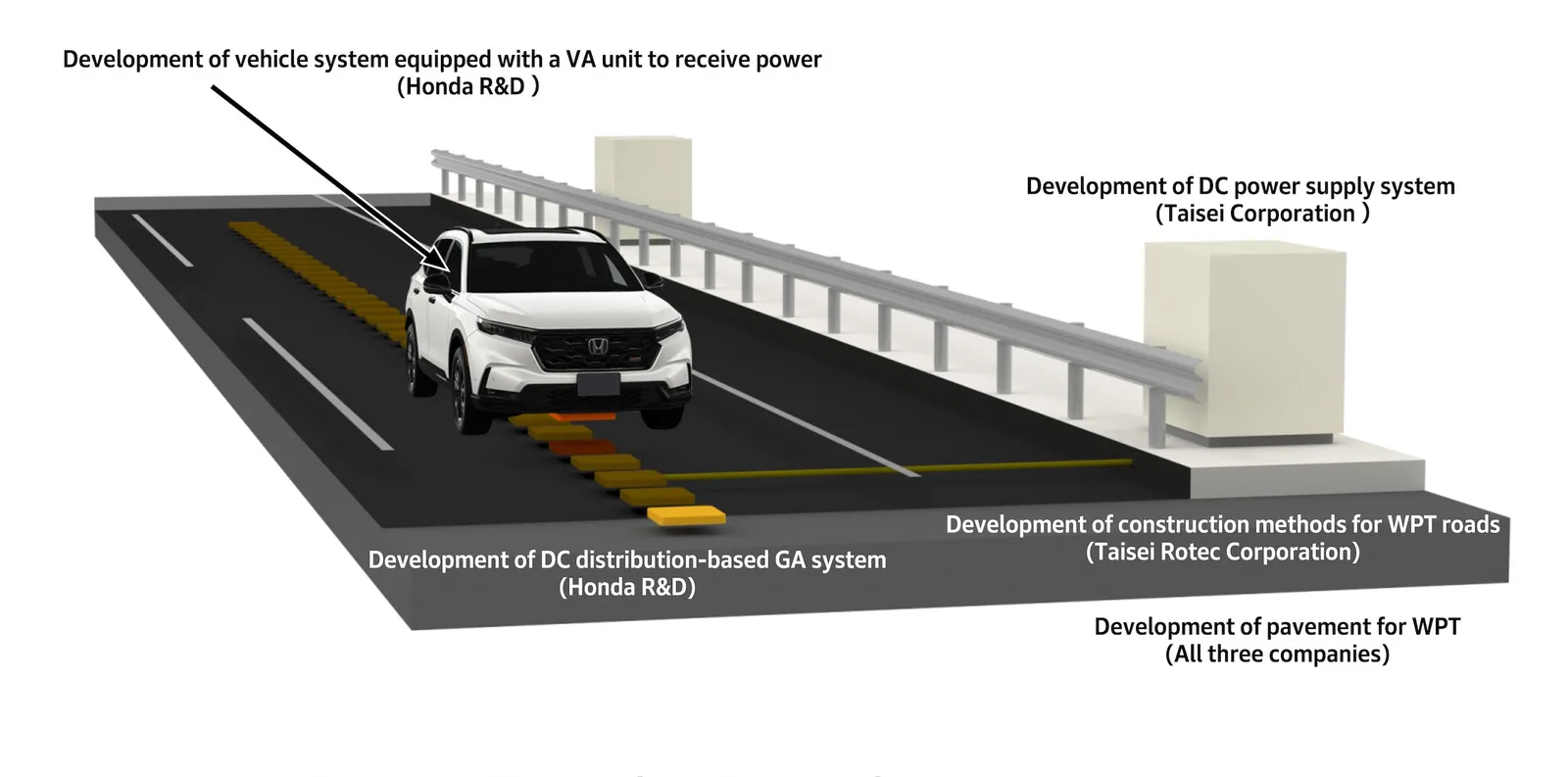
Like Electreon’s system, Honda’s setup comprises three major parts: a DC power supply system located by the roadside, a DC distribution ground assembly that connects multiple road-embedded power transmitter units to a DC electrical system, and an in-car receiver unit.
Honda will develop the power receivers and transmitter units, while Taisei is responsible for the DC power supply system. Taisei Rotec will work on the required technology and infrastructure for installing it into the ground.
An initial test on a piece of test road at Taisei’s Technology Field in Satte, Japan, is scheduled for late 2026. To test its durability, the road surface and the coil/inverter system beneath it will have to withstand the equivalent of over a million wheel loads, and around 20 tonnes of fully-laden electric HGV repeatedly passing over the top at speed. The companies involved will also have to understand how to deal with potential electromagnetic field leakage.
Once these initial tests are complete, a secondary test will be carried out on a public road once again in Japan, albeit on the Tateyama Expressway in Chiba, in April 2027.
The idea behind wireless charging roads is to reduce the number of charging stops a driver needs to make by keeping their vehicle’s battery topped up in a way not dissimilar to a mobile phone. By decreasing the need for lengthy charging sessions, the ‘little and often’ top-up approach reduces stress on the battery and significantly prolongs its life.
Large-scale wireless EV charging roads are unlikely to be making it into the mainstream any time soon. Nonetheless, with firms such as Electreon and Taisei, along with OEMs such as Honda, Porsche, and Toyota exploring wireless EV technologies, they could well become part of the electric vehicle landscape sooner than expected.