
Honda turns asphalt into a 150 kW charger: Japan has already set a date to test it on a highway with 20-ton trucks
30/10/2026 09:30
Updated to
30/10/2026 09:30
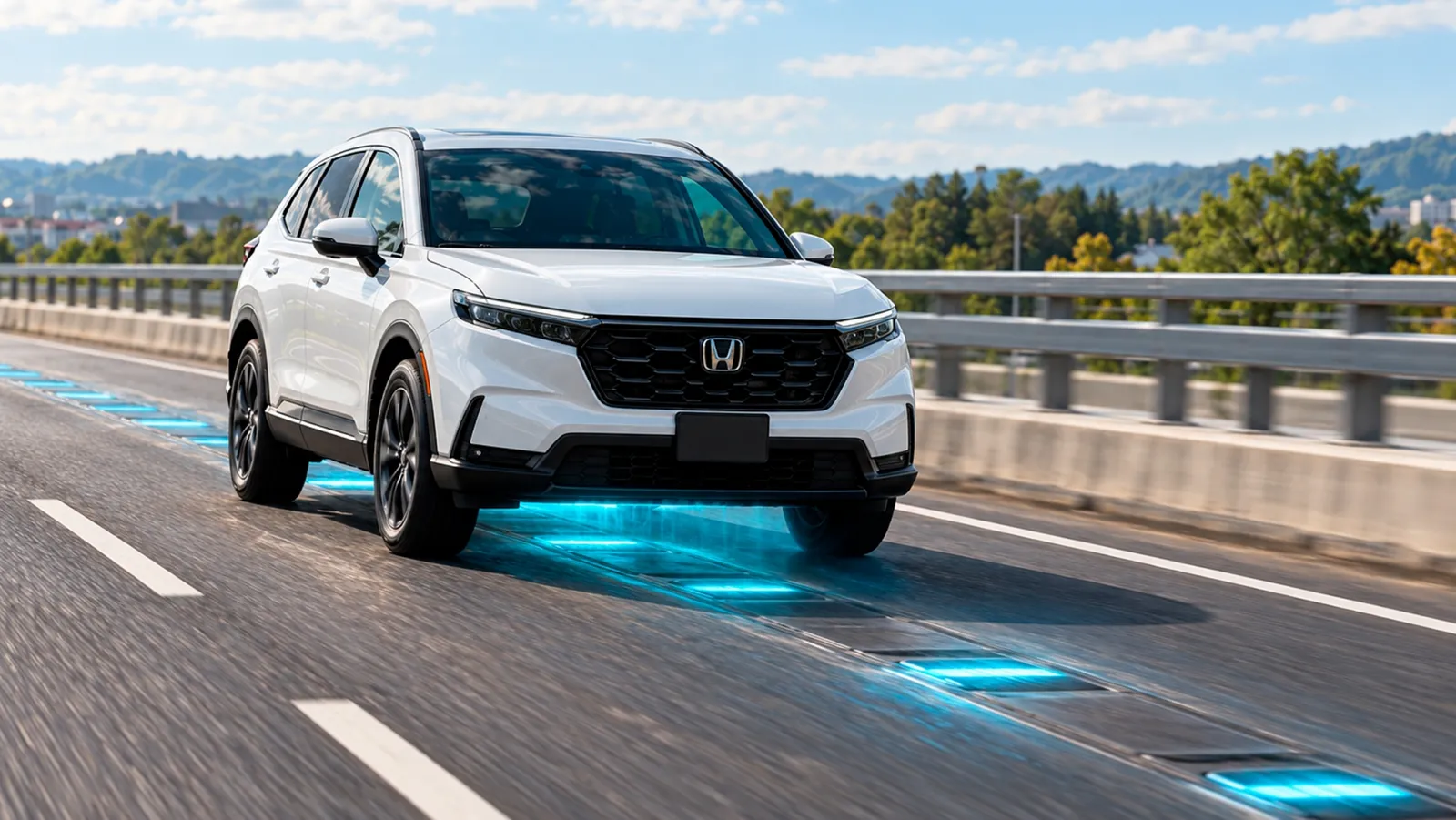
Honda has announced a new advancement in the development of wireless charging systems for electric vehicles. The Japanese company, in collaboration with Taisei Corporation and Taisei Rotec, has completed the basic technology for an infrastructure capable of supplying electricity to vehicles while they are in motion. The project will enter a new phase in 2027, when the first tests on roads open to traffic are scheduled to begin.
The proposal aims to reduce reliance on conventional charging stations, especially in freight transportation, where stops to recharge can impact operational times. Although the technology is still in the experimental stage, Honda is working with power outputs of up to 150 kW per transmitter unit, a figure that would allow for the supply of significant amounts of energy without the need to stop the vehicle.
A road that transmits electricity without physical contact
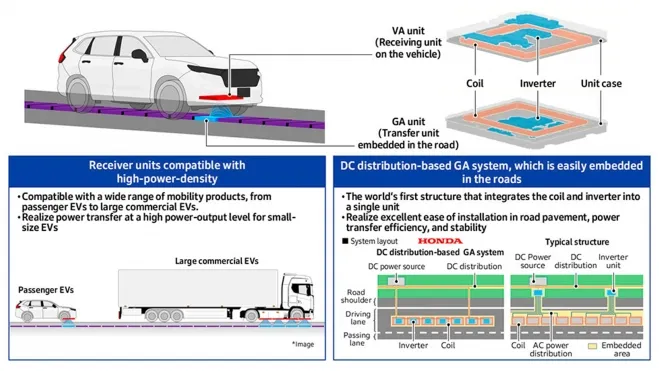
Its operation is based on wireless energy transfer through magnetic coupling, known as DWPT. To achieve this, the infrastructure includes transmitter devices installed beneath the asphalt that generate a magnetic field capable of transferring electricity to a receiver located in the undercarriage of the vehicle. In this way, energy can be transferred from the road to the car while it is in motion, without using cables or physical connectors.
One of the key technical advancements lies in the design of the transmitters. Honda has managed to integrate the inverter and the load coil into a single unit, with electrical distribution among the devices being handled via direct current. According to the company, this configuration reduces the number of components and simplifies the connections required to install the system.
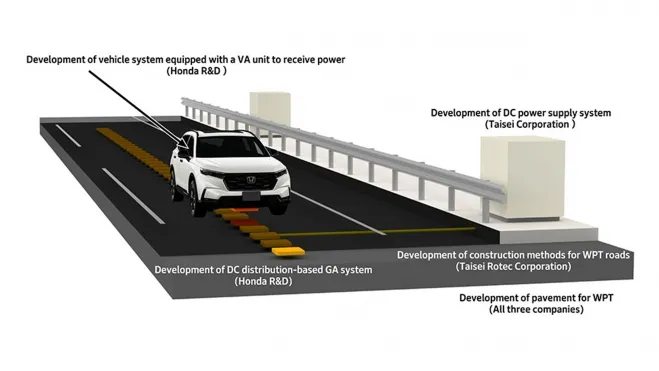
The construction of these roads would not necessarily require completely removing the existing pavement. Taisei Rotec is developing procedures that allow the transmitters to be installed by milling specific sections of the road surface, even taking advantage of regular maintenance operations. The system is completed by an on-ground power supply infrastructure developed by Taisei and receivers designed by Honda R&D.
First road tests are scheduled for 2027
Before deploying this technology on highways, the three companies must pass a series of durability and performance tests. By the end of 2026, construction will begin on a new test track at the T-FIELD/TAMRA facilities, where wear equivalent to one million wheel loads will be simulated, using a reference of 49 kN per wheel to assess the durability of the buried equipment.
The tests will also examine the system’s performance with heavy vehicles having a gross weight of around 20 tons, as well as its ability to supply energy at high speeds. Another key aspect will be verifying that the electromagnetic field remains within established limits and that the infrastructure continues to function after handling heavy traffic.
The next step will take place during Japan’s fiscal year 2027, which begins on April 1 of that year. Honda will participate in a project led by East Nippon Expressway to test dynamic charging on the Tateyama highway in Chiba Prefecture. Commercial vehicles will initially be the main users of this technology, although Honda is also considering its application in passenger cars.
For now, the initiative does not have a launch date, nor is there any public estimate of the cost required to adapt each kilometer of road. The results of upcoming tests will determine its technical and economic viability. Japan is thus joining the research efforts also underway in Europe, with experimental projects in France and Germany aimed at reducing energy storage needs and charging stops during travel.