
“Mastering the activation of V2G and V2H!” – Marcus Fendt, The Mobility House Energy
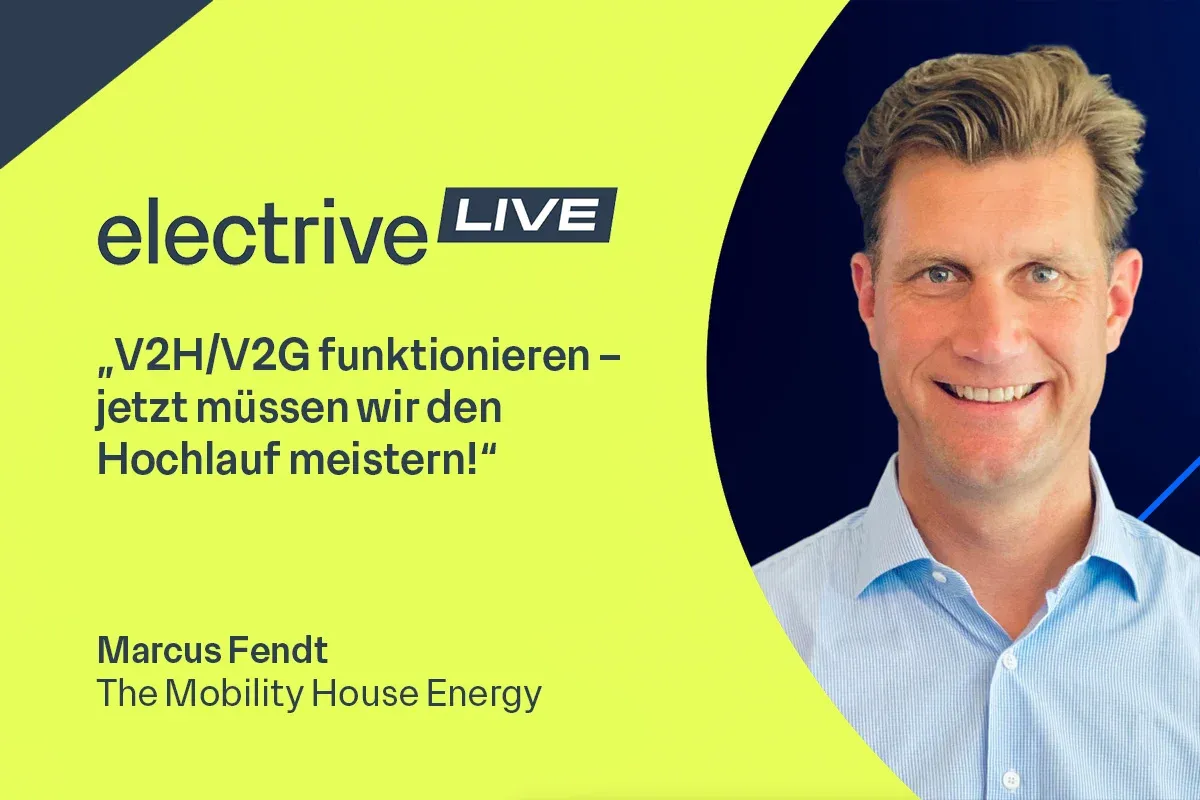
The technology is ready, and the first market products are already in use, but challenges remain regarding the underlying conditions. At electrive LIVE, Marcus Fendt, CEO of The Mobility House Energy, sent a clear message. “Vehicle to Grid and Vehicle to Home work,” emphasized the expert, stressing that for bidirectional charging, one thing is crucial now: “We must master getting it up and running!”
To date, European markets are still lagging behind in advancing electric mobility, while international leaders such as China are moving forward with massive production volumes and extensive experience: During our online conference on “Grid Integration of Electric Mobility,” Marcus Fendt reminded everyone that the roughly three million electric cars currently on German roads together possess a combined storage capacity of about 180 gigawatt-hours. This far exceeds the capacity of conventional pumped-storage systems and provides an ideal buffer for the weather-dependent renewable energy system, according to the CEO of The Mobility House Energy.
The fact that this technology has long become part of everyday life is evident in European countries like France, where Renault drivers can already order affordable two-way AC charging stations and easily participate in the energy market through an app. With deeper integration, this brings significant savings to drivers. “On average, French drivers can cover 10,000 kilometers for free,” explained Fendt, illustrating the financial and environmental benefits for end-users — as they can earn money by feeding electricity back from their electric car batteries into the grid or have part of their own electricity costs refunded.
The Mobility House Energy launches V2G with Mercedes
In Germany, the focus on launching V2G is heavily centered on the residential sector, where combinations of photovoltaic systems, home batteries, and electric vehicles play a dominant role. With the help of an intelligent home energy management system (HEMS), self-consumption can be significantly increased, while the vehicle serves as a flexible battery. Fendt mentioned new collaborations and product launches by The Mobility House Energy with companies such as Mercedes-Benz and Volkswagen to finally introduce the necessary hardware infrastructure across the market.
Behind the scenes, advanced algorithms scan the electricity market around the clock and utilize cars as flexible assets. Contrary to widespread concerns, battery degradation plays almost no role, as the vehicles typically function as virtual capacity without being physically heavily discharged. “This is what’s known as asset back trading, where I can execute many more transactions to stabilize the energy system and lower prices in the merit order,” explained the energy expert from The Mobility House Energy.
According to Marcus Fendt, the biggest obstacle to this much-needed transformation is not a lack of technology but rather outdated and restrictive regulations. He harshly criticized recent bureaucratic hurdles imposed by the Bundesnetzagentur, which unnecessarily complicate market access. After all, the interim report on MiSpeL (“Market Integration of Storage and Charging Points”) released in August alarmed all market participants who wanted to engage in V2G business in the short to medium term. However, shortly after Fendt’s presentation at electrive LIVE, tensions eased: As shown in the MiSpeL regulations published on October 1, the Bundesnetzagentur promptly responded to almost all industry criticisms and even revised relevant sections, such as allowing BiDi charging without a second meter after all.
Fendt calls for ambition in Germany
But back from the digression about MiSpeL to Marcus Fendt’s speech at electrive LIVE: He called for consistent positive communication as well as the courage to quickly build the existing innovation bridges. “We need communication, communication — not just problem-focused communication, but things that actually work,” said the CEO of The Mobility House Energy, urging Germany’s industrial sector to be ambitious.
As a closing remark, Fendt gave the audience an English proverb as a life motto that perfectly captures how transformative the energy system needs to be: “If your dreams do not scare you, they are not big enough.”
Do you want to watch the entire presentation by Marcus Fendt from The Mobility House Energy? Please use the video player above the text or go to YouTube.