
Helsinki expands electric vehicle requirement to vans and minibuses
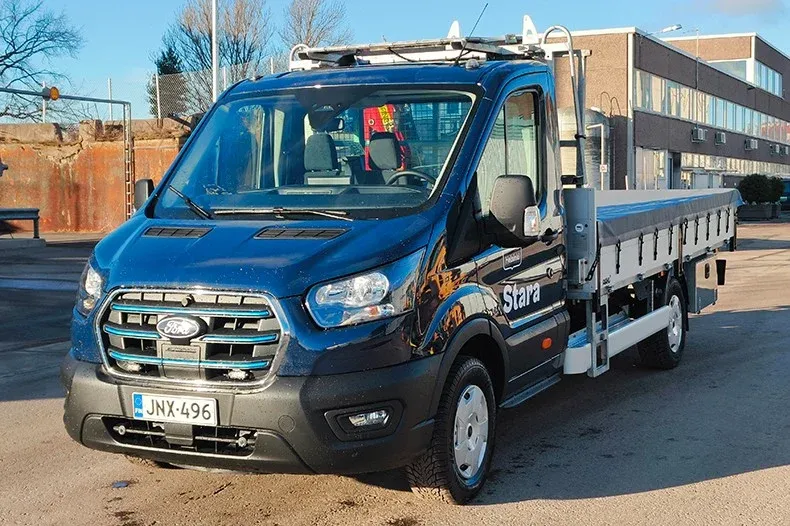
Helsinki is pushing for a gradual phase-out of internal combustion engines in its city fleet. After cars, the Finnish capital will now also prioritize purely electric vehicles for purchasing its own trucks and minibuses. Stricter requirements also apply to companies that transport people or goods on behalf of the city.
Photo: Joonas Sorsa / Helsinki City
In May 2022, Helsinki had already established environmental criteria for the procurement of vehicles and transportation services. Since reducing traffic emissions plays a crucial role in achieving Helsinki’s climate and environmental goals, these criteria have now been updated for the years 2026 to 2030.
Jukka-Pekka Ujula, head of the city hall, approved the rules effective immediately on September 14. These criteria go beyond the requirements of Finland’s clean vehicles law. They are also designed to support Finland’s Green Deal goals for emission-free construction sites.
Helsinki maintains its existing policy of acquiring only electric vehicles for its own cars. The new development is that the city now specifies the propulsion type directly for trucks, minibuses, and outsourced transportation services, rather than merely setting CO2 limits or considering CO2 emissions in the evaluation of bids. Going forward, Helsinki will acquire its own trucks and minibuses exclusively as electric vehicles.
A market dialogue is intended to determine in advance whether a suitable model is available. Only if no appropriate model exists for the specific purpose is a combustion engine permitted, which must then run on biogas or HVO. The criteria allow for flexibility in the case of ambulances, rescue vehicles, and barrier-free vehicles.
30 Percent of the city’s cars are electric
The electrification of transportation in the Helsinki region is advancing faster than in the rest of the country, it is said. It is already well advanced for cars and trucks, while it has just begun for heavy commercial vehicles. By the end of 2025, 30 percent of cars registered in the city and 13 percent of its trucks were fully electric.
Average-wise, Helsinki acquires around 92 trucks and minibuses through leasing each year. The city estimates that the associated acquisition costs amount to approximately 3.6 million euros per year. According to the city’s current estimates, the price difference between an electric and a combustion-engine truck is on average 11,000 euros. The city does not provide figures for the annual acquisition volumes and costs of cars.
In total, the city’s fleet includes around 1,300 passenger cars, vans, trucks, and buses. The city uses both its own vehicles and those leased through the municipal construction service provider Stara.
Lifecycle costs become mandatory for heavy vehicles
Regarding heavy commercial vehicles, Helsinki cites high purchase costs and an still inadequate charging infrastructure. When acquiring its own trucks and buses, the city plans to first check whether battery-electric vehicles, hydrogen-powered models, or those primarily running on biogas are available.
Until now, the use of alternative drives only influenced the quality assessment of offers. Vehicles powered by electricity, hydrogen, or biogas received more points in this evaluation. Going forward, market dialogue and a comparison of lifecycle costs are required. Factors considered include purchase price, energy costs, residual value, and maintenance expenses.
The most cost-effective result calculated does not automatically determine the choice of drive. The relevant guide explicitly states that the city may still choose an electric vehicle even if it is deemed the most expensive option over its lifetime. Based on availability and lifecycle costs, it is then determined whether a diesel vehicle is necessary instead. Such vehicles may only be operated using HVO.
Tighter requirements also for transportation services
In passenger transport by car, such as taxi services, purely electric vehicles will be required in the future. Previously, a limit of up to 50 grams of CO2 per kilometer according to WLTP applied, which also allowed the use of plug-in hybrids. If an immediate switch is not yet possible according to market discussions, a transition period can be established. However, the service must be provided entirely electrically by 2028 at the latest.
In freight transport using trucks and passenger transportation using minibuses, at least 50 percent of the vehicles used must be fully electric. These electric vehicles must also cover at least half of the total mileage. The remaining vehicles must be powered by biogas or HVO. If there are not enough suitable electric vehicles available for a particular use case, the required proportion of electric vehicles can be adjusted.
Helsinki now mandates that purchased trucks and buses be powered by electricity, hydrogen produced without fossil fuels, HVO, or primarily biogas. Conventional diesel is no longer permitted. However, a market dialogue will be held first to determine which propulsion systems are available. If market conditions permit, Helsinki can set stricter requirements in specific tenders and require only battery-electric, hydrogen, or biogas vehicles. The city considers HVO a transitional solution that it aims to abandon once emission-free alternatives are widely available, according to the statement.
The criteria apply to the city office, all departments, and the municipal enterprises Stara and Palvelukeskus Helsinki. Municipal companies are advised to apply them as well. Deviations from the criteria may be made if necessary for crisis preparedness reasons. The next review is scheduled for 2030.