
Up to 590 kWh and a backup battery: this is how CATL’s new proposal for electric trucks works
While some in the industry are focusing on more powerful chargers, CATL continues to develop another way to reduce downtime for electric trucks: replacing a depleted battery with a charged one. Its new solution includes an interesting feature—a second battery that remains installed in the truck, allowing it to keep moving when the main battery approaches its capacity limit.
The system, unveiled on October 20, is called the Dual-Electric Range Extender. Although the name suggests vehicles with range extenders, there is no internal combustion engine generating electricity here. All energy comes from two batteries that serve different functions.
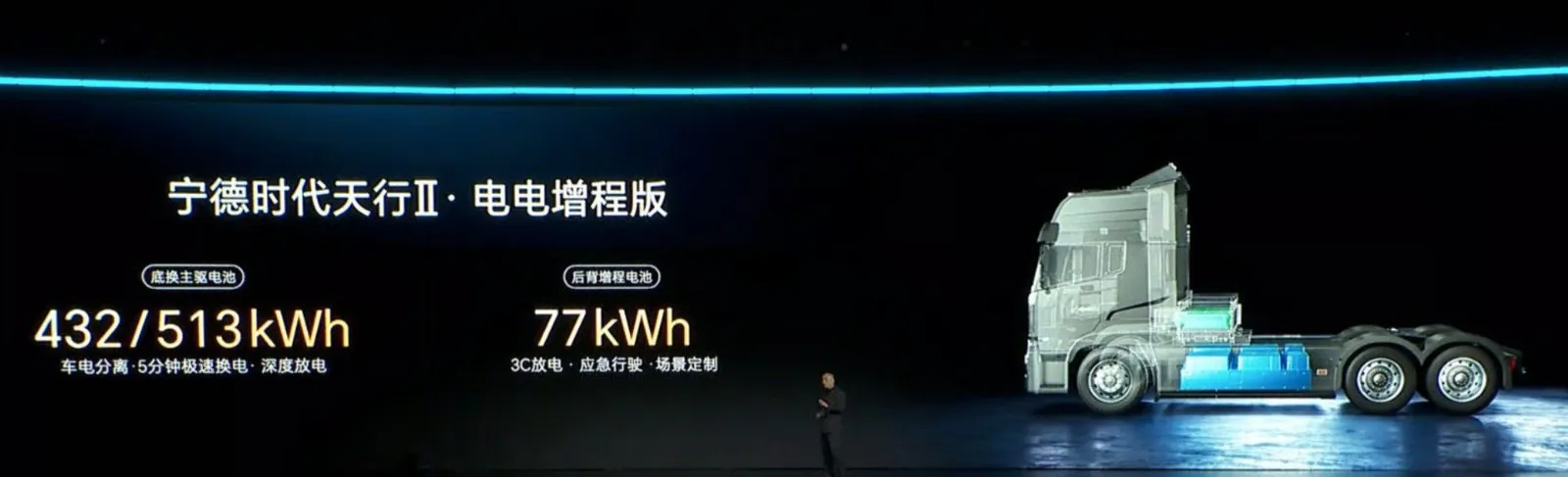
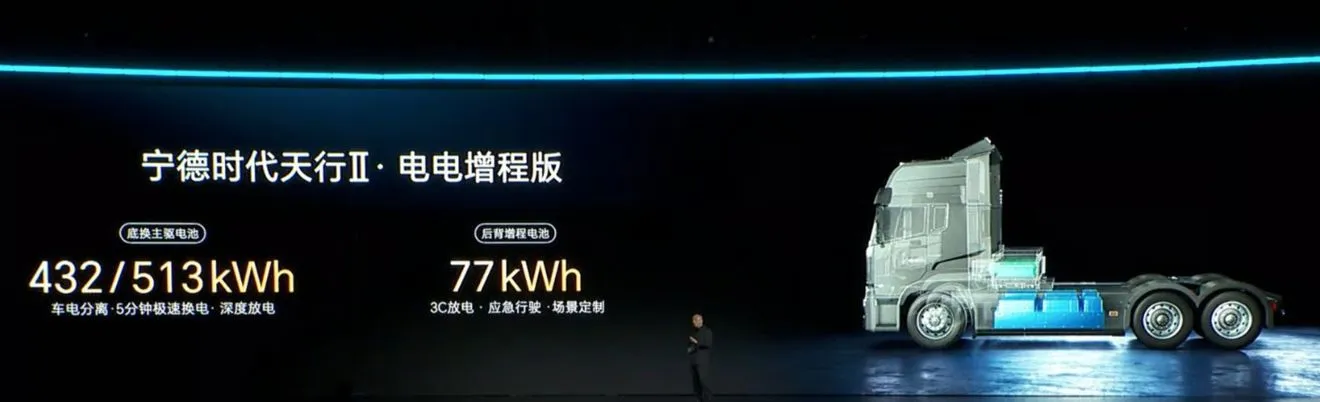
CATL describes it as an A+B architecture. Battery A is the main pack, installed under the chassis and available in 432 or 513 kWh capacities. Battery B remains fixed to the truck and adds another 77 kWh, resulting in a combined capacity of 509 or 590 kWh depending on the configuration.
The idea is to use the main pack until it reaches approximately 5% charge, after which the auxiliary battery takes over. This backup provides enough power to continue driving to a compatible charging station, though it does not eliminate the need to plan the route. The additional distance covered will depend on consumption, payload, and driving conditions.
A rental battery and five-minute swaps
The main battery pack can be acquired through a leasing system. For transportation companies, separating the purchase of the truck from the battery can reduce upfront costs, which is one of the factors influencing fleet renewal. However, the overall savings will depend on the payment terms and the cost of using charging stations, not just the purchase price.
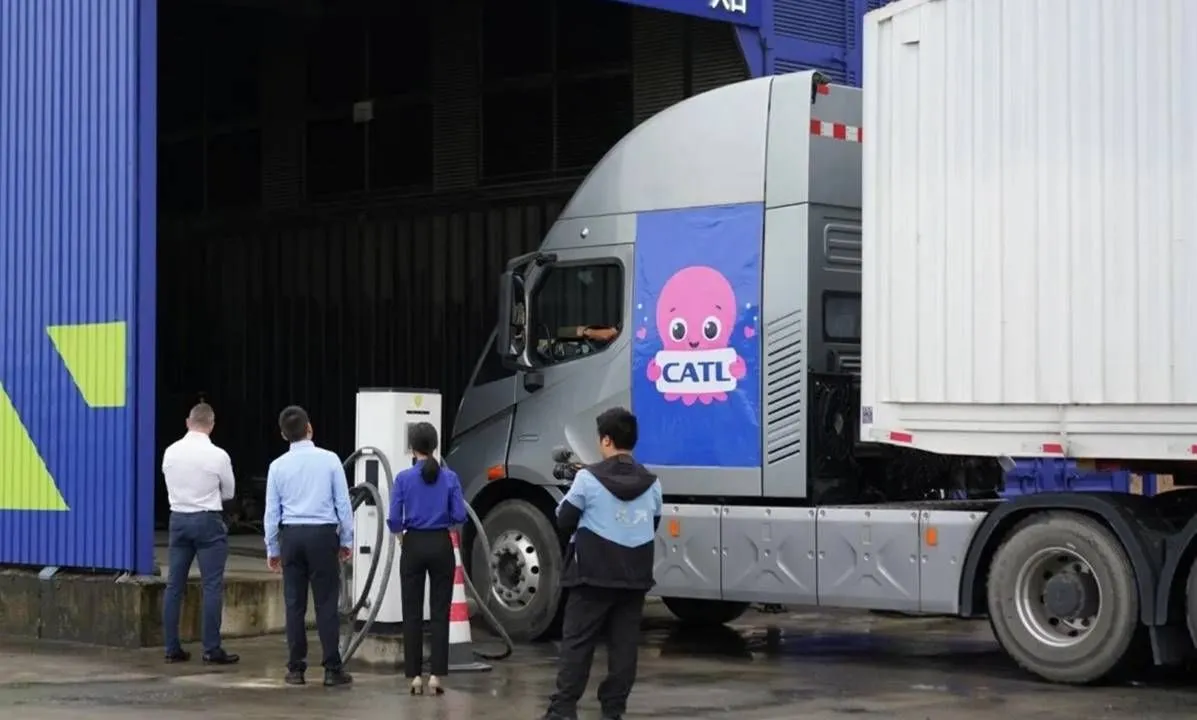
CATL states that the battery swap can be completed in five minutes. The truck delivers its empty battery and receives a new one ready to go, while the station charges the removed battery pack. The advantage lies in separating the time required to charge the battery from the duration the truck must stay stopped.
To streamline the process, the company has defined two formats. The 260#, with 432 kWh of capacity, is designed for trucks with an axle distance of 3.8 meters. The 300#, featuring 513 kWh, is suited for models with an axle distance of 4.2 meters. This standardization allows shared infrastructure among models compatible with the QiJi system.
The network currently serves five major transportation corridors in China. CATL aims to reach 900 stations by the end of 2026 and 2,000 by 2027, with a long-term goal of reaching 10,000 installations. These are deployment targets, and meeting them will be just as important as battery performance: without stations where needed, battery swapping loses much of its appeal.
The proposal makes sense especially on repetitive routes with heavy freight traffic. A fleet that regularly travels along the same corridors can organize its operations around exchange points. For more scattered routes, network coverage and the availability of fully charged packs will be decisive.
Europe is also part of CATL’s plans. In June, the company announced alongside Octopus Energy the creation of Swaptopus, a joint venture aimed at establishing large exchange centers for electric trucks. The first facilities in the UK are scheduled for 2027, before expanding the network to other European markets.
The goal is to surpass 30 major hubs in Europe by 2035, with a network that could serve more than 300,000 electric trucks. This project confirms interest in bringing battery swapping to the continent, though it does not mean the new dual-battery architecture has an approved European launch yet.
The main challenge will be getting enough manufacturers to adopt compatible formats and interfaces. It is not sufficient to build a station capable of handling batteries of hundreds of kWh: trucks prepared to use them and operators who see it as profitable to maintain an inventory of available battery packs are also needed.
On paper, the combination seems attractive. The transporter can reduce initial investment, recover energy through a short stop, and maintain a reserve to complete the journey. But adding a second battery also requires considering the weight, space, and payload of the entire setup.
The greatest advantage of this proposal is expanding options for electrifying heavy transportation. There will be fleets that suit charging during their regular stops, and others that can benefit from battery swapping. To convince transporters, CATL will need to prove that the promised five minutes result in greater availability and better financial outcomes by month’s end.
Source | Octopus.energy