
I have much to prove – and much to offer
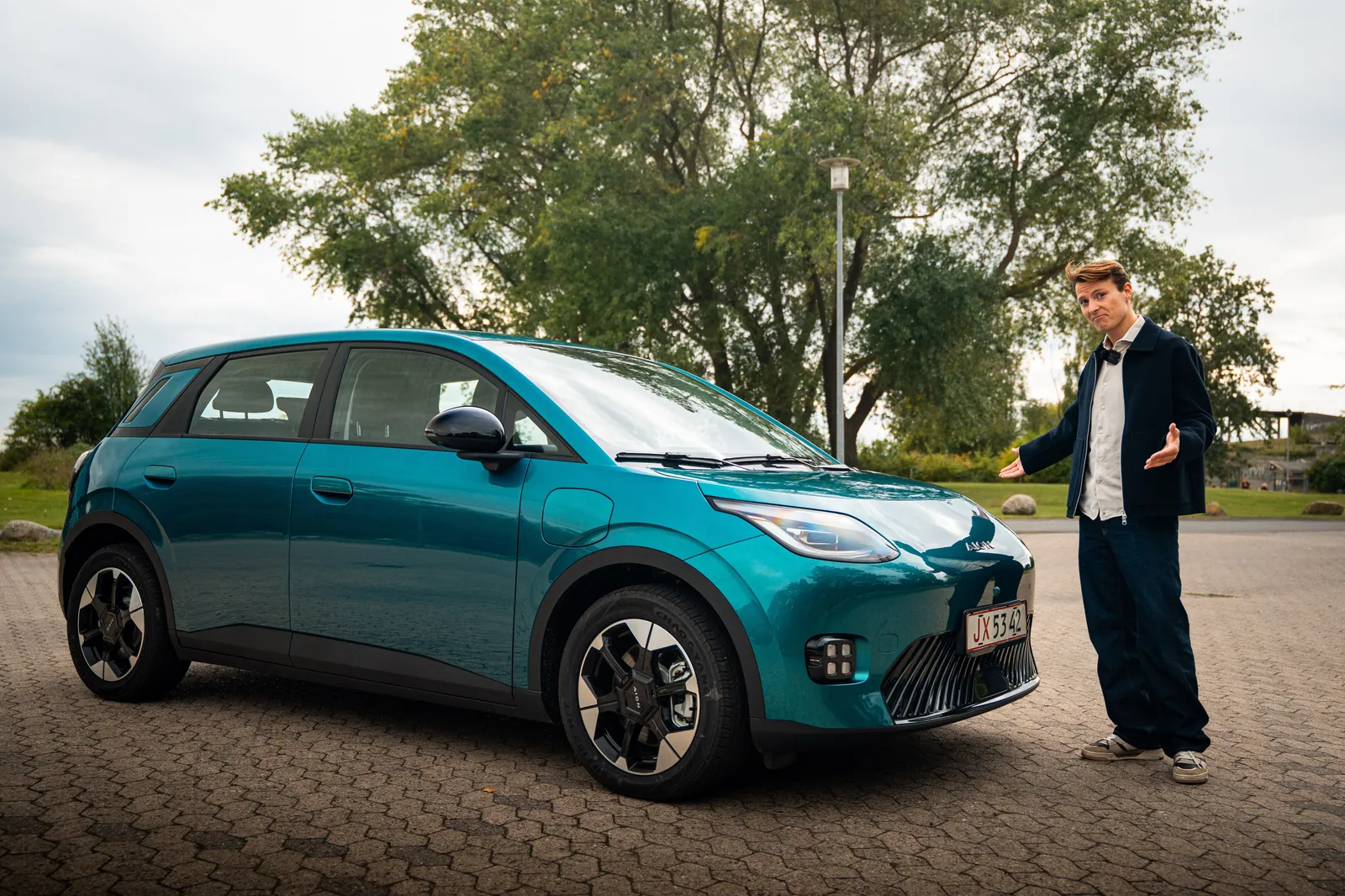
The Aion UT offers plenty of space, a range of 430 kilometers, and an eight-year warranty for 249,990 kroner. We tested it in Copenhagen and found both charm and irritating aspects.
25.09.2026 12:44 | Updated 12:45
You may not have heard of this brand before, but GAC has been producing cars in China for nearly 30 years. Now this state-owned manufacturer is entering Norway with a compact electric vehicle at a price that’s almost aggressive.
We spent about an hour with the car in Copenhagen. That was enough time to take a closer look at its interior, features, and overall design, as well as to form an initial impression while driving it.
We’ll need to return for a full test to evaluate its range, noise level, and driving performance on Norwegian roads.
We’ll take a closer look at:
What kind of car is this?
More about the car
Seats – lack of length adjustment
Interior – tidy, but screen-dominated
Rear seat space – surprisingly spacious
Trunk space – large for its class
Driving experience – comfort first
Driver assistance – five stars and plenty of features
Range – two battery sizes
Charging – fast for the price
Price and equipment – Luxury is the clear choice
Warranty – among the longest
Conclusion
What kind of car is this?
The Aion UT is a compact, all-electric station wagon that falls between traditional small cars and family vehicles. It’s roughly the same length as the Volkswagen ID.3, but its price is closer to that of smaller cars like the Volkswagen ID. Polo, Renault 5, and the even cheaper Citroën ë-C3.
This is primarily a car for those who want plenty of space and range for their money. The rear seat area is more spacious than it appears from the outside, and its 440-liter trunk space is quite large for its class.
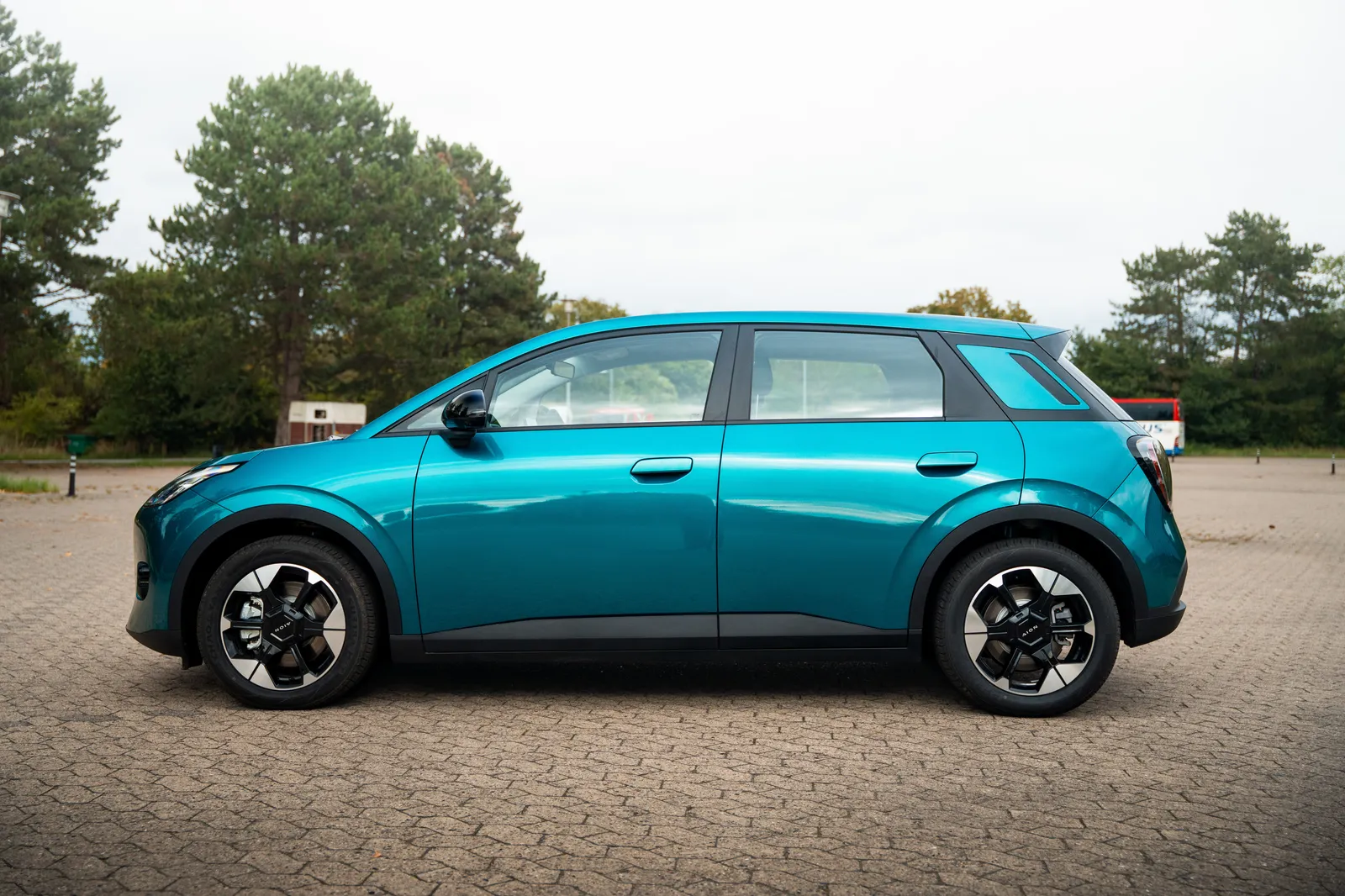
The design is simple and quite smooth, without many elements standing out. If you’re unsure, its profile might remind you of an ID.3.
The car might require a lower price point. GAC is an unfamiliar name to most Norwegians, and it competes with cars from brands with established dealer networks and high credibility.
So it shouldn’t be cheap on paper. Software, winter features, resale value, and after-sales support from the importer become at least equally important.
The import arm of the Sulland group, Electric Way, is responsible for imports in Norway and Denmark. The company already has brands like Voyah, Dongfeng, and MHero in its portfolio. We’ve previously written about GAC’s entry into Norway here.
More about the car
Aion UT is 4.27 meters long, 1.85 meters wide, and 1.58 meters high. The wheelbase is 2.75 meters.
Its length is nearly identical to that of the Volkswagen ID.3, but the UT has a 57-liter larger trunk space. It is also 22 centimeters longer than the ID. Polo.
According to GAC, the car was developed for Europe, with design work done at GAC’s studio in Milan. Production takes place at Magna Steyr in Graz, Austria, a factory that has also built vehicles for several well-known European manufacturers.
Manufacturing in Europe also makes GAC less vulnerable to the EU’s extra tariffs on electric vehicles imported from China. The importer says this is not the only reason to build the car in Austria, but it is clearly an advantage in the EU market. Norway has not introduced such extra tariffs.
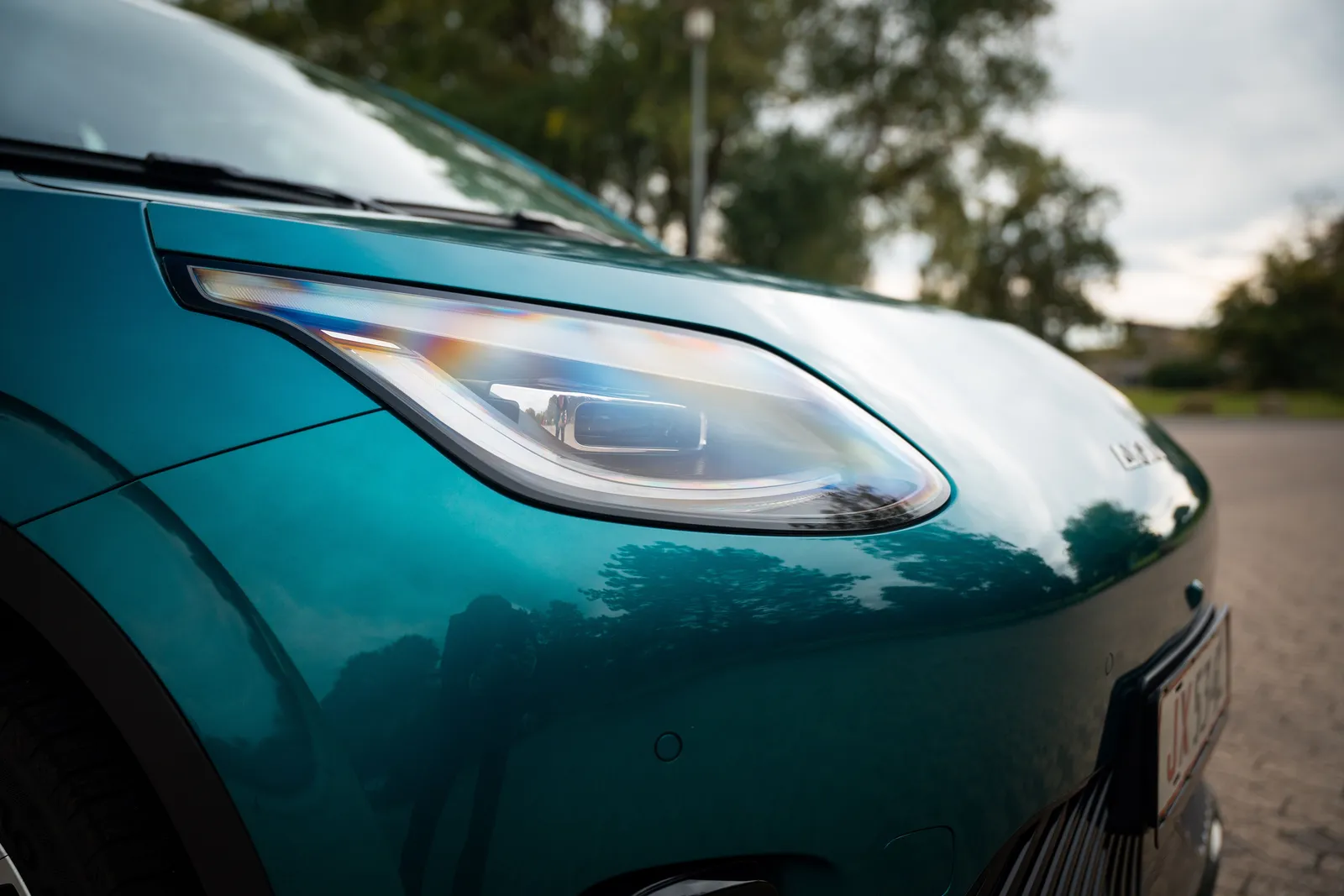
The markings on the lights read “Matrix” as well. The Norwegian specification list only mentions standard LED headlamps with automatic high beams. Here, “Matrix” apparently refers to the design of the lights, not adaptive matrix lighting.
Seats – lacks length adjustment
The luxury version has an electrically adjustable driver’s seat with six-way adjustment. The seats are warm, while ventilation in the driver’s seat is included in the optional Luxury Pack, which costs an additional 30,000 and also includes items such as an electric rear window and a panoramic glass roof.
I’m comfortable in the default seat position. The seats are soft and have usable adjustment options, but the backrest can only be raised and lowered. It cannot be moved closer to the driver.
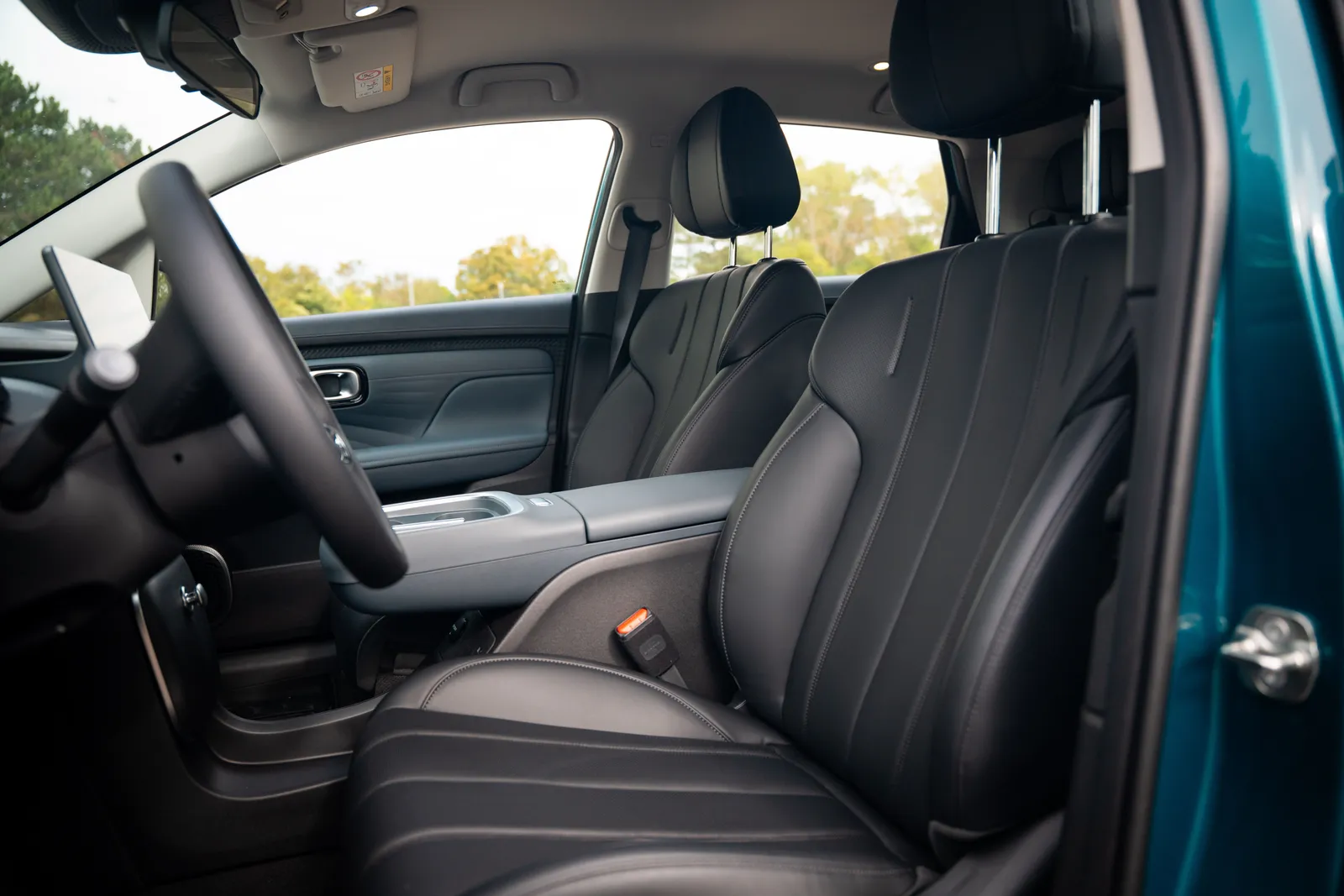
For me at 1.80 meters, it’s just right, but the ability to pull it a few centimeters closer would definitely improve the seating position.
Interior – clean, but screen-driven
The interior is minimalist, featuring a 14.6-inch center screen and an 8.8-inch instrument panel. Apple CarPlay and Android Auto are standard, including wireless versions.
There are few physical buttons. Temperature, mirrors, and various vehicle settings are controlled through the screen. The layout is relatively easy to understand, but operating it requires more attention than using physical buttons would.
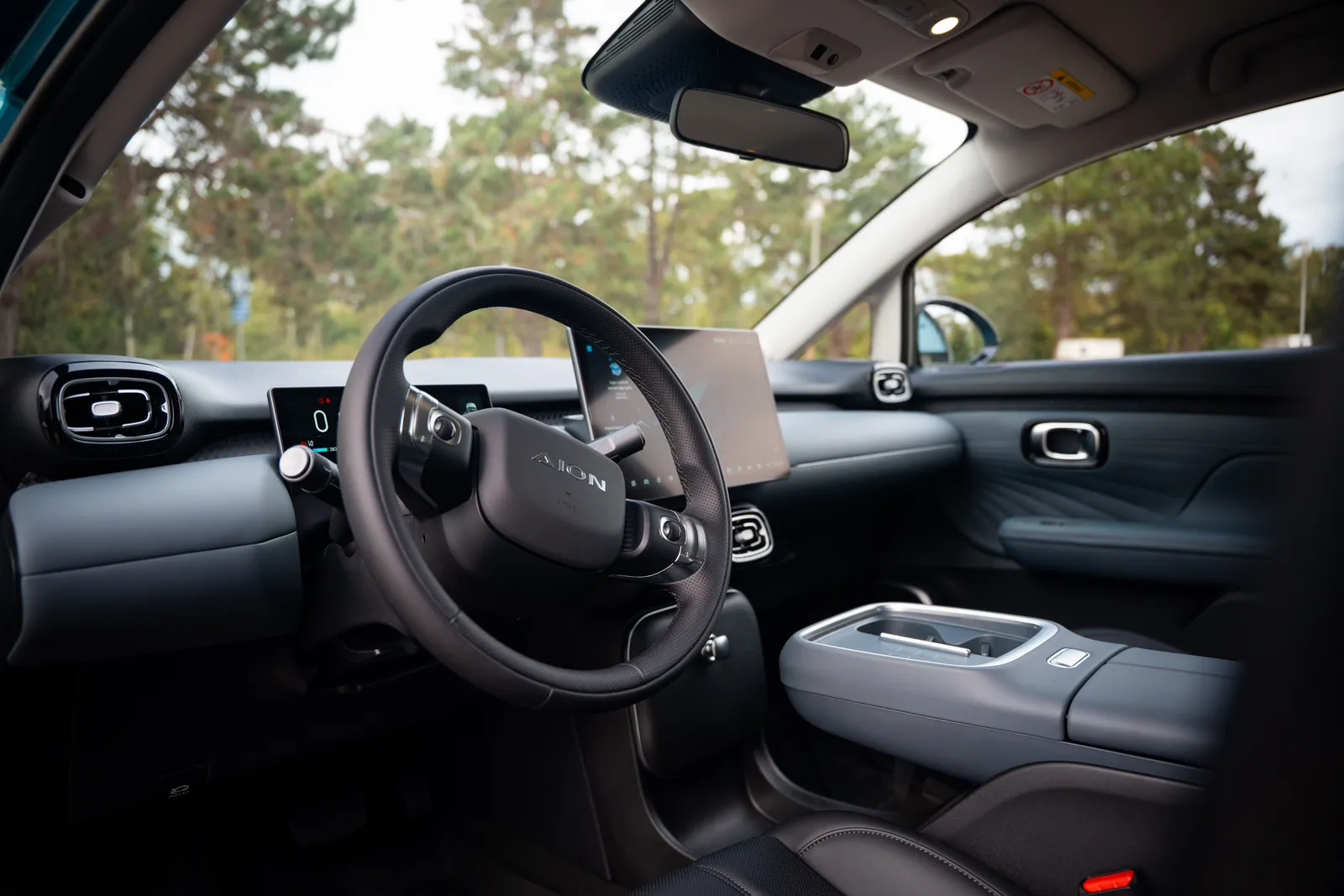
The Norwegian software wasn’t fully polished either. Several texts showed signs of direct and somewhat awkward translation.
The material quality is decent for the price. There are some soft surfaces on the synthetic leather, but there’s also a bit of hard plastic. The City version, being the cheapest, has seats made of black fabric, while the Luxury model uses synthetic leather.
Rear Seat – Surprisingly Spacious
With the rear seat adjusted for me at 1.80 meters tall, I have plenty of space for my knees, feet, and head. The long wheelbase is quite noticeable.
The battery pack raises the floor, so my knees end up relatively high and my thighs receive limited support. It works fine for short trips, but it might become less comfortable over longer distances.
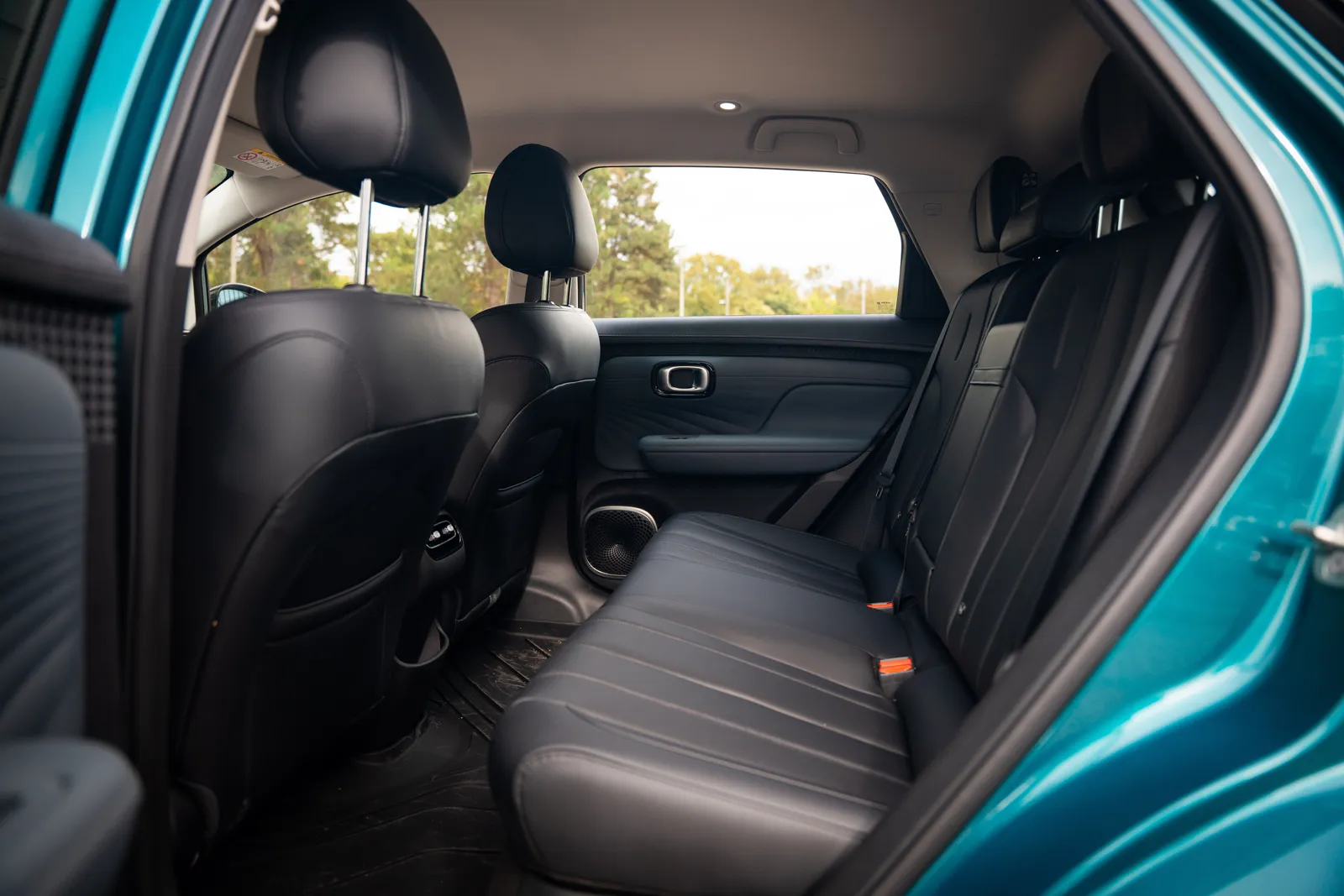
The middle seat is harder and flatter. I sit more on the seat surface here rather than on the padding. Therefore, the Aion UT appears to be an excellent four-seater and a usable five-seater when needed.
The car has three Isofix anchors: one in the front passenger seat and two in the rear seat.
Trunk Space – Large for Its Class
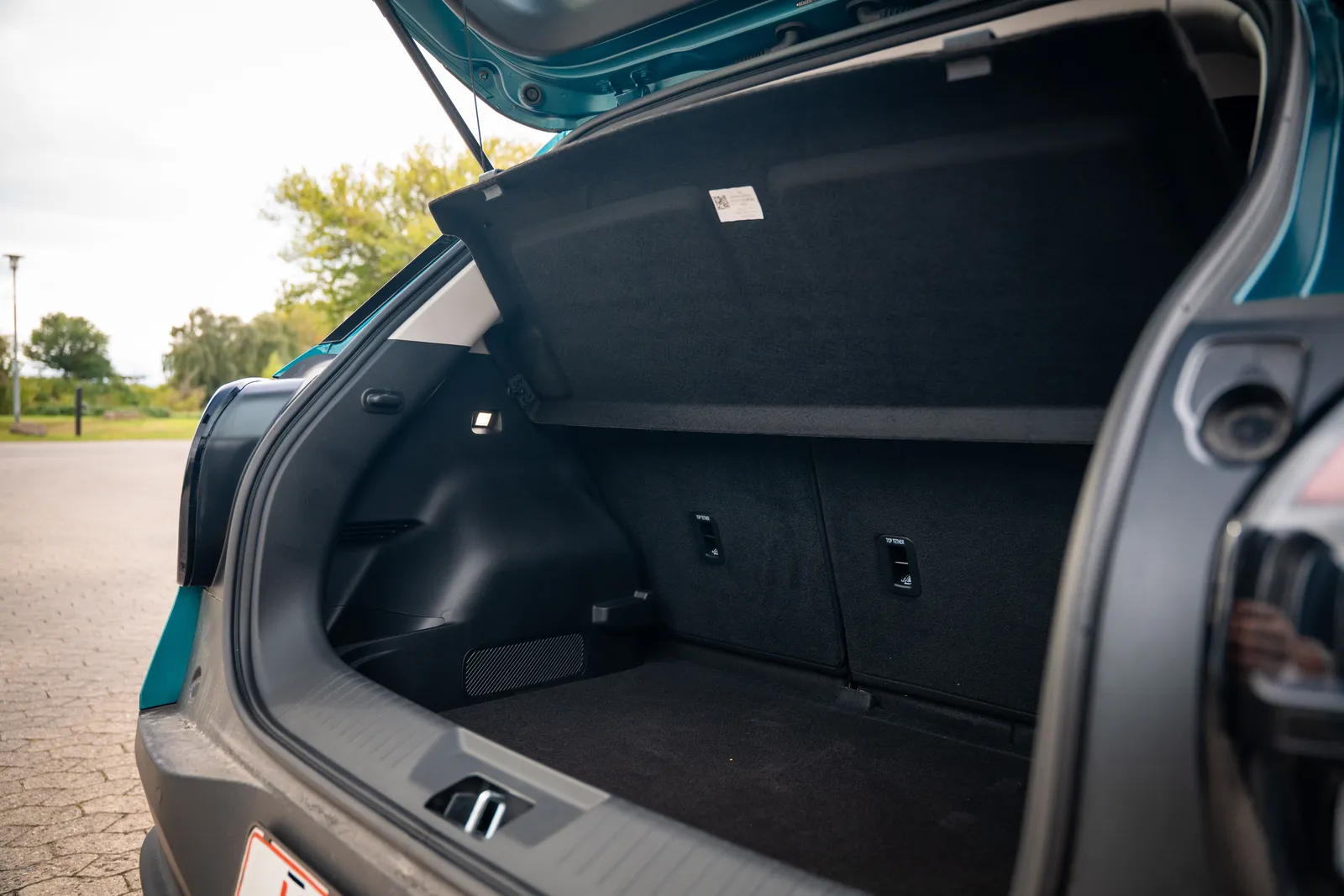
The trunk holds 440 liters, or up to 1,600 liters with the rear seat folded down. The rear seats are split 60/40.
The trunk is deep, with a separate space under the floor for charging cables and small items. There’s no trunk space in front, as that area is occupied by the engine and other electronics.
Driving Experience – Comfort First
Both versions have 204 horsepower and 210 Newton meters of torque, delivered to the front wheels. The 0-60 time is 7.3 seconds.
The Aion UT feels fast enough, but the car doesn’t try to be sporty. The suspension is soft, handling is easy, and the overall setup seems designed for comfortable city driving.
The test car was on a Chinese Chao Yang tire. When I applied slight pressure to a corner, the front tires lost grip and the tires screeched. Whether this was primarily due to the unknown tire manufacturer, the road surface, or weight distribution, we will investigate further when the car arrives in Norway.
Copenhagen also features flat, straight roads with little challenge. We didn’t test the car on bumpy country roads, poor-quality asphalt, or at high speeds on highways. Therefore, our ability to draw conclusions about its driving characteristics after this trip is limited.
The first impression is still that of a soft and comfortable city car.
Driver assistance – five stars and lots of noise
The Aion UT has five radars, one camera, and driver assistance features such as adaptive cruise control, lane keeping, traffic sign recognition, blind spot warning, and automatic emergency braking.
During the test drive, there were still numerous warnings regarding speed, driving lane, and driver attention.
Several functions can be disabled, but they are located deep within the screen, and most are reactivated upon the next startup.
This is partly due to European safety requirements and Euro NCAP’s stricter rules for 2026. The new rules place more emphasis on driver monitoring but also consider how user-friendly the systems are.
The Aion UT received full marks and five stars in the test, although traffic sign recognition only showed the correct speed limit in 68 percent of cases during Euro NCAP’s test drive. In such situations, frequent speed warnings become particularly annoying.
Range – two battery sizes
The City model has a 44 kWt peak battery and an advertised WLTP range of 320 kilometers. The reported fuel consumption is 1.69 kWt per mile.
The Luxury model has a 60 kWt peak battery, a range of 430 kilometers, and an advertised fuel consumption of 1.64 kWt per mile.
Charging – acceptable for the price
Both versions can be charged at up to 11 kW.
After a software update, the importer now claims a peak charging power of up to 100 kW. The time to reach 80 percent charge remains 30 minutes for the Luxury model.
There’s no record-breaking charging speed, but it’s perfectly fine for this price range. We’ll need to conduct a proper charge test in Norwegian temperatures later.
Both versions also have V2L functionality, allowing the car’s battery to power external devices.
Price and features – Luxury is the clear choice
The Aion UT is available in two versions. Additionally, the Luxury model can be upgraded with an optional feature package (see below).
City – 229,990 krone
The City model has a 44 kWt battery and a range of 320 kilometers. Standard features include:
Heat pump
Heated seats
Adaptive cruise control
Rear camera and rear parking sensors
Wireless Apple CarPlay and Android Auto
V2L
Luxury – 249,990 krone
For an additional 20,000 krone, you get a 60 kWt battery and a range of 430 kilometers. This alone makes the Luxury version the most attractive option.
In addition, you receive:
Electrically adjustable steering wheel
Heated steering wheel and front seats
360-degree camera and front parking sensors
Leather upholstery
Wireless mobile charging
USB port in the rear seat area
Automatic dimming interior mirrors
Six speakers instead of four
Luxury Pack – 29,995 krone
This is an optional package for Luxury, not a separate model. The package includes:
Panoramic roof with electric sunshade
Electric rear door
Ventilation in the front seat
Electric folding side mirrors
Keyless entry
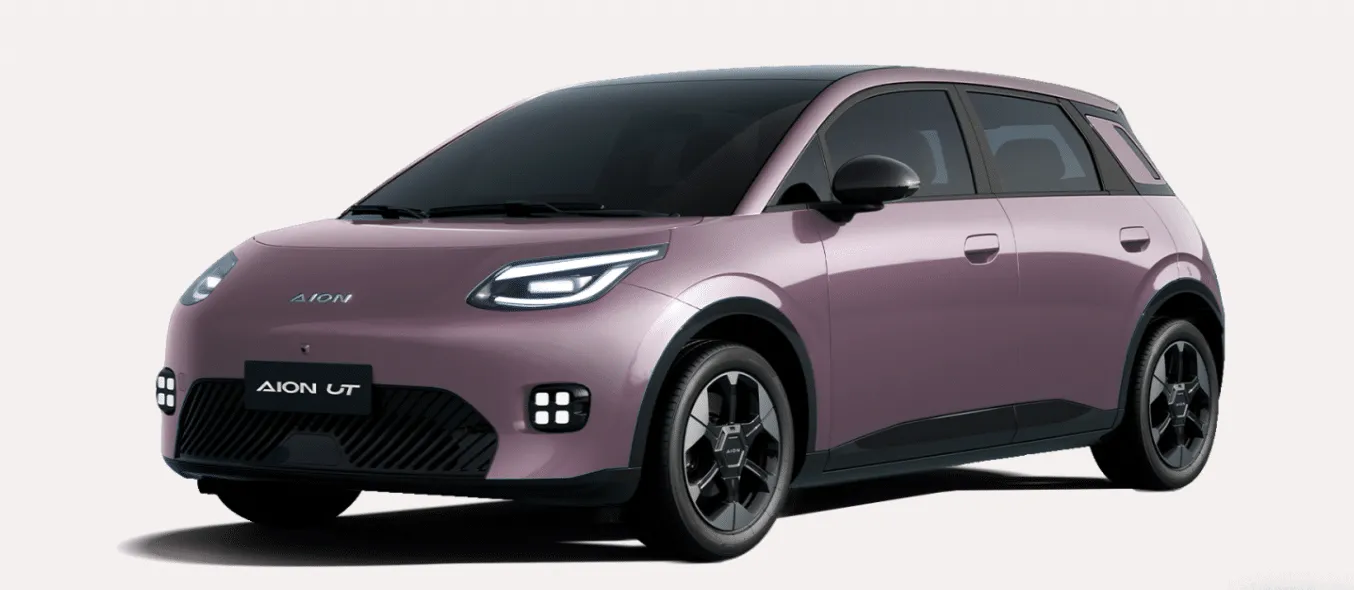
The car might already be cute enough on its own, so you can soften the look with another color at a cost of 8,995 kroner.
The beige interior for Luxury costs 5,995 kroner.
A fully equipped car with the Luxury Pack, optional paint, and beige interior ends up at 294,975 kroner. This is only 5,025 kroner below the 300,000 kroner tax threshold for 2026.
Electric Way aims to deliver the first Norwegian cars in early November. If plans hold, the first customer vehicles should arrive before the new year.
The delivery date is important. The tax threshold is planned to be reduced to 150,000 kroner by 2027. With the base price unchanged, this will make a fully equipped car approximately 36,000 kroner more expensive.
For comparison, the Volkswagen ID. Polo starts at 249,900 kroner, with a currently specified range of 323 kilometers. The Aion UT Luxury costs roughly the same, but it is larger and has a range of 107 kilometers more.
Warranty – among the longest in the market
The new car warranty lasts for eight years or 160,000 kilometers, whichever comes first. This is among the longest factory warranties in the Norwegian market.
The battery warranty is eight years or 200,000 kilometers. GAC guarantees at least 70 percent of the battery’s capacity remaining during that period.
The service interval is two years or 30,000 kilometers. The car also comes with three years of European road assistance, including a replacement vehicle and mobility coverage.
Conclusion
The GAC Aion UT makes a compelling impression in terms of space, comfort, and price.
The luxury version with a range of 430 kilometers priced at 249,990 kroner is clearly the most interesting option for us, and even a top-equipped car can be found for under 300,000 kroner if it becomes available in 2026.
At the same time, important questions remain. The software needs improvement, and all the warnings make the car unnecessarily stressful to drive. The range shown by the test vehicle also wasn’t convincing.
We therefore need a full test on Norwegian roads before we can form a final judgment. But one thing is clear already: competitors will have a new model with an especially competitive price to compete against.
Technical specifications: GAC Aion UT
City
Luxury
Price from
229,990 NOK
249,990 NOK
Engine power
150 kW / 204 hp
150 kW / 204 hp
Torque
210 Nm
210 Nm
Drive wheels
Front wheels
Front wheels
Battery capacity, gross
44 kWt
60 kWt
Range, WLTP
320 km
430 km
Consumption, WLTP
1.69 kWt/mile
1.64 kWt/mile
Normal charging (AC)
11 kW
11 kW
Fast charging 10–80 percent
28 minutes
30 minutes
0–100 km/h
7.3 seconds
7.3 seconds
Top speed
160 km/h
160 km/h
Length × width × height
4.27 × 1.85 × 1.58 m
4.27 × 1.85 × 1.58 m
Wheelbase
2.75 m
2.75 m
Ground clearance, empty/loaded
147/130 mm
147/130 mm
Trunk space, seats up/down
440/1,600 liters
440/1,600 liters
Tire dimension
215/55 R17
215/55 R17
New vehicle warranty
8 years / 160,000 km
8 years / 160,000 km
Battery warranty
8 years / 200,000 km
8 years / 200,000 km
More like this?
Sign up for our newsletter
– get electric vehicle news straight to your inbox!
Also read
The post Has a lot to prove – and a lot to offer appeared first on Norsk elbilforening.