
Handsfree driving: Stellantis aims to achieve door-to-door service by 2028
At Stellantis, handsfree driving is set to advance significantly starting in 2028. The company is working with the British firm Wayve to develop cars that can steer, brake, and accelerate not only on highways but also in urban areas.
Handsfree driving goes beyond highways
Those who purchase a modern car with advanced driver assistance features already know how it works. The car maintains its distance, stays within lane markings, and can sometimes change lanes automatically. But these functions are usually designed primarily for highways and other well-visualized roads.
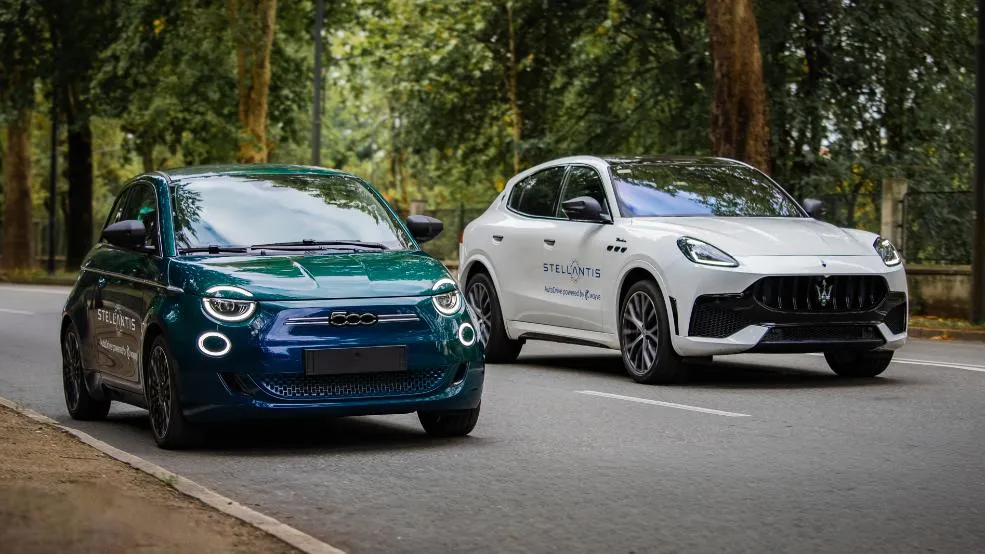
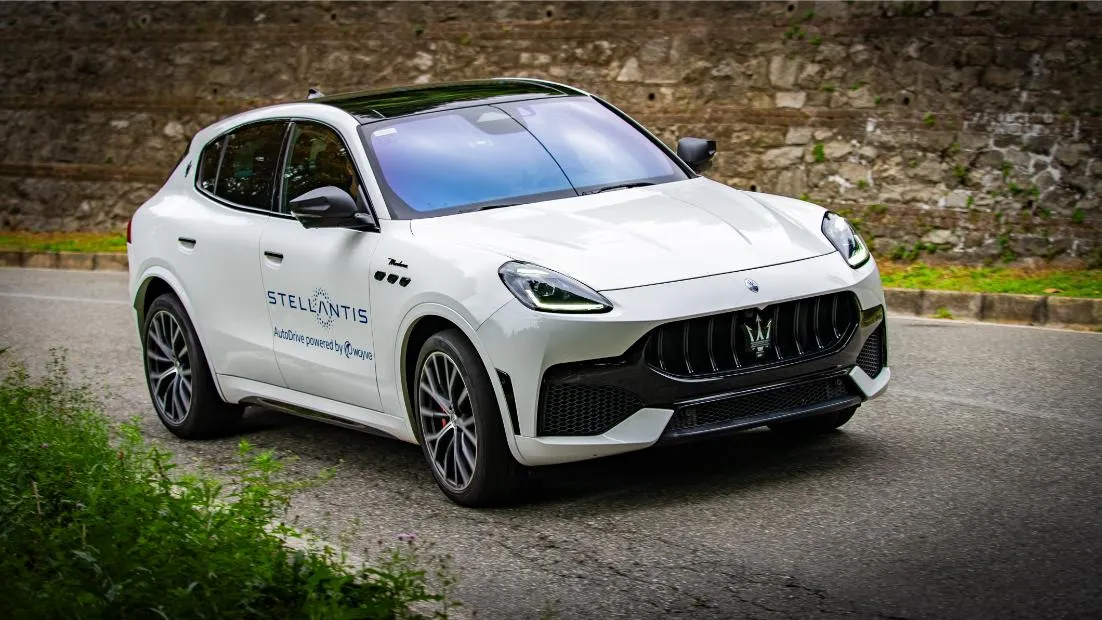
Stellantis and Wayve aim to go further. Their system ultimately needs to be able to drive handsfree from door to door, not only for long distances on highways but also through urban traffic. The driver selects the destination, and the car takes over much of the actual driving. This is exactly what Stellantis will demonstrate from October 7 to 9 at Wave by Vento in Turin. Visitors can ride in development versions of the Fiat 500e and Maserati Grecale, which drive in real traffic conditions using STLA AutoDrive and Wayve’s AI Driver.
Level 2++ sounds more autonomous than it is
Stellantis refers to this technology as Level 2++. This requires some explanation, as there is no such thing as Level 2++ in SAE International’s official classification. There, the levels simply range from Level 0 to Level 5. At Level 2, a car can steer and control speed simultaneously, but the driver must remain vigilant and intervene if necessary.
This remains true with Stellantis and Wayve’s new technology. You can take your hands off the steering wheel, but not your attention from the traffic. Watching a video, checking emails, or taking a nap is not allowed. It’s this distinction that matters. “Handsfree” might sound like the car is driving autonomously, but responsibility still lies with the driver. It’s only at Level 3 that the system takes over full driving tasks under certain conditions, fundamentally changing the driver’s role.
The Fiat 500e shows why handsfree driving becomes interesting for Stellantis
Perhaps the most interesting detail of the demonstration is the Fiat 500e. Not because it suddenly appears on the market as a self-driving car, since it is clearly a development vehicle. Rather, it shows how broadly this system needs to be applied. During the Investor Day in May, Stellantis already demonstrated the technology in a Jeep Grand Cherokee. Now, the same foundation and AI are also used in a compact Fiat 500e and a Maserati Grecale. Three cars that differ significantly in size, price, platform, and character.
That is ultimately where the relevance to drivers lies. Stellantis owns brands such as Fiat, Peugeot, Citroën, Opel, Jeep, Alfa Romeo, and Maserati. If the same software and AI can be applied relatively easily to various models and platforms, advanced driving assistance won’t have to remain limited to large and expensive cars in the long term. That is currently the main promise behind this technology. Stellantis has not yet announced which production models will receive the system, nor what the cost of the option will be.
AI should learn to drive instead of being programmed for every situation
Wayve’s approach is also interesting. The British company is developing a so-called end-to-end AI driver. Instead of programming rules separately for each traffic situation, the system uses artificial intelligence to interpret traffic scenarios and respond accordingly. Stellantis combines this software with its own STLA AutoDrive platform. According to both companies, this setup enables the same foundation to be deployed relatively quickly in various vehicles and markets.
Wayve stated in the announcement of the partnership that a prototype could be integrated into a Stellantis model in less than two months. This also explains why the Fiat 500e, Maserati Grecale, and Jeep Grand Cherokee are being highlighted side by side now. Stellantis is not only interested in a impressive demonstration drive but primarily wants to determine whether one digital brain can function across various cars.
Stellantis’ handsfree driving by 2028, but Europe must wait
The partnership between Stellantis and Wayve was announced in May 2026, with a specific deadline given: the first commercial application is scheduled for 2028. Introduction will start in North America. Stellantis has not yet announced a date for Europe.
That makes the demonstrations in Turin interesting, but we also need to put them in perspective. The Fiat 500e and Maserati Grecale driving there are development vehicles. Stellantis has not yet announced a European production model where you can actually order this version of STLA AutoDrive.
Moreover, Europe itself is an interesting testing ground. A system designed to drive door to door faces roundabouts, cyclists, scooters, narrow city centers, road construction, and sometimes barely visible lane markings here. That is different from having a car drive autonomously within its lane on a wide highway.
The real test begins only after the demonstration drive
Stellantis has something more interesting with Wayve than just another system for automatic distance control and steering. The goal is hands-free driving from door to door, with the same AI eventually being available in vehicles from various brands and price ranges. For now, however, it remains at Level 2. No matter how advanced the technology becomes or how many positives Stellantis highlights, the driver must remain alert and responsible.
Only when this technology appears in production vehicles starting in 2028 will we know how much of the demonstration in Turin can be replicated in everyday traffic.
Text: Arjan Hordijk
