
Hamburg is getting public “Low-DC” charging stations
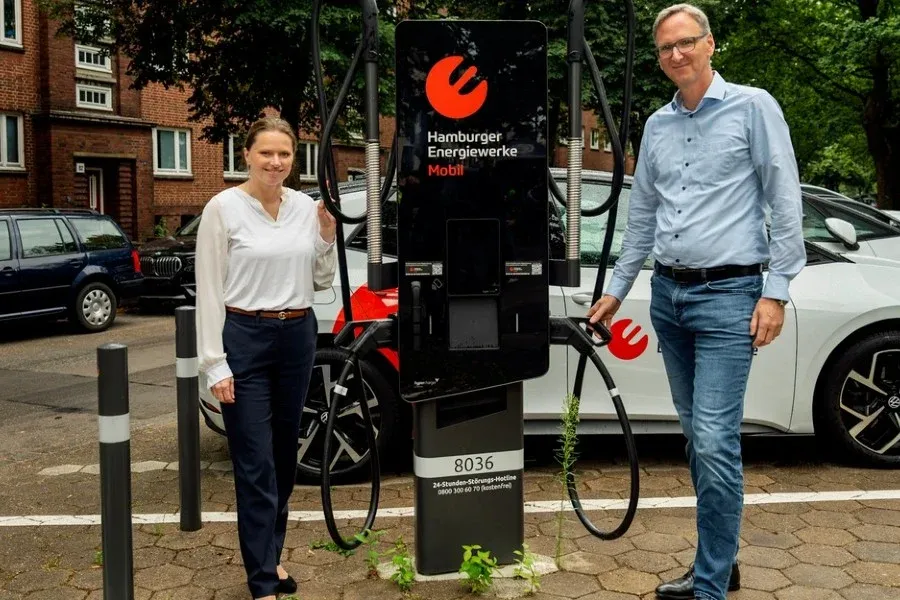
Hamburg Energy Works Mobil is recently installing so-called low-DC charging stations in the Hanseatic city to expand the charging network there. These are chargers that are relatively rare in Germany, offering DC charging capacities of up to 50 kW.
Hamburg Energy Works Mobil – abbreviated as HEnW Mobil – is a subsidiary of Hamburg Energy Works and aims to fill the gap between traditional AC charging and high-power charging using its moderately fast DC charging devices. According to the company, it is the first provider to install this charging technology in public spaces in Hamburg. HEnW Mobil’s pilot location equipped with such low-DC chargers is located on Paul-Sorge-Straße in Niendorf. Another location is set to open soon on Grünebergstraße.
And that’s not all: HEnW Mobil claims to have 13 locations already in planning or under construction. The press photos from this Hamburg-based provider show that the chargers used are Hypercharger 50 models by Alpitronic, each equipped with two charging ports. Such chargers are relatively rare in Germany. According to the Bundesnetzagentur’s charger registry, its July statistics listed only
8,386 charging points with a power range of 49 to 59 kW — four percent of all registered charging points in the Federal Republic. In the 22–49 kW range, which is partially covered by AC and DC chargers, the number is even lower (
HEnW Mobil sees good reasons for low-DC charging stations: “They are particularly suitable for densely populated urban areas as well as so-called Points of Interest, where vehicles are typically parked for a limited time. Low-DC allows for significantly higher charging speeds during this period compared to conventional AC charging points, while also allowing compact integration into public spaces.” Additionally, the technology places lower demands on the power grid than HPC chargers, which is especially advantageous in existing urban structures.
The subsidiary of Energiewerke currently operates around 2,150 AC charging points and over 150 fast-charging stations. According to HEnW Mobil, this makes it one of the largest public AC charging networks in Germany. Low-DC is set to add another charging technology for locations with moderate stay times to this offering in the future. Prices remain identical to those for AC charging, according to a report by NDR. By mid-2027, HEnW Mobil’s network is expected to grow to more than 2,800 charging points covering all power levels. By 2030, around 10,000 charging points across all providers are planned in the city, with half of that already completed, according to the statement.
Dr. Melanie Leonhard, Senator for Economy, Labor, and Innovation, commented: “Hamburg is making good progress in expanding charging infrastructure. This is crucial for ensuring that electric mobility works in everyday life. It’s essential that people can charge their electric cars where they are already — in their residential areas, while shopping, or at work. That’s why we focus on the right combination of urban development, private investment, and appropriate technology for each location.”
Michael Prinz, CEO of Hamburger Energiewerke, added: “Charging needs to fit into everyday life, and not every stop requires a full charge. For electric vehicle owners, a fully charged battery is essential to keep moving. That’s why we choose the appropriate charging technology for each location. Our new low-DC charging stations are particularly suitable for everyday locations where vehicles stay for a limited time. This allows our customers to make the most of their parking time for charging.”
The use of HEnW Mobil’s charging network continues to grow: The company reported that it has already seen one million charging sessions this year, 22 percent more than during the same period in 2025. At the same time, the number of electric vehicles in Hamburg is increasing: According to the city administration, 28.2 percent of all new car registrations in Hamburg now involve electric vehicles. Consequently, the demand for high-capacity public charging infrastructure is also rising.