
Green NCAP: Tesla Model Y and BYD Dolphin Surf excel in sustainability
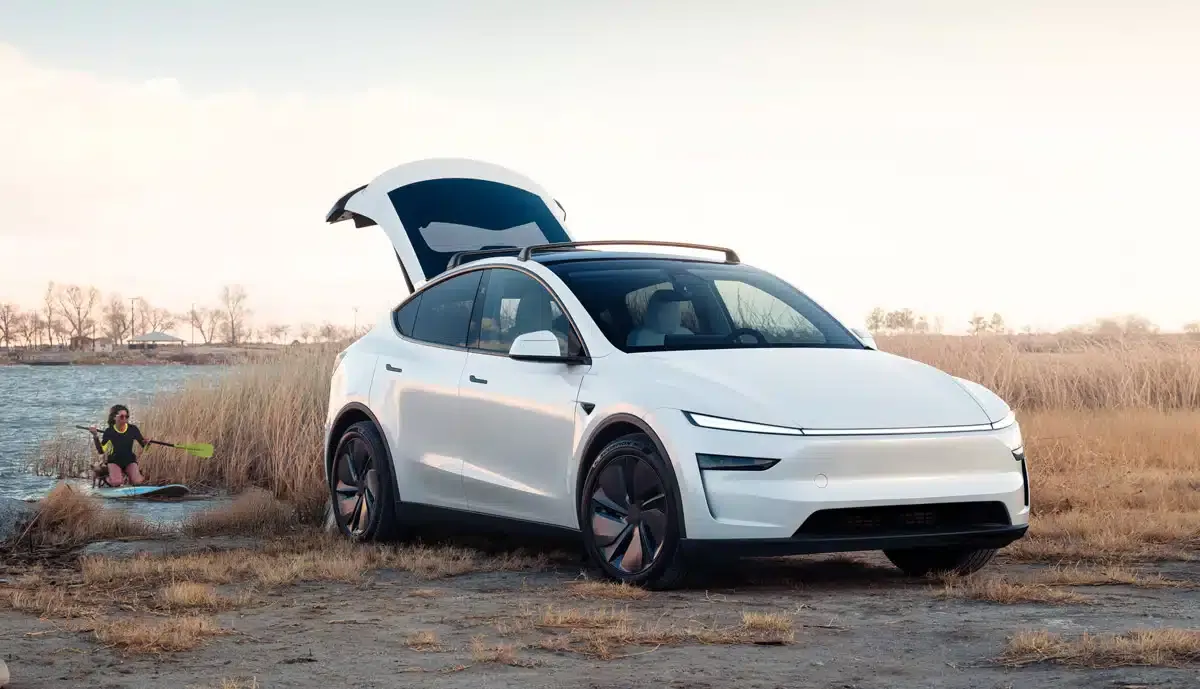
Image: Tesla
Green NCAP evaluated the sustainability of five vehicles and noted that the Tesla Model Y, equipped with a 62.6-kWh battery and rear-wheel drive, received five stars and a score of 93 percent. For the evaluation of this electric SUV coupe produced in Brandenburg, Tesla provided comprehensive, verified life cycle data for the first time. However, a Chinese electric vehicle performed even better. The assessment takes into account the entire vehicle lifecycle, from raw material extraction through manufacturing and distribution to operation.
The 1.9-ton Tesla Model Y has a CO2 footprint of 95 grams of CO2 equivalent per kilometer over its lifetime, earning full points in terms of greenhouse gas emissions. Green NCAP particularly highlights its energy efficiency and low emissions during manufacturing and operation. At minus seven degrees, thanks to the heat pump and excellent insulation, the interior maintained its temperature relatively stable for 30 minutes even after shutdown. DC fast charging from 10% to 80% takes 24 minutes, though it lacks a bidirectional charging function for V2L or V2G.
With a score of 96 percent and five stars, the electric BYD Dolphin Surf, equipped with a 43-kWh battery, achieves an even higher sustainability rating than the Tesla. This compact car manufactured in China stands out for its low energy consumption, light weight, bidirectional V2L charging capability, and a 33-minute fast charging time to reach 80 percent charge. According to Green NCAP, limitations exist in terms of range and rear cabin heating.
The Suzuki e Vitara with a 60-kWh battery earns 87 percent and four and a half stars, with low fuel consumption and efficient charging via an 11-kW wall box standing out positively. In this model, the weight of 1.8 tons and the environmental impact based on assumptions about production in India limit its score. Additional issues include slow interior heating in cold weather and a DC fast charging time of 44 minutes to reach 80 percent charge. Inaccuracies in the dashboard display were corrected by Suzuki as part of a service update.
The VW Golf 2.0 TDI achieved the best result to date among combustion engine vehicles tested by Green NCAP, scoring 69 percent and three and a half stars. This diesel Golf excels with low emissions and fuel consumption under various driving conditions, but it falls just short of the four-star threshold of 70 percent. According to Green NCAP, the Audi A3, Seat Leon, and Škoda Octavia share this sustainability rating.
The mild-hybrid gasoline vehicle VW Tayron 1.5 eTSI DSG performs significantly worse, earning 41 percent and two and a half stars. Its lifecycle emissions amount to 263 grams of CO2 equivalent per kilometer, compared to 95 grams for the Tesla Model Y. Green NCAP particularly highlights the Tayron’s high fuel consumption and poor greenhouse gas rating.
Also interesting
About the author
Thomas Langenbucher is an expert in electromobility with professional experience in the automotive industry and finance sector. Since 2011, he has been covering electric vehicles, sustainable technologies, and mobility solutions for ecomento.de. Learn more.
Reader interactions