
Göttingen’s public transportation company puts four eCitaro articulated buses into service
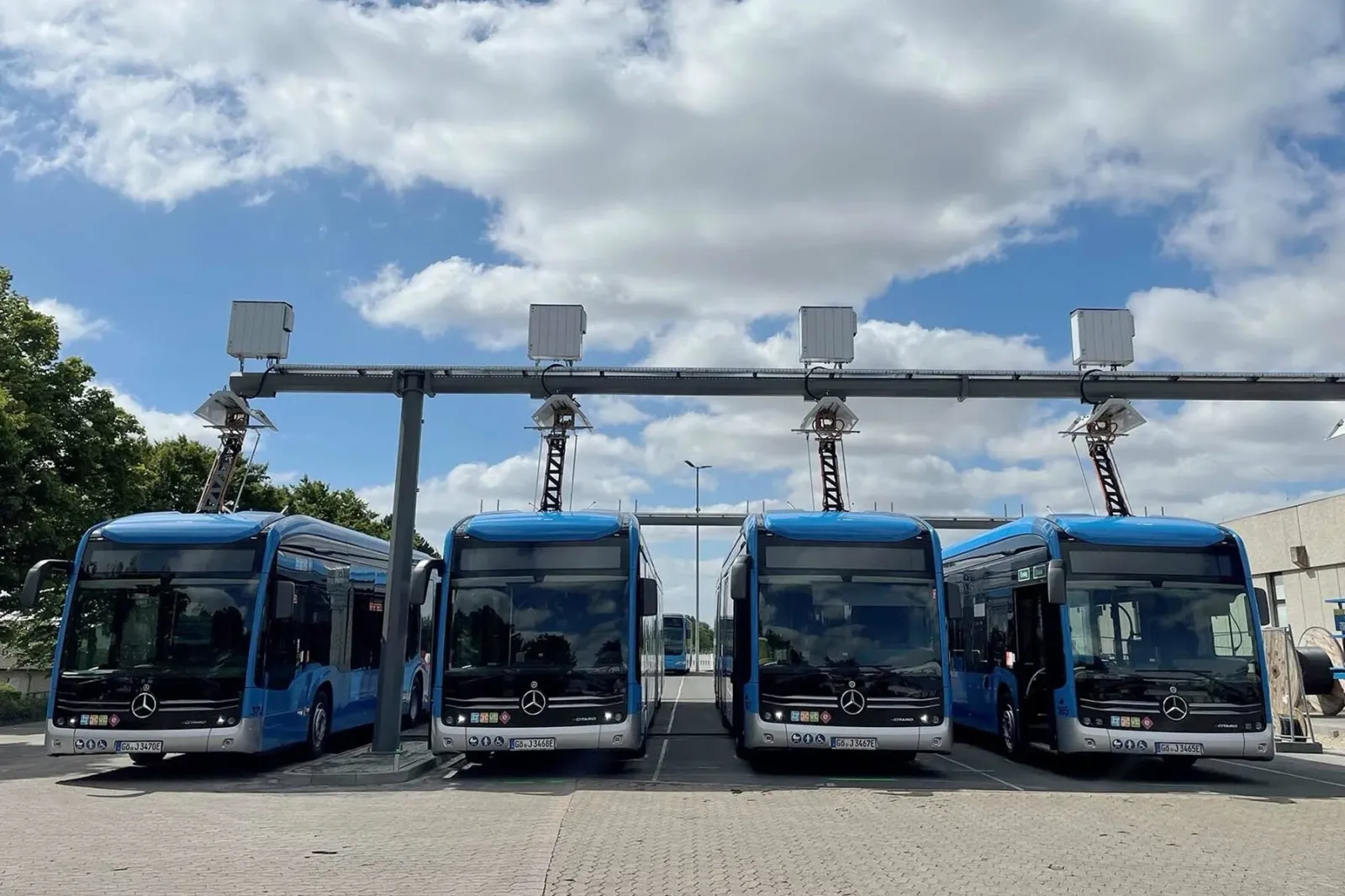
The Göttingen Transportation Company (GöVB) has put four new Mercedes-Benz eCitaro buses into service. These articulated buses will primarily be used on routes 71 and 72, increasing GöVB’s electric fleet to 34 vehicles. The federal government and the state cover more than half of the purchase cost.
Image: GöVB
The Göttingen Transportation Company (GöVB) is expanding its electric bus fleet. Since mid-October, four additional Mercedes-Benz eCitaro buses in the articulated version have been in service. They will mainly be used on routes 71 and 72. As a result, GöVB now has 34 electric buses, including 26 articulated and eight standard buses. A month ago, the number was 30, after two eCitaro buses were delivered at the end of August.
The four buses cost around 3.5 million euros, or approximately 875,000 euros per vehicle. The Federal Ministry of Transport contributes 1.3 million euros, while the state public transport company Niedersachsen (LNVG) adds another 513,000 euros. This funding covers just under 52 percent of the investment; roughly 1.7 million euros remain the responsibility of GöVB.
Details on GöVB’s new electric buses
Each bus can accommodate 139 passengers, of whom 44 sit and 95 stand. The buses feature barrier-free entrances, air conditioning, USB charging ports, and digital passenger information systems. The transportation authority states that range can reach up to 350 kilometers, depending on operating conditions. GöVB does not disclose the size of the batteries or the charging power used. Charging takes place at the depot on Gustav-Bielefeld-Straße as well as at charging stations at the ends of each route, where buses can recharge during turnaround times before heading out on their next journey.
"Every additional electric bus means less noise and operation without local emissions," says GöVB CEO Michael Neugebauer. In urban traffic, this is certainly a strong argument. A diesel bus is significantly louder at stops and when starting up compared to an electric bus.
Göttingen has been electrifying its fleet for a long time
The topic is not entirely new in Göttingen, though the approach took a detour. In September 2017, GöVB ordered three plug-in hybrid buses of the Volvo 7900 EH type. These buses were put into service on routes 41 and 42 in April 2018. The buses could be recharged at an ABB OppCharge station with 150 kW in about six minutes, allowing them to travel roughly seven kilometers on pure electric power. This was sufficient for sections in the city center, near the hospital, and at the train station; the diesel engine covered the rest of the distance. GöVB paid 435,000 euros per bus at that time, with the state of Lower Saxony contributing 138,000 euros each.
In November 2021, the first two fully electric eCitaro G buses arrived. At that time, the transit authority set a goal to convert two-thirds of its bus fleet to electric power within ten years. It remains unclear whether this goal still holds true today.
The speed at which this can proceed depends mainly on the space available for parking and charging. Therefore, GöVB is planning a new depot on Hermann-Kolbe-Straße. On a site covering around 40,000 square meters, equivalent to approximately five and a half football fields, parking spaces and charging infrastructure for at least 100 electric buses, along with workshops and an administrative building, are set to be built. The cost is estimated at around 60 million euros. Construction is scheduled to begin in 2029, with operation set to start by the end of 2031. Until then, the existing depot and charging points at the terminal stations must suffice.