
Germany: hydrogen truck mobility ‘alliance’ moves forward
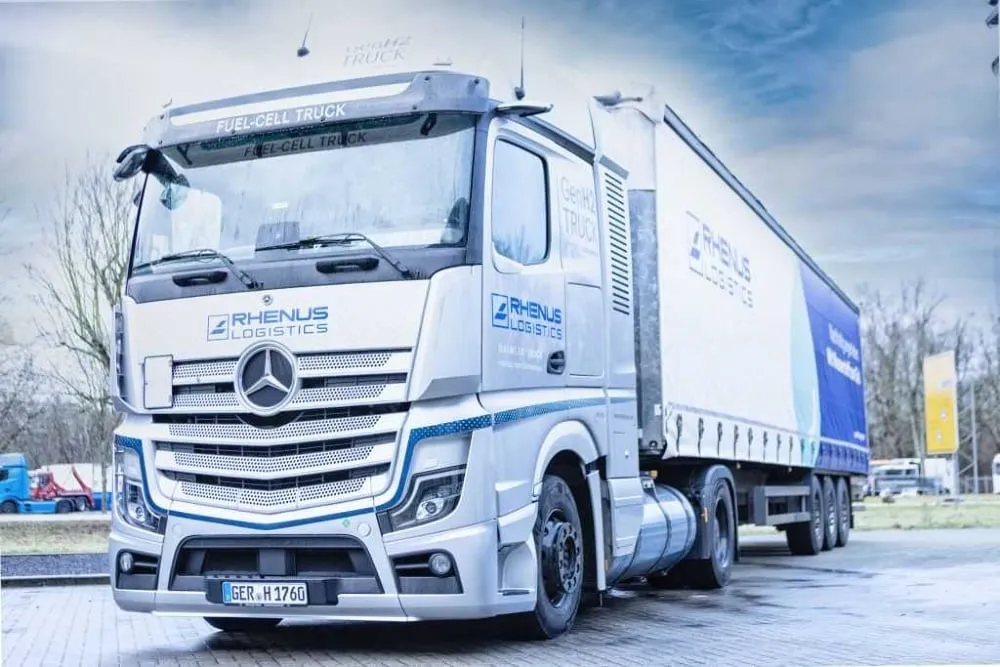
In Germany, an alliance is forming to accelerate the commercialisation of heavy H2 trucks and associated infrastructure. To achieve this, Daimler Truck, the Volvo Group, and Toyota are joining forces, supported by industry giants such as Bosch, Air Liquide, and TotalEnergies. The message: Domestic players want to establish an H2 ecosystem - before others do.
Hydrogen-powered mobility in Germany and Europe is technically feasible – as demonstrated by numerous pilot projects. What is clear: fuel cell technology does not pay off for passenger cars, but it does have opportunities in niche applications for heavy-duty transport. Yet, for years, little has progressed in this capital-intensive field. There is a lack of confidence that green hydrogen will become affordable. The prevailing view is that battery-electric trucks are more efficient – and there is also a lack of broad, committed engagement.
Elsewhere, however, the hydrogen ecosystem for trucks is already developing—led by China. And what works on the roads in China is, as is well known, currently arriving in Europe with a slight time lag. Against this backdrop, leading figures in Europe’s domestic industry have forged an alliance behind the scenes, whose goals are to be presented in detail on 15 September at the IAA Transportation in Hanover. Even the announcement of this date is newsworthy, as Daimler Truck – one of the main players in the new alliance – is already outlining the rough dimensions of this plan. So far, everything points to a concerted approach with considerable ambition.
Initially, the alliance will consist of manufacturers Daimler Truck, Volvo Group, and Toyota, as well as suppliers, transport, and energy companies Bosch, Air Liquide, TotalEnergies, TEAL Mobility, and MB Energy. The inclusion of the manufacturer trio comes as little surprise; Daimler Truck and the Volvo Group have been cooperating for years on the development of fuel cell technology, as evidenced above all by their joint venture, Cellcentric. This year, Toyota also joined Cellcentric as a third equal partner. This brings the circle back to the alliance: the three manufacturers want to advance a future business into which they have already invested significant development work and capital, both operationally and strategically.
So what does the alliance plan to do? Daimler Truck outlined that it wants to “accelerate the commercialization of hydrogen-powered mobility and build the ecosystem needed to scale it along the whole value chain,” – incidentally, in parallel with the further roll-out of battery-electric trucks, which remains unaffected by the initiative. Activities will specifically include the establishment of hydrogen refuelling stations “along key strategic corridors in Europe”. In addition, the alliance aims to ensure the supply of hydrogen at “competitive” prices. For further details, Daimler Truck refers to a press conference on 15 September at the IAA Transportation.
But even now, the announcement speaks to long-standing discussions behind the scenes. All stakeholders share an “ambition to scale hydrogen with a focus on customer-oriented refueling infrastructure and competitively priced hydrogen fuel. According to Daimler Truck, the prior agreements have now culminated in the fact that “Germany is bringing together the full ecosystem needed to scale the deployment of hydrogen trucks by 2030, combining supportive policy frameworks, a strong OEM offering and an integrated hydrogen supply chain and infrastructure”. The goal is to enable customers to operate hydrogen-powered vehicles with competitive total cost of ownership.
The Stuttgart-based company emphasises that its corporate alliance is working on the hydrogen initiative together with political decision-makers. The exact nature of this cooperation has not yet been specified by the stakeholders. What is clear: the German government is committed to establishing an initial hydrogen truck network and has recently received over 500 applications (DE) in response to its first funding call in this area. The awards will be made in the second half of the year.
Currently, subsidies totalling €220 million are available in Germany to expand hydrogen mobility. This is intended to create a basic network for heavy-duty transport – as required by the European AFIR (Alternative Fuels Infrastructure Regulation). Importantly, the funding also includes hydrogen internal combustion engines. This technology is largely based on conventional reciprocating piston engines.
Interestingly: according to the Ministry of Transport, leading manufacturers of heavy commercial vehicles were among the applicants in the “broad participation” for the funding. The electrive editorial team subsequently wondered whether manufacturers intend to increasingly register their hydrogen vehicles themselves or perhaps also invest in infrastructure. Now it is becoming clear: the answer is likely to be provided at the press conference on 15 September at the IAA. What is already evident, however, is that OEMs will engage in building the hydrogen ecosystem in a way that goes far beyond merely providing the vehicles.
The reason is obvious: Daimler Truck and Volvo Trucks placed their bets on hydrogen early, alongside their BEV roadmap, and have spent years developing and investing in the technology. Anyone who wants to sell series-production vehicles with fuel cell drives must also provide customers with the necessary framework conditions. Both OEMs underestimated the inertia of the system. Initially, the first series-production vehicles were announced for 2027 – and under this premise, Cellcentric was founded in 2021 to produce the corresponding technology toolkit in series.
In 2024 and 2025, the companies slowed down: Cellcentric is still building a large-scale production facility in Weilheim an der Teck, Baden-Württemberg, but construction has been hit with multiple delays. At Daimler Truck, the Next GenH2 Truck is soon to enter customer testing (such as with Dachser), although the manufacturer has already postponed series production until the 2030s. Cellcentric must therefore adjust its plans accordingly. Meanwhile, little has been heard about Volvo Trucks’ planned fuel cell trucks for some time. However, the Swedes have now announced that they will showcase a unit at the IAA Transportation.