
The Genesis GV90 with a 123.5 kWh battery made its official debut. The Koreans are targeting BMW but using tactics similar to Rolls-Royce’s.
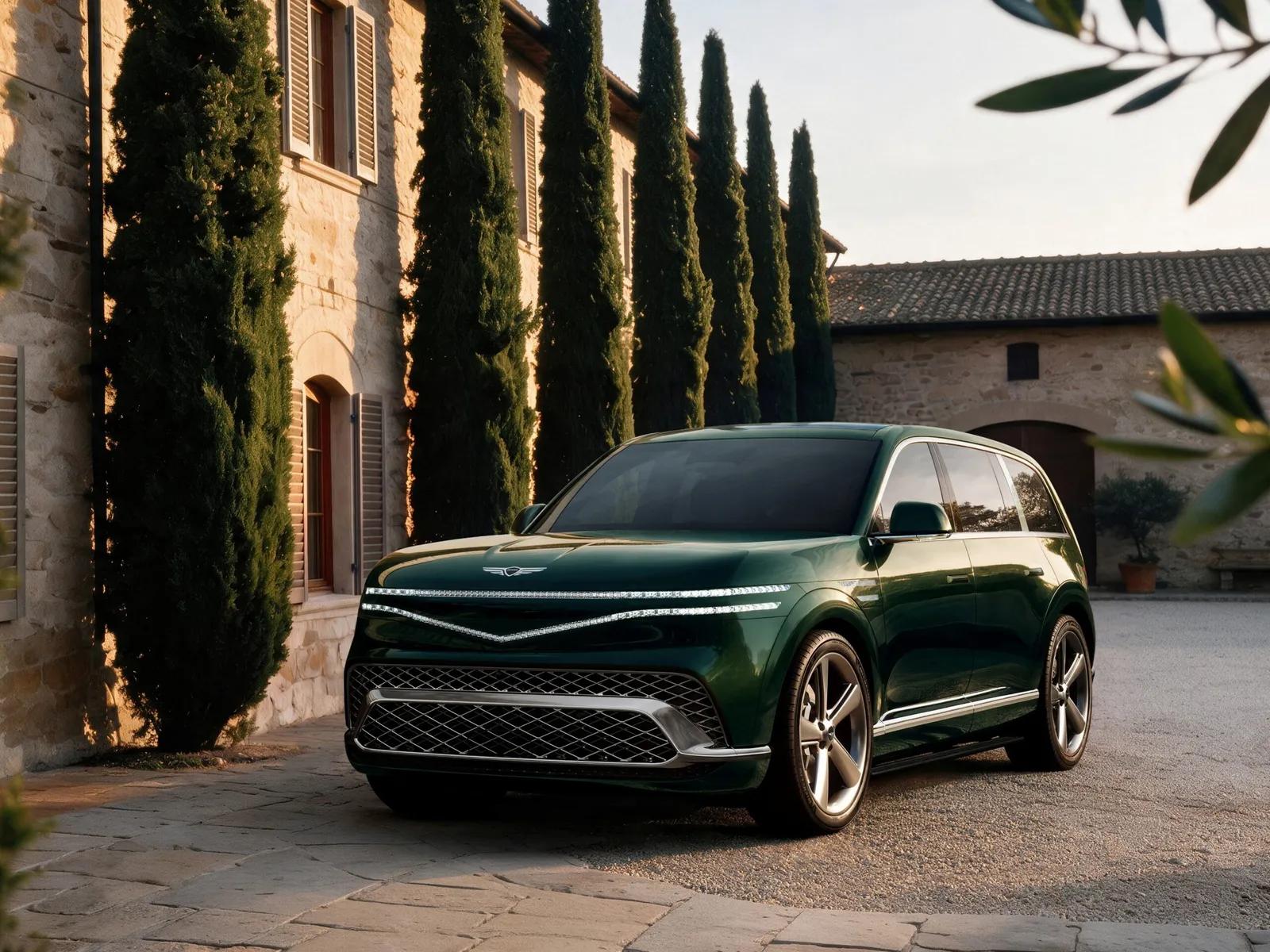
Genesis unveiled the electric GV90, the brand’s new flagship SUV and also the most luxurious model in the entire Hyundai group. The vehicle features 657 horsepower, a 123.5 kWh battery, 350 kW charging capability, and a Neolun version with pillarless coach door design.
Table of Contents
Show
Hide
If anyone was waiting for Korea’s answer to the BMW iX, Mercedes EQS SUV, or even more upscale models like the Rolls-Royce Cullinan, this is it. The question isn’t anymore whether Genesis can create a premium luxury electric vehicle. The question is how much it will cost.
Genesis GV90: Flagship Size, Large EV Specs
The GV90 is a large vehicle even by the standards of full-size electric SUVs. Its body length is 208.1 inches, or about 528.6 cm, with a wheelbase of 127.8 inches, or roughly 324.6 cm. At this size, it’s no longer considered a typical family SUV but rather a car designed with space and a “living room on wheels” experience in mind.
Beneath the hood lies the new eMP platform, developed specifically for Genesis’ flagship models. This isn’t another variation of the well-known E-GMP architecture but rather a separate platform for the brand’s largest and most expensive vehicles.
The powertrain remains similar across all versions. Genesis specifies two engines, delivering 657 horsepower and 800 Nm of torque. This is paired with a battery having a capacity of 123.5 kWh. The claimed range is around 500 kilometers, or 311 miles, but it’s important to note right away that this figure comes from internal tests, not EPA or WLTP certification.
The charging claims look much more interesting. The GV90 is supposed to support fast charging at up to 350 kW, with a 10-to-80% charge taking just 22 minutes. On paper, this sounds excellent, though as usual, the real issue lies in the charging curve. The mere figure of “350 kW” doesn’t guarantee anything.
Genesis GV90 Specifications
Parameter
Genesis GV90
—
—:
Platform
eMP
Drive System
2 engines, AWD
Power
657 HP
Torque
800 Nm
Battery
123.5 kWh
Claimed Range
about 500 km / 311 miles
DC Fast Charging
up to 350 kW
10-80% Charging Time
22 minutes
Models
GV90, GV90 Neolun
Seating Arrangement
7-seater, optional 4-seater Executive Suite
The chassis also received top-tier upgrades. The vehicle is equipped with a pneumatic suspension featuring multi-chamber air springs, dual-valve shock absorbers, a steerable rear axle, and electronically controlled differential mechanisms on both axles. It’s an interesting combination, as Genesis tries to merge two worlds: the plush comfort of a limousine with the handling prowess of a large electric vehicle.
Neolun, or B-pillar-free coach doors
The most eye-catching version is the GV90 Neolun. This model features a design called Neolun Arch Gate, which means rear doors that open “against the wind” without a traditional visible B-pillar. In practice, it resembles a feature known from Rolls-Royce, but presented in its Korean version.
Here, Genesis didn’t stop at just a concept car. The production model retained this feature, with the rear doors having their own dual-action mechanism. They first slide outward before opening, and there’s no need to open the front doors first. This is important because many similar systems only look good in photos.
The absence of a B-pillar required structural reinforcements. The manufacturer mentions a new structure connecting the doors to the body, double steel beams in place of the pillar, and a hidden framework resembling a safety cage. The cabin frame is said to be about 1.5 times thicker than average.
It sounds ambitious. But here, a cool head is needed. Luxury is one thing, but the everyday usability of such doors depends on one factor: how well they perform in a tight garage, in the wind, and after three winters. That’s still unknown to us.
Interior: more lounge than a traditional SUV
The GV90’s cabin is arguably the car’s strongest feature. Genesis clearly aimed to create something that resembles a private lounge more than a traditional cockpit with a single large tablet stuck to the dashboard.
In the center sits a 23.6-inch OLED screen that can extend and grow to 24.6 inches after parking, serving as a entertainment hub. Instead of traditional gauges, the driver gets a 25-inch HUD displaying speed, navigation, and ADAS functions. This is a bold approach, as Genesis essentially abandons the traditional set of instruments.
The car also features a new Pleos Connect system based on Android Automotive OS. The interface is designed to function more like a smartphone, with apps and customizable screens. There’s also the Gleo AI assistant, which is meant to answer questions and control car functions. It’s good that the manufacturer no longer tries to pretend that premium customers don’t want a familiar app ecosystem. It’s worse if the AI turns out to be just a gimmick for demonstrations at launch.
An interesting feature is the way the car “wakes up.” When you pull on the handle, the car starts automatically and closes the doors. The lever next to the steering column shifts from 12 o’clock position to 2 o’clock, and the crystal controller rotates to reveal the controls. It’s impressive. Probably exactly what was intended.
Genesis didn’t skimp on audio. The Bang & Olufsen Premier 3D system features 25 speakers, including Acoustic Lens tweeters, ceiling-mounted speakers, midrange drivers, and subwoofers. Additionally, it has the Virtual Venue function, which aims to replicate the acoustics of famous halls and stadiums, from Boston Symphony Hall to Wembley Stadium.
There are also more practical amenities: ambient lighting, motorized vents, cabin monitoring, Remote Smart Parking Assist 3 for remote parking, and Memory Reversing Assist for reverse path memory.
Executive Suite and a refrigerator. Yes, a refrigerator.
In its top-tier GV90 Neolun Executive Suite configuration, the car transforms into a four-seater lounge. The front seats can rotate so that passengers sit face to face. The rear cabin is separated from the trunk, featuring heated floors with wooden trim and heated armrests.
There’s also a refrigerator. In a car of this class, it shouldn’t surprise anyone anymore, but it clearly shows where Genesis positions the GV90. It’s not a “larger EV for families.” It’s a vehicle meant to transport VIPs, even if the owner uses it to get themselves to the office as a VIP transport.
In its seven-seater version, the GV90 certainly has a more traditional look, but the overall design still focuses on delivering an extremely luxurious experience. It’s more of a Mercedes EQS SUV than a Kia EV9, and more of a Rolls-Royce in spirit than a BMW with a sporty focus.
Safety and battery: there are specifics, but no full picture
Genesis has added several strong safety features. The GV90 comes with 12 airbags and the world’s first Roof Airbag, which expands during a rollover to protect the entire glass surface of the roof. In addition, it features an interior monitoring system.
The manufacturer mentions a cloud-based BMS system for real-time diagnostics along with Thermal Runaway Protection to limit heat spread between cells and reduce the risk of fire when using a battery.
These are concrete details rather than just marketing claims. However, without independent tests and information on the car’s weight, it’s hard to say how well the GV90 will perform in practice, especially with a large battery and extensive features.
The biggest question mark is the price
So far, Genesis has not announced a price for the U.S. market, and it is this price that will determine whether the GV90 becomes a real competitor to German luxury brands or merely an expensive novelty with a nice interior.
If the brand maintains a clear distance from the Mercedes EQS SUV and BMW iX, it can win with its features and wow factor. However, if its price comes close to that of European top-tier models on a nearly 1:1 basis, customers will inquire about the brand’s prestige, residual value, and sales network. And that will be a more difficult conversation.
In Europe and Poland, such a model would likely be a niche vehicle but important for branding. For Genesis, it doesn’t have to be a sales hit. It’s sufficient if it shows that Korea can create an electric flagship without insecurities.
The most interesting aspect of the GV90 is perhaps that Genesis didn’t simply copy German luxury but added its own theatrical style. My question to you: would you prefer a classic luxury electric car like the BMW iX, or something as extravagant with doors like a Rolls-Royce?