
Genesis GV90: Electric luxury SUV unveiled
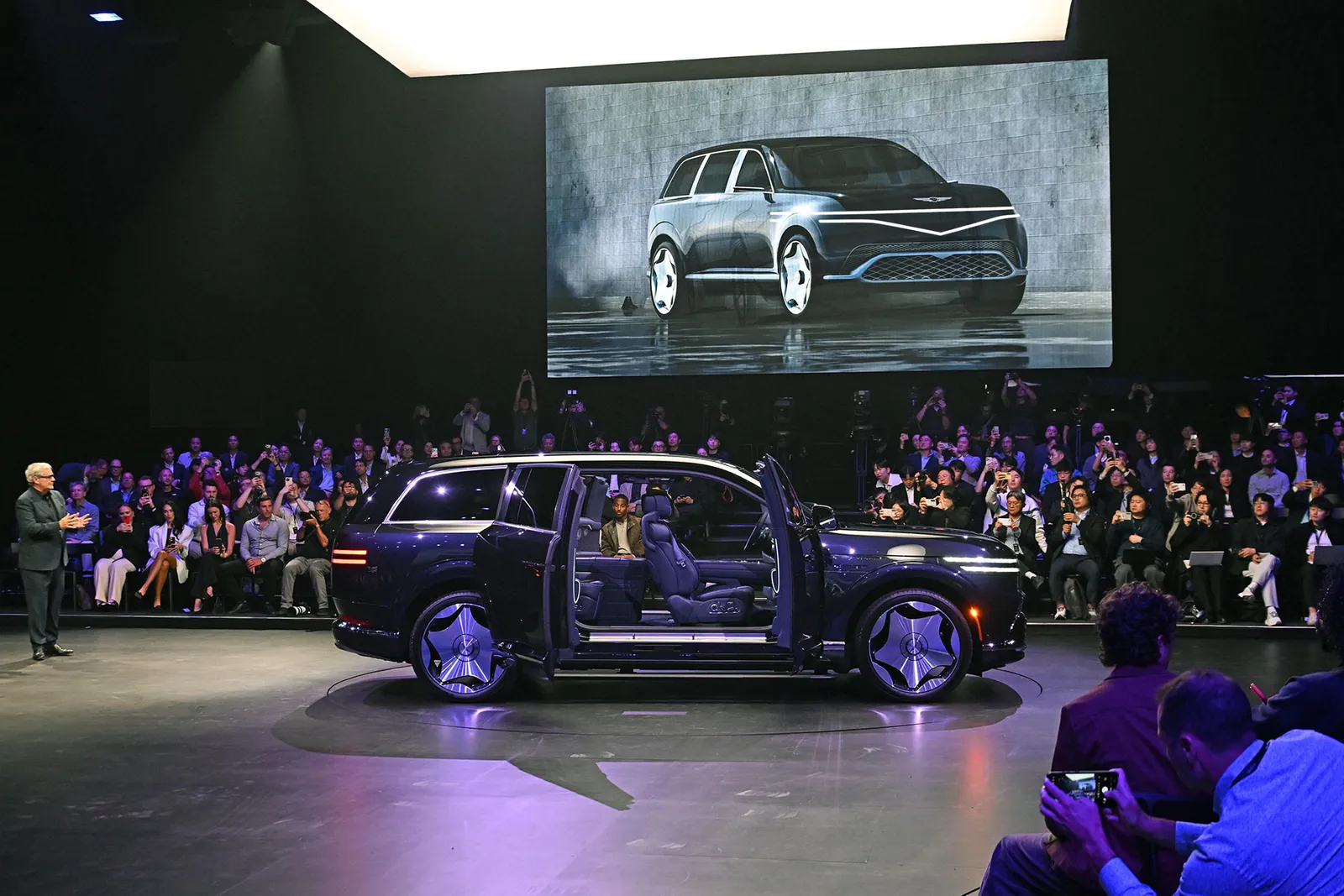
Hyundai Motor Group’s (HMG) luxury brand Genesis unveiled a full-sized electric SUV, the GV90, in San Francisco. It is the largest model in the entire group and will be the first vehicle produced at Hyundai’s new factory built specifically for electric vehicles in Ulsan, South Korea.
With the GV90, Genesis brings its new flagship model to the forefront. This generously sized SUV completes the existing lineup of the two smaller E-SUVs, the GV60 and Electrified GV70, as well as the E-limousine Electrified G80, by providing a larger option at the top end. At 5.30 meters in length, 2.0 meters in width, and 1.80 meters in height, the GV90 is also the largest model among all HMG brands — meaning no Hyundai or Kia model is larger than it.
The new luxury electric SUV features a long wheelbase of 3.2 meters and is available only in a two-motor all-wheel-drive configuration, with one motor per axle connected to its own electronic limited-slip differential. The front motor delivers 240 kW of power and 350 Nm of torque, while the rear motor produces 250 kW of power and 450 Nm of torque. Together, this configuration offers a total output of 490 kW and 800 Nm of torque.
A battery pack with 123.5 kWh (gross)/115 kWh (net) powers these engines. Genesis cites a wireless battery management system (WBMS) as another technical innovation that enabled its transition to series production. According to the specifications, charging from 10% to 80% SoC using a 350-kW charger takes 22 minutes. Genesis estimates the range at around 500 kilometers based on internal tests, but it does not specify whether the official South Korean certification process, the WLTP test, or the EPA methodology was used in these tests.
New platform for Genesis’s flagship models
The GV90 is built on a new eMP platform (Electric Mobility Prime), which was developed exclusively for Genesis’s flagship models. eMP is likely the first and most advanced version of the eM platform that the Hyundai Group announced in 2022 alongside the eS platform for purpose-built vehicles (PBVs). eM and eS were introduced at the time as part of the Integrated Modular Architecture (IMA), an evolution of the well-known Electric Global Modular Platform (E-GMP).
Genesis announced at the world premiere this week that it will offer the GV90 in two versions: a standard model and a Neolun version. The regular GV90 is expected to compete with the Mercedes-Benz EQS SUV, while the GV90 Neolun is likely aimed at competing with other luxury vehicles such as the Mercedes-Maybach EQS SUV or the Range Rover Electric at a higher tier.
Genesis GV90 – Exterior with Sleek Design
The GV90 is essentially an evolution of the Neolun study unveiled by Genesis in 2024. The production vehicle remains remarkably faithful to the concept design, which is especially evident in the top-tier GV90 Neolun version. Visually, this full-size SUV combines upright, angular proportions with softly curved surfaces and a somewhat polarizing lighting signature. Its overall silhouette differs significantly from many common full-size SUVs, regardless of the powertrain type.
Because the hood slopes down extremely smoothly into a large, vehicle-colored panel that houses the “Wing Face” headlights with Micro Lens Array (MLA) technology. In contrast, a large two-tiered radiator grille featuring a distinctive diamond pattern and chrome accents adds to the front end’s recognizable appearance. Depending on the trim level, the GV90 also comes equipped with sporty 22-inch five-spoke wheels or nearly fully covered 24-inch aerodynamic wheels.
The slightly sloping roof line seamlessly transitions into the rounded rear, creating an arch-like design. The absence of a roof rail and spoiler enhances this effect, giving the GV90 an unusually sleek appearance. The standard version features regular doors, while the Neolun version comes with opposite-opening doors (“Coach Doors”) without a B-pillar, resulting in an exceptionally large opening for entry.
Luxury and Features Inside
Inside, the GV90 features a luxurious interior inspired by modern living spaces, with classic premium elements such as an analog-style digital clock in the center of the dashboard and quilted upholstery on the seats and door panels. Just like the exterior, the entire interior is adorned with unconventional and innovative design details.
The dashboard houses an ultra-wide OLED infotainment touchscreen that can be raised by 90 mm when the vehicle is parked, increasing the screen diagonal from 23.6 inches to 24.6 inches. Additionally, Genesis uses Hyundai Group’s new “Pleos Connect” cockpit in the GV90, though without a combined instrument cluster. The company does integrate a 25-inch head-up display instead.
The conventional three-spoke steering wheel design contrasts with a motorized gear shift lever mounted on the steering column. This lever rests in the 12 o’clock position and moves to the 2 o’clock position once the driver closes the door. A crystal ball in the center console adds to the theatrical effect: it rotates to reveal an integrated controller for the infotainment system. Another novelty is that the clock face on the dashboard also serves as a dial for adjusting speaker volume, temperature, and air flow.
Regarding the seating configuration, Genesis will offer the standard GV90 in seven- and six-seater versions, as well as the GV90 Neolun in six- and four-seater versions. The four-seater configuration, dubbed the “Executive Suite,” includes features such as a floor made of real wood veneer, electrically adjustable front seats, a partition between the second-row seats and the cargo area, a panoramic roof with electrochromic tinting, and a rear center console with a refrigerator and integrated tables.
Genesis has not yet revealed the price of the GV90 at its world premiere. The vehicle is set to launch first in its home market of South Korea before becoming available in the U.S. and Europe. According to several media reports, the European market debut is scheduled for the first half of 2027.
newsroom.genesis.com, koreajoongangdaily.com
This article by Sagar Parikh first appeared in our international edition electrive.com.