
The Geely Galaxy Zhanjian 700 has started presales at 199,800 yuan. Europe may receive it from Spain in 2028.
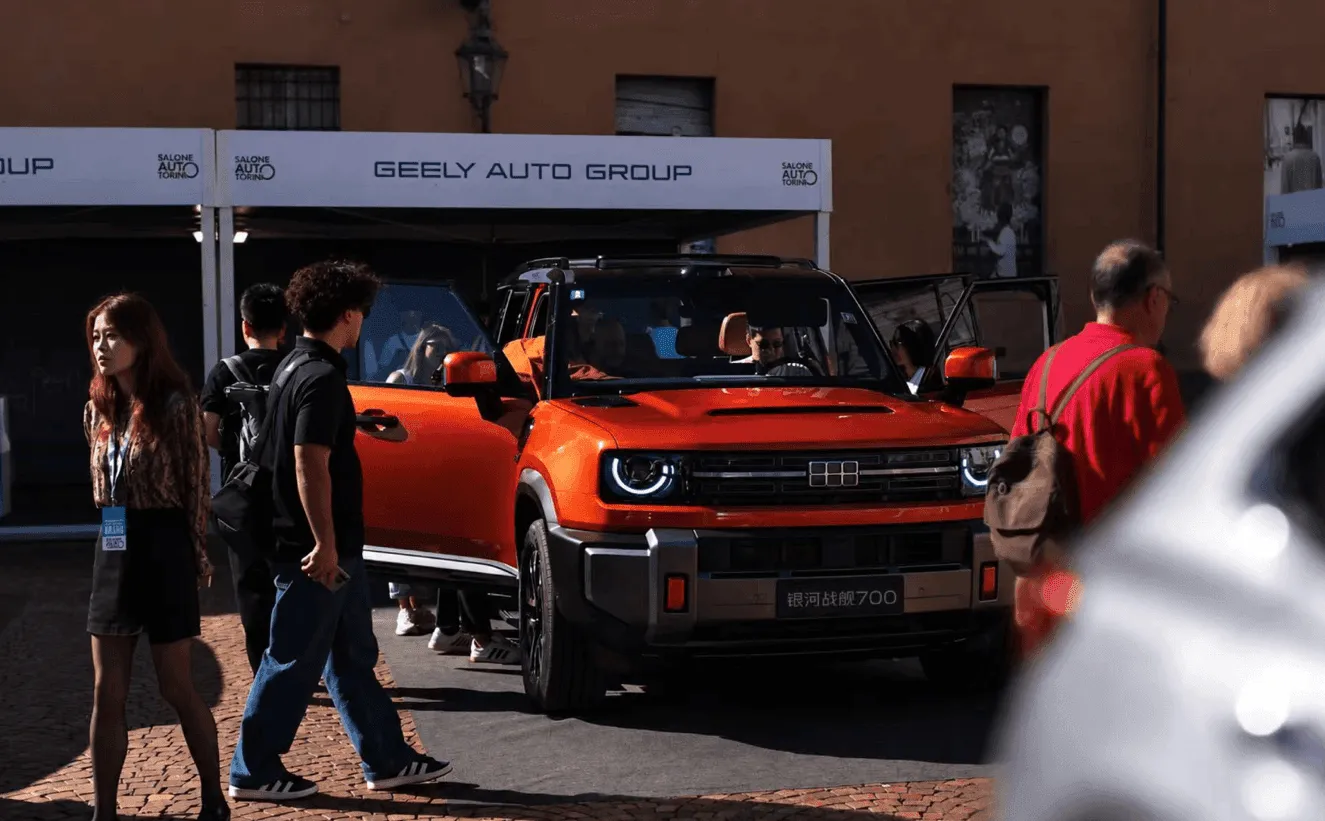
Geely has launched pre-orders in China for the Galaxy Zhanjian 700, the brand’s first off-road styled SUV. Within 9 minutes, the vehicle received 10,000 orders, and after an hour, it had 43,900 reservations, with prices ranging from 199,800 to 389,800 yuan.
Table of Contents
Show
Hide
For Europeans, the second piece of information might be more interesting right from the start of sales. According to plans involving Geely and Ford, this model is set to go into production at the Valencia plant and serve the European market starting in 2028.
The Chinese launch looks strong, but hype must be separated from actual sales
The Zhanjian 700, also referred to as the Cruiser 700 in some markets, is available for pre-order in six versions. The pricing is as follows:
Version
Price in China
1.5T 2WD Explorer Edition
199,800 yuan
1.5T 2WD Explorer+ Edition
209,800 yuan
1.5T Tri-Motor AWD Peak-Control Edition
229,800 yuan
1.5T Tri-Motor AWD Peak-Control+ Edition
239,800 yuan
2.0T Tri-Motor AWD Summit Edition
269,800 yuan
Land Ark Edition
389,800 yuan
The limited Land Ark version was capped at 700 units and sold out immediately. It sounds impressive, but the standard caveat applies: we’re talking about pre-order bookings here, not final registrations or deliveries to customers. The Chinese market loves dramatic product launches, and manufacturers know how to package them well.
Still, the scale is enormous. 43,900 reservations per hour is a figure that cannot be dismissed as insignificant. Especially since Geely is entering the popular segment of rugged, “adventure” new energy SUVs, where customers buy not only propulsion but also a lifestyle. It’s somewhat similar to the Yangwang U8 or Fang Cheng Bao, only at a much lower price point.
1113 horsepower, a 47.14 kWh battery, and three engines. On paper, it’s quite impressive.
The Zhanjian 700 measures 5085 mm in length, 1999 mm in width, and 1895 mm in height, with a wheelbase of 2900 mm. This is no longer a compact car disguised as an SUV—it’s a full-sized vehicle. Geely also lists its off-road specifications: a 30-degree approach angle, a 31-degree departure angle, 233 mm of ground clearance, and the ability to navigate through water up to 800 mm deep.
The most powerful versions use the Thor EM-T AWD AI drivetrain. Options include 1.5T gasoline engines with 120 kW of power or 2.0T engines with 160 kW of power, paired with three electric motors and AWD drive. The maximum system power reaches 830 kW, which is equivalent to 1113 horsepower.
Geely boasts a torque of 13,920 Nm at the wheels. This figure should be interpreted with caution, as it is not the traditional engine torque measured on the crankshaft, but rather a “wheel torque” figure suitable for marketing purposes and less useful for comparing with competitors.
The top version is said to accelerate from 0 to 100 km/h in 3.95 seconds. For a large, boxy PHEV, this is an absurdly good result. The questions remain as to the car’s weight and how long it can maintain consistent performance beyond a single sprint. We still do not know these answers.
The battery is supplied by CATL. It’s a 47.14 kWh LFP pack, which is quite large for a plug-in hybrid. The electric range according to China’s CLTC standard is claimed to be 305 km, with a total range of over 1200 km. Under certain test conditions, Geely even claims a range of over 1700 km. Here, some caution is needed—CLTC is more optimistic than WLTP, and PHEV results vary greatly depending on driving style and battery state of charge.
There are also two figures that sound reasonable. The car features an 800 V architecture and fast DC charging, with fuel consumption at a depleted battery level said to be 5.95 l/100 km. On paper, that’s good. In reality, such a vehicle with three motors is unlikely to be fuel-efficient if bought for highway driving and long trips.
A cabin like a lounge plus some off-road features that cars are selling these days
Inside, the Geely offers a luxurious-technical blend. It features five screens, a 18.5-liter refrigerator with dual opening, and 14-way massage seats for the driver and front passenger.
For off-road driving, the manufacturer adds digital gimmicks. The car has 17 preset driving modes, including “Crab Walk” and “Waltz Turn.” The latter is designed to reduce the turning radius to 3.36 meters, which seems almost unbelievable in a vehicle over 5 meters long, but we’ve seen similar tricks from Chinese competitors before.
At the back, there is a mechanical differential lock that can engage in 200 milliseconds according to Geely. There is also an emergency water floating mode. The manufacturer claims that once the specified wading depth is reached, the car can move through water for up to 40 minutes. This sounds impressive, but no sensible person should consider this an incentive to drive a car in water.
In short, Geely combines three features that are currently selling well in China into one vehicle: high power, extensive equipment, and off-road capabilities.
Europe is set to receive this model from Ford’s factory in Spain
The second topic is more important to us than the Chinese launch itself. According to information regarding the planned partnership between Geely and Ford, the Galaxy Cruiser 700, internally designated as KO11, is intended to be produced in Valencia for the European market.
The company was agreed upon in July 2026 and passed China’s antitrust review in September. Ford will hold 66% of the shares, while Geely will own 34%. The goal is to use Ford’s plant in Spain for producing models from Geely’s portfolio.
It has already been confirmed that two vehicles will be produced in Valencia: a jointly developed multi-energy crossover primarily designed by Ford, and the electric Geely EX5. Additionally, there is a third SUV planned for 2028. This model is expected to be the Zhanjian 700 under a different name or brand.
This makes sense for several reasons. Local production in Europe reduces logistics costs, shortens the supply chain, and partially mitigates the issue of tariffs on cars imported from China. For Geely, it’s also a way to enter Europe not just as a container importer but as a player with a factory on site. Customers and regulators view this differently.
The plant’s planned capacity is 500,000 cars per year, with production set to begin in 2028. If the schedule holds, the European version is unlikely to be a 1:1 copy of the car from China. Changes can be expected in the name, drive train calibration, homologation, and possibly even the product positioning. European customers are less influenced by figures like 13,920 Nm of torque and are more focused on real-world fuel consumption, towing capacity, weight, and safety.
Geely is accelerating its efforts abroad and no longer focuses solely on exporting from China.
The background is also specific. From January to August 2026, Geely Auto sold 691,000 cars overseas, representing a 170% year-on-year increase. In August alone, exports totaled 110,094 cars, which is 205% more than the previous year and 3% higher than in July.
The company has already raised its overseas sales target for 2026 from 640,000 to 920,000 cars and is now aiming for 1 million. At this scale, establishing a foothold in Europe no longer seems like an option but rather a necessity.
This also reveals the group’s broader strategy. It’s not just about Volvo, Polestar, or Lotus, which Europe is already familiar with. Geely wants to bring in its own Chinese brands here more quickly, but without being entirely dependent on exports from China. Spain is set to be one of the key tools for this goal.
If the Zhanjian 700 does arrive in Europe, it won’t be as an exotic curiosity from a Shenzhen showroom. Rather, it will be part of a larger picture in which the Chinese manufacturer is building an European production base alongside Ford.
For now, the most plausible scenario is simple: in China, Geely is testing market demand for powerful, impressive PHEVs, while in Europe it plans a smooth entry through a local factory. My question to you: is such a 5-meter-long, 1113-horsepower plug-in vehicle “pretending to be an SUV” meaningful in Europe, or is it primarily a product designed for China?