
The Geely EX5 features 329 horsepower and a 460 kW charging capacity. The price starts at 97,800 yuan.
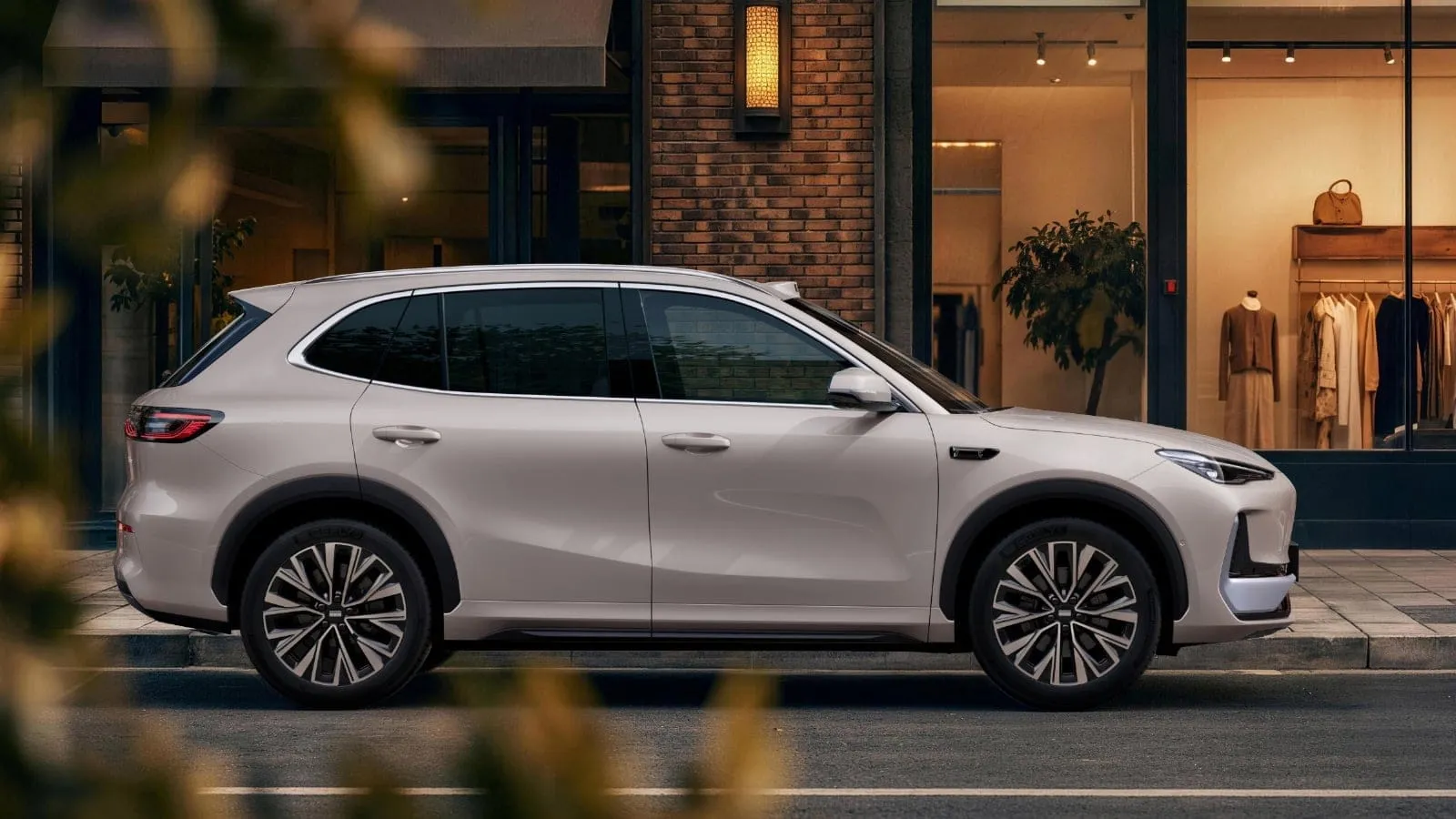
On September 23, 2026, Geely unveiled a thoroughly modernized Galaxy E5 SUV, which is sold outside China as the Geely EX5. The vehicle features an 800 V power system, rear-wheel drive, 245 kW of power—equivalent to 329 horsepower—and a battery that can be charged at up to 460 kW.
Table of Contents
Show
Hide
In China, the promotional price starts at 97,800 yuan, which is around 53,000 Polish zlotys. However, the cheapest version lacks an 800 V system, rear-wheel drive, and 6C charging capability.
One model, but two technically different versions
The Galaxy E5 made its debut in China in August 2024. The 2026 update is much more substantial than a typical facelift, as Geely has changed the powertrain, electrical architecture, battery, and driver assistance systems.
The four higher-end variants use an 800 V power system along with the new integrated Leishen 16-w-1 drive module. The engine is located at the rear and produces 245 kW, 85 kW more than the previous model. The acceleration from 0 to 100 km/h takes 5.8 seconds.
The base Galaxy E5 Global Classic retains a 400 V power system, front-wheel drive, and an engine with 160 kW of power, equivalent to 218 horsepower. Its maximum charging speed is 1.8C. In practice, the cheapest version is technically closer to the previous EX5 than to the other versions in the new pricing list.
Specifications
Geely Galaxy E5 / EX5
Drive Type
front or rear
Power
160 kW or 245 kW
0-100 km/h Acceleration
from 5.8 s
Architecture
400 V or 800 V
Battery
LFP, 60.22-70.01 kWh
CLTC Range
530-635 km
Maximum Charging Power
up to 460 kW
Charging 10-70%
8 min 25 s
Length
4,615-4,636 mm
Width
1,901-1,920 mm
Height
1,670 mm
Wheelbase
2,745-2,750 mm
Front trunk
160 l
Slight differences exist in dimensions according to the initial specifications. For rear-wheel drive versions, the length is given as 4,630 or 4,636 mm with a wheelbase of 2,745 or 2,750 mm. The base front-wheel drive version has a length of 4,615 mm and a width of 1,901 mm.
A new feature is the front trunk with a capacity of 160 liters. The previous Galaxy E5 did not have a front trunk, even though it was designed from the start for electric drive.
6C charging is impressive but requires a suitable charger
Geely has adopted new LFP Aegis Golden Brick batteries with short blade cells. The available capacities are 60, 22, 61, 52, and 70, 01 kWh. Corresponding ranges are 530, 550, and 635 km according to China’s CLTC testing procedure.
The manufacturer claims ranges of 429, 446, and 514 km for these variants under the WLTP cycle. These figures should not yet be considered as the result of European homologation for a specific EX5 model. CLTC is clearly a milder test, and the final range of the export version may vary depending on equipment, tires, and software.
The 800 V versions support charging at up to 6C with a peak power of 460 kW. Charging from 10% to 70% should take 8 minutes and 25 seconds at normal ambient temperatures.
During this time, the vehicle will absorb approximately 36-42 kWh, depending on the battery variant. This results in an average power output of around 257-299 kW, without accounting for losses. The peak power of 460 kW will only be reached during a portion of the charging process, not throughout the entire session.
This also does not mean a full charge in eight minutes. It takes about nine minutes to reach 80%, while reaching 100% will be significantly slower. Reaching such speeds requires a charger capable of delivering over 400 kW as well as a properly heated battery.
Geely is responding in this way to BYD’s Flash Charging system. The 6C charging capability will also be available in other models from the group, including the updated Smart #1. The race for power continues, though outside of China, it’s easier to find a vehicle with a 500 kW charger than a public charging station that can actually deliver that much power.
LiDAR, 27 Sensors, and Flyme Auto 2
The most expensive variant of the Galaxy E5 features a LiDAR on the roof along with the G-ASD H5 system, also known as G-Pilot H5. The package utilizes a total of 27 sensors and supports highway driving, urban NOA, memory parking, and remote maneuvering.
This remains an advanced assisted driving system, not a fully autonomous vehicle. In particular, the urban functions will depend on the market, maps, homologation, and local software.
The cabin includes a 15.4-inch central display with a 2.5K resolution and a 10.2-inch digital instrument cluster. The Flyme Auto 2 system uses a 4-nanometer Longying chipset. Features may include an HUD, a 23-speaker audio system, a 50 W wireless charger, voice control in four zones, and a passenger seat with a reclining position.
Geely has also returned to traditional door handles. The body features a modified front bumper, additional cameras on the fenders, tinted rear windows, and 18 or 19-inch wheels.
The manufacturer claims a torsional stiffness of 36,000 Nm per degree for the body. The structure uses hot-rolled steel with a strength of 1,500 MPa, and the tire puncture stabilization system is designed to help maintain control at 160 km/h on a straight road and 120 km/h in corners. These are impressive figures, but their true significance will only be confirmed by independent tests.
The Chinese price won’t translate directly to the Polish pricing
The promotional prices for the five versions range from 97,800 to 137,800 yuan, which is approximately 53,000 to 74,000 zł. The regular price range is 107,800–147,800 yuan. For comparison, the 2025 model version started at 109,800 yuan.
Version
CLTC range
Promotional price
—
—:
—:
530 km Global Classic
530 km
97,800 yuan
550 km Smart Charging Voyage
550 km
107,800 yuan
550 km Smart Charging Exploration
550 km
115,800 yuan
635 km Smart Charging Exploration+
635 km
125,800 yuan
635 km Smart Charging LiDAR
635 km
137,800 yuan
The Galaxy E5 is one of Geely’s most important export models. Outside China, it is known as the EX5, and in Malaysia as the Proton eMas 7. In its first ten months of sales, its total output exceeded 150,000 units.
There is still no release date for the upgraded EX5 in Europe, nor is there a price list for it in Poland. After adding shipping, customs fees, taxes, and homologation costs, simply converting the Chinese price to zlotys doesn’t make much sense.
The most interesting change isn’t the LiDAR, but rather the relocation of the drive to the rear and an increase in power by 114 HP, because this is something the driver will feel with every start, not just when plugged into an ideal charger. Would you choose the cheaper 400 V version or pay extra for the 800 V model with 329 HP and 460 kW charging?