
Geely begins rolling out 2.25 MW chargers in China
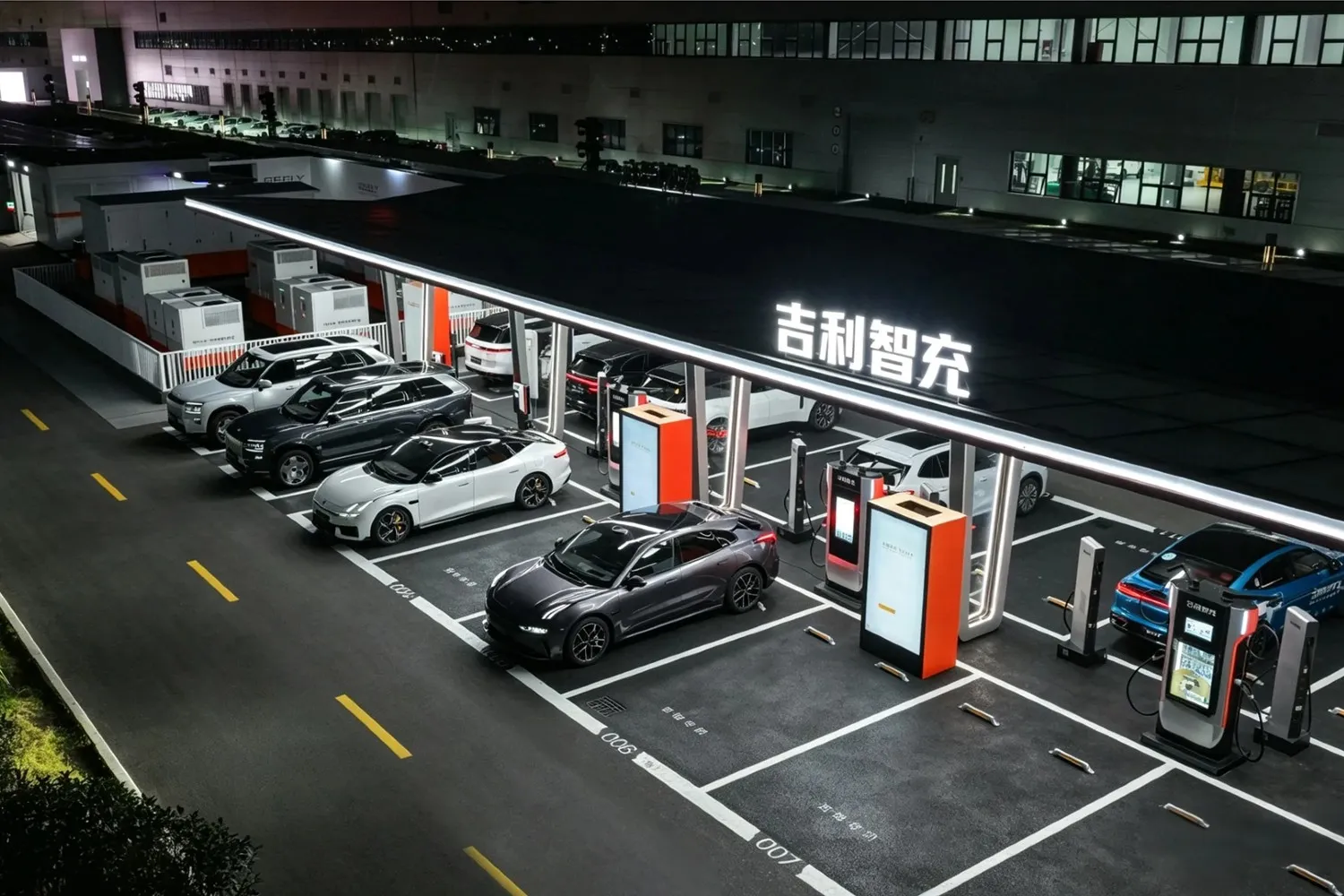
Shortly after unveiling its ultra-fast charging system with a peak power of up to 2,250 kW, Geely has begun rolling out a corresponding charging network. Reports indicate that fast-charging stations have already appeared in five Chinese cities under the name "Smart Charging C12".
Image: Geely
According to Chinese media reports, Geely has already installed its new ultra-fast charging technology in charging parks in Hangzhou, Shanghai, Ningbo, Jiaxing and Xi’an after unveiling the technology just last week. According to the manufacturer, the charging devices have a peak power of 2,250 kW per connection. This reportedly enables EVs from Geely’s brands Zeekr and Lynk & Co to charge from 10 to 97 per cent in less than nine minutes. In China, it is seen as a counter to BYD’s megawatt charging technology for passenger cars, which reaches a maximum of 1,500 kW.
Geely reportedly calls its megawatt fast-charging stations ‘Smart Charging C12’, with C12 likely referring to the maximum charging rate of 12C. The C-rate is a measure of the charging or discharging speed relative to the battery’s nominal capacity. A rate of 1C means that the entire battery capacity is charged or discharged in one hour (60 minutes). At 12C, this would theoretically take five minutes. However, since this is the maximum rather than the continuous charging rate, the actual result takes longer.
Currently, the Zeekr 001 and the Lynk & Co 10 in Geely’s portfolio can utilise the high charging power to some extent. _Car News China_ reports that both achieve a peak charging power of 1,100 kW. However, Geely is reportedly already developing a 1,000-volt high-voltage architecture to reduce the charging time from 10 to 80 per cent to under 5.5 minutes. Currently, the two mentioned EVs operate on 783 V and 773 V systems, respectively.
Geely made its move public last week in Ningbo – in the form of a new 12C battery (“Shendun Golden Battery”) combined with the fifth generation of its charging devices. As mentioned, on paper, the technology surpasses BYD’s Flash Charging column introduced in March, which can deliver up to 1,500 kW to vehicles with the second generation of BYD’s Blade Battery via a single connection.
To manage the high charging power, Geely uses a model developed jointly with the Chinese AI company StepFun, called “Xingrui PowerMind”. This control system connects the vehicle, battery, charging station, cloud, power grid and stationary storage, continuously adapting the charging strategy. The system is said to predict battery temperature up to 30 seconds in advance and adjust the charging power accordingly.
Geely states that it aims to keep the average temperature during fast charging below 55 degrees Celsius and the peak temperature below 65 degrees. The thermal management is supported by a special liquid cooling system that extends from the stationary battery storage through the charging station, cable and charging connector to the vehicle battery.
The competition for extremely short charging times in China has intensified significantly in recent months. It is increasingly not just about the battery and vehicle, but also about building the appropriate megawatt charging infrastructure. BYD had already installed 10,000 of its Flash Charging stations by the end of August and aims to reach 20,000 by the end of 2026. Battery manufacturer Sunwoda also recently unveiled a fast-charging battery and plans to build 10,000 megawatt-class charging stations by the end of 2027.
Geely plans to roll out its new megawatt chargers not only in China but also in Europe – specifically in Germany. In a press release we have seen, Geely announces its intention to focus on the German market through its subsidiary Geely Auto. The company is specifically seeking “local partners to jointly build ultra-fast charging stations with a charging capacity of up to 1,000 kW.” Here, too, the “Xingrui PowerMind” AI system will enable these high charging capacities. However, the 12C charging standard, which is being pursued in some parts of China, is apparently not currently being considered for Europe. Geely does not specify a timeframe for the development of a charging network in Europe.
Info via email, carnewschina.com
