
GDDKiA signed the final contract for reconstructing A2 worth 1.3 billion złoty. Drivers face years of difficulties!
In short:
Why did GDDKiA deem the expansion of A2 necessary?
Who will carry out the various sections of the project and how much will the work cost?
How will construction proceed while maintaining traffic on the highway?
Why is the rebuilt A2 set to become Poland’s first energy-independent highway
GDDKiA: A2 between Łódź and Warsaw with all contracts in place
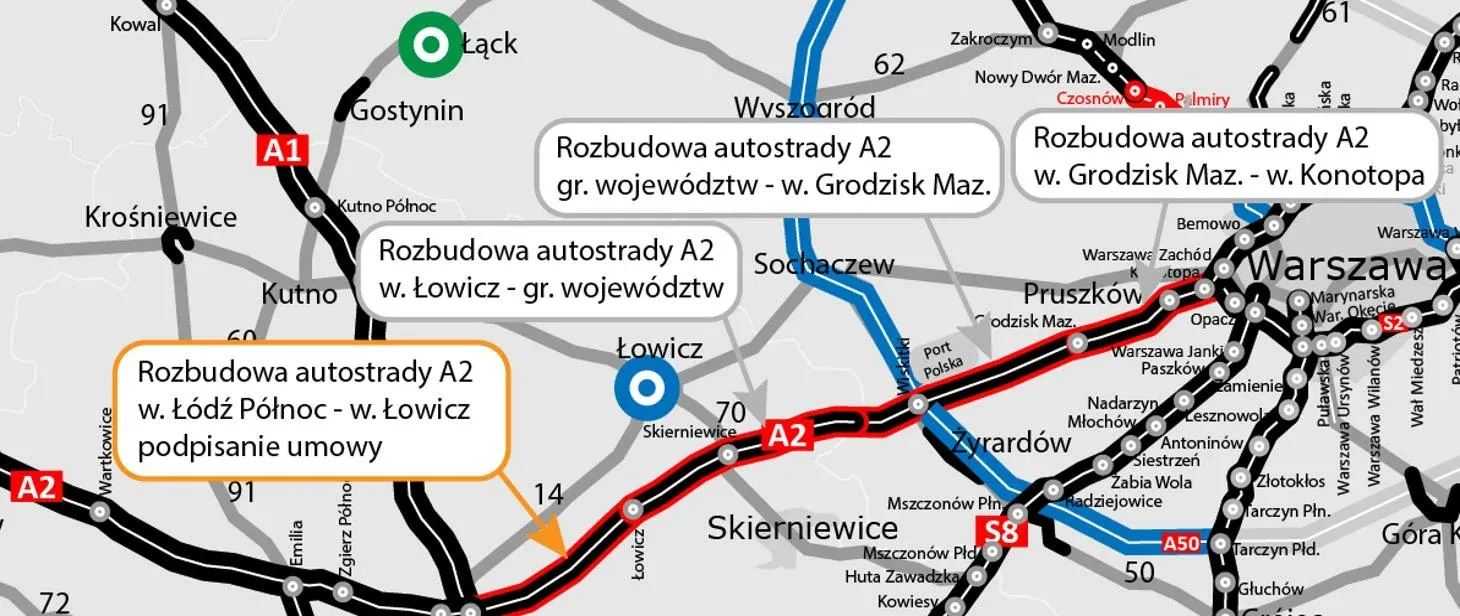
After months of bidding procedures and appeals, the General Directorate of National Roads and Highways (GDDKiA) finalized all contracts related to the expansion of highway A2 between Łódź and Warsaw. The signing of the final contract means that the project, covering over 90 km of one of the country’s most important routes, can now proceed according to schedule.
The key step was the signing of a contract to expand the nearly 28-kilometer section between the Łódź Północ and Łowicz interchanges. Budimex was chosen as the contractor, with the contract value exceeding 453 million złoty. According to GDDKiA, the contract could be signed after a ruling by the District Court in Warsaw, which upheld an earlier decision by the National Appeals Chamber regarding the selection of the most favorable bid. This marked the completion of the formal process related to choosing the contractor for the final section of the project.
Previously, three contracts were signed with Strabag. These cover the sections from Grodzisk Mazowiecki to Konotopa, from Łowicz to the border between Łódź and Mazowieckie voivodeships, and from the voivodeship border back to Grodzisk Mazowiecki. The total value of these contracts is around 871 million złoty. Together with the contract for Budimex, the total cost of the entire project amounts to nearly 1.3 billion złoty, according to gov.pl.
The highway’s capacity is nearing its limit
Highway authorities do not hide that the expansion of A2 is a response to the rapidly increasing traffic between the country’s center and Warsaw. Recall that the highway was opened to traffic in 2012, but its capacity is now becoming increasingly limited. According to data from the General Traffic Survey cited by GDDKiA, around 60,000 vehicles use the route in the Łódź area daily, while nearly 100,000 vehicles use it near Warsaw. As the highway administration emphasizes, “its capacity is currently nearing its limit,” which is why “adding more lanes is necessary.”
This is not an arbitrary solution. GDDKiA adds that even during the highway’s design phase, land was reserved for future expansion, and some of the engineering structures were prepared for additional lanes.
Three lanes to Pruszków, four lanes to Warsaw
As we reported recently on Elektormobilni.pl, the project will cover a total of 92 km of the A2 highway. Additional lanes will be added over 89 km, while the remaining 3 km involve modernization work in the Łódź Północ interchange area. Once the reconstruction is complete, the section between the Łódź Północ and Pruszków interchanges will have three lanes in each direction. Further on, up to the Konotopa interchange, drivers will have four lanes in each direction.
At the Łódź Północ interchange, where highways A1 and A2 intersect, no widening will be necessary. However, surface replacement and the installation of modern, energy-efficient lighting are planned there.
One of the most challenging road construction projects in recent years
The expansion of A2 will take place with traffic continuing to flow, which significantly complicates the entire project. GDDKiA describes the project as “one of the most difficult and complex investments in recent years.” A particular challenge will be managing traffic during construction. According to road officials, drivers heading either toward Warsaw or Poznań will have two lanes available throughout the construction period. This solution is intended to minimize the negative impact of the work on passenger and freight transportation.
According to Portal Samorządowy, section-specific speed monitoring will also be implemented on the section under reconstruction. GDDKiA argues that a similar approach proved effective during the construction of highway A1 between Tuszyn and Częstochowa, improving safety levels.
The first disruptions will occur with the introduction of temporary traffic arrangements, which include setting up barriers, vertical signage, and installing new horizontal signage.
Timeline until 2028
The work on the Łowicz – border between Łódź and Masovian voivodeships section and the Grodzisk Mazowiecki – Konotopa section will be completed fastest. In both cases, the completion date is set for the end of 2027.
The section between the voivodeship borders and the Grodzisk Mazowiecki interchange is set to be completed in January 2028. The reconstruction of the Łódź Północ – Łowicz section, carried out by Budimex, will be finished at the latest. According to the schedule, work there is expected to last until April 2028.
Poland’s first energy-autonomous highway
One of the most innovative elements of the project will be the energy solutions. GDDKiA announces that the expanded A2 section will become Poland’s first energy-autonomous highway.
The lighting, weather stations, and other devices necessary for the route’s operation will be powered by energy from renewable sources. The system will also be supported by energy storage units. According to road authorities, this solution is intended to serve as a model for future road projects in Poland.
Oskar Włostowski