
GAC is developing a motor with 99.03% efficiency to improve range without enlarging the battery.
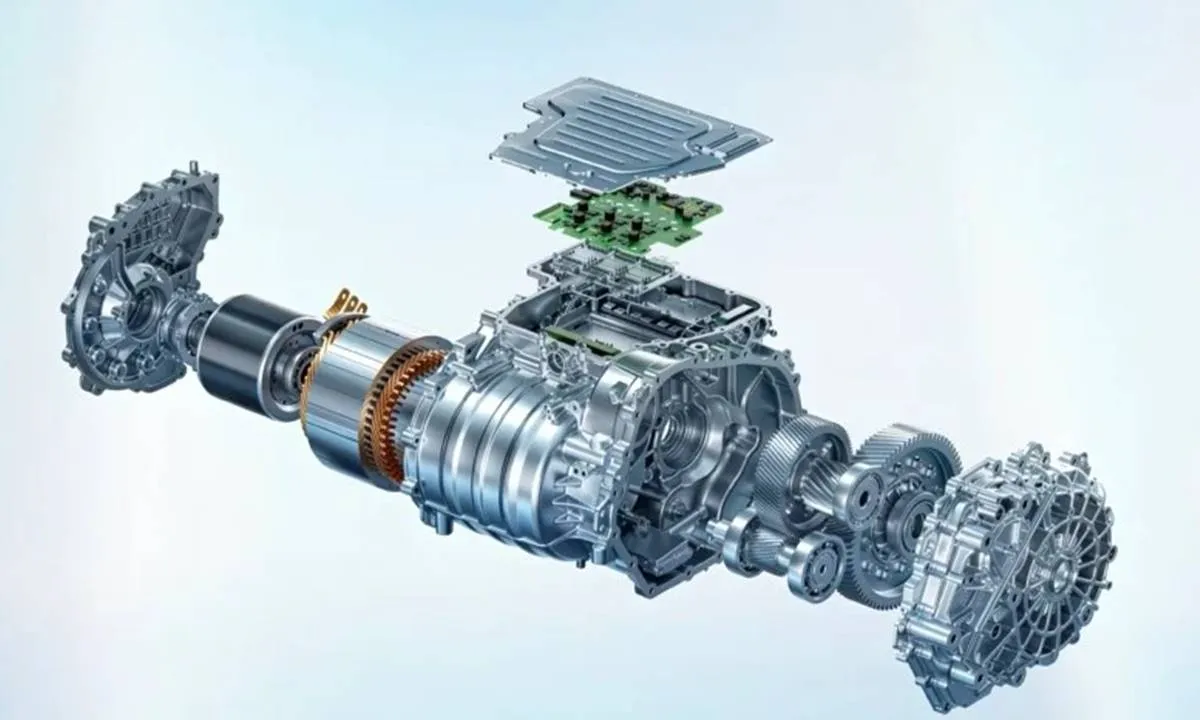
Improving the range of an electric car doesn’t solely involve installing a larger battery. There is also room to make better use of the available energy by reducing losses in the propulsion system. GAC has unveiled new details about its Quark 2.0 technology, a solution that combines advanced magnetic materials with carbon fiber to create more efficient, lightweight, and compact engines.
Developed in collaboration with nine other organizations, this project received one of the early awards in the 2026 China Society of Automotive Engineers Science and Technology Awards. Beyond the recognition, what’s interesting is how GAC is translating this technology into mass production and the improvements it promises for its vehicles.
The most striking figure is a maximum engine efficiency of 99.03%, which, according to the available information, has been certified by China’s automotive research institute, CAERI. This means that under its most favorable operating conditions, the engine converts almost all the electricity it receives into mechanical energy, with losses of less than 1%.
It’s important to distinguish this figure from the overall propulsion system’s performance. GAC’s integrated system, which combines twelve functions into a single unit, achieves an efficiency of 94.184% under CLTC operating conditions. These are different measurements: the engine’s maximum efficiency does not represent its continuous performance or the car’s overall efficiency from the battery to the wheels.
25-micron sheets and carbon fiber to reduce losses
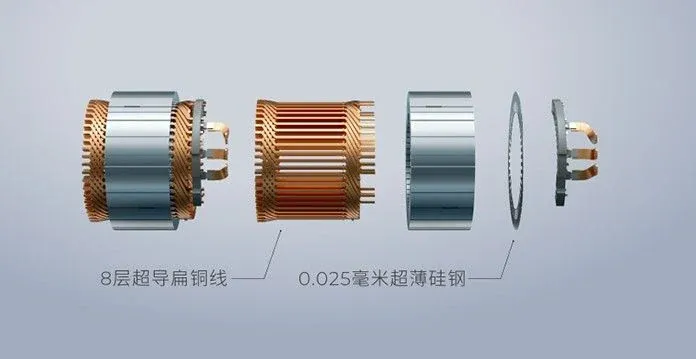
One of the key elements of the Quark 2.0 lies in the stator, the fixed part of the motor. GAC replaces conventional silicon steel laminations with strips of amorphous magnetic alloy that are only 0.025 mm thick, equivalent to 25 microns. Its non-crystalline atomic structure helps reduce magnetic losses, especially when the motor operates at high frequencies.
According to the manufacturer, the core loss in the stator is approximately 5.7 W/kg, roughly half that of the ultra-thin silicon steel used as a reference. The challenge lies in manufacturing these components: the strips are fragile and require specific processes for handling, cutting, and stacking. To address this, GAC has developed automated equipment capable of working with material over 240 mm wide.
Another key component is the rotor, the rotating part. It features a carbon fiber coating only 1 mm thick, designed to contain the forces generated when it rotates at high speeds. This solution enables speeds of up to 30,000 rpm and, compared to a thicker metal coating, reduces mass while allowing for a smaller magnetic gap between the rotor and stator.
The system achieves a claimed power density of 17.29 kW/kg, equivalent to about 23.5 horsepower per kilogram. This is a ratio of power to mass, not the total power of a specific engine. This figure represents an improvement over the production milestone reported by RuiPai’s subsidiary in August 2024, when it announced 13 kW/kg, around 17.7 horsepower per kilogram, and a maximum efficiency of 98.5%.

To ensure that carbon fiber can withstand the stresses within the engine, GAC has also developed specialized manufacturing solutions. Plasma treatment of the metal core improves the strength of the bond with the composite material by more than 40%. Additionally, it uses a resin designed for 180 degrees Celsius temperatures, compatible with exposure to the fluid used in oil cooling.
The automated winding process keeps the voltage variation of the filaments within a ±5% range. Though it is a subtle detail, it is crucial for distributing forces evenly around the rotor. Manufacturing a unit capable of rotating at such speeds requires consistent precision from engine to engine.
For drivers, GAC promises a reduction in fuel consumption of about 4% and an increase in CLTC range of 30 to 50 kilometers without increasing the battery capacity; according to our estimates, it’s 26 to 44 kilometers WLTP. These are improvements announced by the manufacturer, with actual results depending on the model, its configuration, and usage conditions.
Production is handled by RuiPai Powertrain Technology, a GAC subsidiary, at a facility in Guangzhou with the capacity to manufacture 100,000 units per year. According to the group, the technology has already entered mass production for Hyptec and Aion models, including the 2027 Aion i60. However, this manufacturing capacity alone does not equate to the total number of engines produced or delivered to date.
The advantage of this advancement lies in achieving more mileage without adding a battery, and thus avoiding the weight and cost associated with increasing its capacity. It remains to be seen how much these improvements translate to road consumption, but the direction is clear: even in already highly efficient electric motors, materials and manufacturing processes can still yield useful gains.