
Electric vans see decline after summer peak. Unrae: “Help needed for fast charging stations”
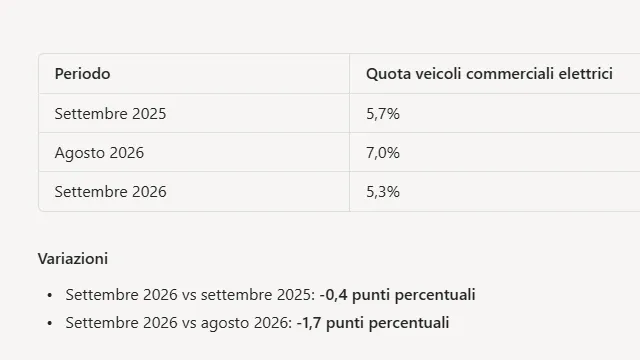
The incentive effects for electric vans are diminishing, shared with internal combustion engine vehicles. After reaching a peak of 7% in August, their market share in registrations dropped to 5.3% in September. This figure also shows a slight decline compared to September 2025, when it was 5.7%. Structural measures are needed to support the transition: the automotive fund provides incentives until 2030. On the charging front, Unrae, through its president Roberto Pietrantonio, calls again for national planning of infrastructure, a reduction in energy costs, and the introduction of a 50% tax credit for private investments in high-power charging stations exceeding 70 kW.
A declining market, not just for electric vehicles
Unrae data shows that after the summer period marked by a decline in July and a recovery in August due to the introduction of incentives, Italy’s light commercial vehicle market contracted again in September. Registrations dropped to 15,737 units, a 6.9% decrease from 16,899 units recorded in the same period of 2025. The share of electric commercial vehicles stood at 5.3%, slightly down from 5.7% in September 2025, and back to more normal levels after the 7% peak seen in August with the incentives in place.
"The overall market situation in September and the adoption of zero-emission vehicles do not seem to be influenced by incentives, with their residual effects likely to spread across the market in the coming months. It is once again confirmed that one-time measures that are quickly exhausted are not sufficient to establish a stable growth trajectory." These are the words of Roberto Pietrantonio, President of Unrae.
To boost electric vehicles, tax credits for fast charging stations and affordable electricity are needed.
"At the national level, advancing the energy transition for freight transport requires concrete enabling conditions: it is necessary to extend the infrastructure planning already in place for heavy vehicles to light vehicles, reduce energy costs for charging, and introduce a 50% tax credit for private investments in high-power charging stations (over 70 kW) during the 2027–29 triennium."

This is the president’s solution. We should also note the issue of access to historic centers, which is facing restrictions as shown by Rome’s case, yet in the Netherlands zero-emission zones have boosted battery-powered logistics.
In the nine months, plug-in vehicles grew by 2.1%, hybrids by 13.1%, while electric vehicles declined by 0.6%
In terms of propulsion types, diesel vehicle sales dropped in September, accounting for 75.2% of total sales (-5.4 percentage points, down to 77.7% on a year-to-date basis). Gasoline engines continued to decline, losing 0.4 percentage points to account for 3.5% of sales in September and 3.6% over the nine months. CNG vehicles remained at 1.2% in September and 2% on a year-to-date basis. Plug-in vehicles saw their share rise to 1.6% in September and 2.1% from January to September. BEV vehicles dropped to 5.3% in September (-0.4 percentage points) and 3.9% on a year-to-date basis, a decrease of 0.6 percentage points from 4.5% a year earlier, while hybrid vehicles doubled their share to account for 13.1% of total sales (10.8% from January to September, an increase of 3 percentage points).
READ ALSO: Laguida on incentives and watch the VIDEO
Previous Article
Volvo news: SUV with 810 km range, truck with 700 km range plus loader and excavator
Next article
Used Chinese electric vehicles: discounts and high fuel prices drive prices up by 280% in Europe