
The Freelander 8 received 5,000 firm orders in 12 hours. It’s more of a Chinese EREV with a JLR logo than a new Land Rover.
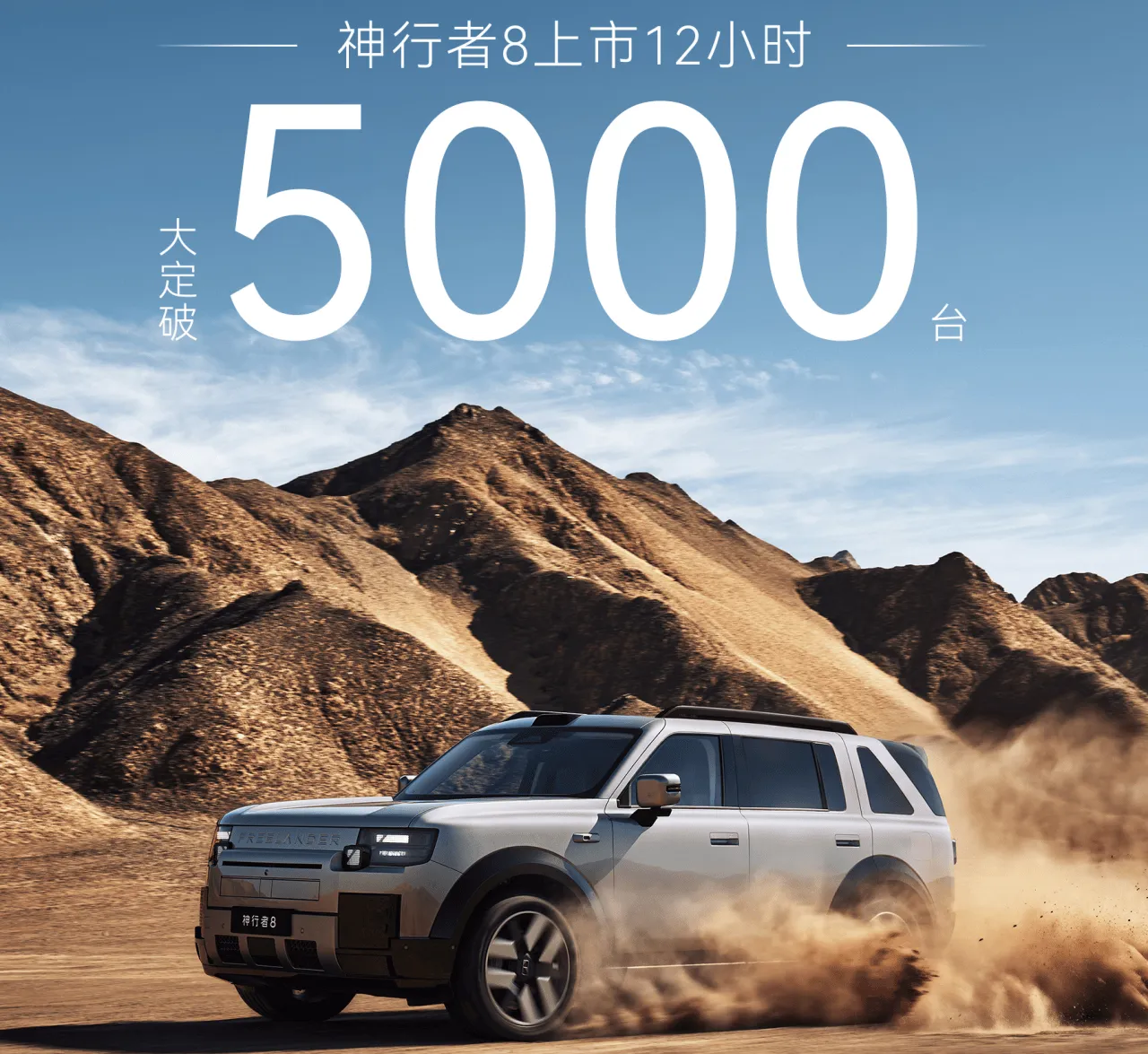
The Freelander 8, the first model developed jointly by Chery and Jaguar Land Rover, went on sale in China on September 3 and received 5,000 firm orders within 12 hours. It is a large, boxy SUV with range extender power, an 800 V architecture, a 60.3 kWh CATL battery, and a system power output of 610 kW.
Table of Contents
Show
Hide
What’s most interesting, however, isn’t just the speed of the orders. What’s more intriguing is how much this car reflects the new power dynamics in Sino-Western joint ventures.
Freelander specified that these are “firm” orders, meaning pre-configured options that customers cannot simply change for free. Reserving through the app requires a deposit of 5,000 yuan.
The price list with launch incentives starts at 289,900 yuan and goes up to 379,900 yuan. Without these time-bound bonuses, the price is higher, ranging from 309,900 to 399,900 yuan depending on whether it’s a 5- or 6-seater version.
This is important because the goal of 5,000 orders didn’t appear out of nowhere. The manufacturer added a bundle of benefits valued at up to 166,000 yuan. These include a bonus for trading in an old car, a purchase tax discount, an additional subsidy for the Huawei ADS 5 package, and free or discounted optional features. In short, the promotional price was set aggressively.
Even before sales started, the model received over 10,000 reservations within 48 hours of the pre-sale launch. On top of that, the price after the launch turned out to be about 50,000 yuan lower than the previous pre-sale price. Such momentum usually boosts sales significantly, and it clearly had that effect here.
Given Xiaomi’s high-profile launches, this hasn’t yet reached the level of buying frenzy. But compared to more traditional brands and large premium SUVs, the results look solid.
This isn’t a classic Land Rover. It’s a Chinese EREV in a Western suit.
The Freelander 8 features a body design created by Jaguar Land Rover, and indeed the British flair is evident here. The car is tall, upright, boxy, and aims for the same image that Land Rover has been selling for years. The difference is that there’s no Land Rover logo on the body; it reads Freelander instead.
And that says a lot.
The car’s technical components mainly come from China’s new energy vehicle supply chain. The platform, range extender system, battery, onboard electronics, and driver assistance systems are much closer to those of Chery, CATL, Huawei, and Qualcomm than to those of traditional JLR. This is not accidental but a trend evident in other Chinese joint ventures as well, such as the Toyota-GAC models or the new Dongfeng Nissan series.
For customers, this means one thing. If someone views the Freelander 8 as just another Land Rover, they might be surprised. But if they see it as a Chinese EREV model with strong JLR support in terms of design and positioning, the picture becomes much more accurate.
800 V, 60.3 kWh, and 310 km on electric power per CLTC
The Freelander 8 uses an 800 V architecture and EREV drive, meaning it has a battery charged from the wall outlet as well as a combustion engine generator to extend range. Under the hood is a 1.5-liter range extender, with energy stored in a 60.3 kWh LFP CATL battery.
The claimed electric range is 310 km according to CLTC. For context, CLTC is usually significantly more optimistic than the European WLTP standard, not to mention real-world driving conditions. On paper, this sounds great, but in practice, one should expect a vehicle that can cover a reasonable distance without activating the generator, rather than 310 km everywhere at all times.
The standard powertrain features two engines and AWD drive. The system power is 610 kW, or about 818 horsepower, with a maximum torque of 813 Nm. A 0-100 km/h acceleration time of 4.6 seconds for a vehicle weighing 2,980 kg is impressive, though it also shows how much the Chinese market favors heavy, highly powerful, and large EREV vehicles these days.
Below are the key specifications:
Parameter
Freelander 8
Drive Type
EREV, AWD
Architecture
800 V
Battery
60.3 kWh LFP CATL
Electric Range
310 km CLTC
System Power
610 kW
Torque
813 Nm
0-100 km/h
4.6 s
Body Style
5- or 6-seater
Length
5,118 mm
Width
2,050 mm
Height
1,898 mm
Wheelbase
3,040 mm
Ground Clearance
220 mm
Weight
2,980 kg
Towing capacity
2,000 kg
Large, luxurious, and surprisingly agile for its size
We’re talking about a vehicle with a length of 5.118 m and a wheelbase of 3.04 m, so this is no longer a mid-size family SUV but rather a full-sized behemoth. Yet the manufacturer claims a turning radius of 5.15 m, attributed to its agile rear axle.
The car also features a two-chamber air suspension, a ground clearance of 220 mm, and the ability to tow trailers up to 2,000 kg in weight. The DMC weighs 3,495 kg. Inside, there are 5- and 6-seater configurations, with an interior design aimed at offering a Chinese “everything on board” experience: a 46.3-inch screen under the windshield, a 15.6-inch central display, a 17.3-inch ceiling monitor, massage seats in the second row, a 10-liter refrigerator, and foldable tables.
It sounds a bit like a combination of a lounge car and an expedition vehicle. And that’s exactly the intention.
The Freelander 8 features three differential locks, the i-ATS intelligent off-road driving system developed in collaboration with Huawei, and a 250-kilowatt two-speed rear drive system. The manufacturer also claims it can navigate through 900 mm of water depth. On paper, these specs are impressive. The question is, how many customers will actually take a nearly 3-ton EREV vehicle for 300-400 thousand yuan into rough terrain. Probably a minority, but in this segment, the appearance alone also helps sell it.
Huawei, Qualcomm, and Chinese electronics play the leading roles here
Inside the cabin and in the driver assistance systems as well, there’s no room for nostalgia toward the old automotive world. The Freelander 8 uses the Qualcomm Snapdragon 8397 chip and Huawei’s Qiankun ADS 5 system.
This is an important detail, because just a few years ago, Western premium brands in China tried to sell the advantage of their own technology. Today, they increasingly build cars with Chinese partners, as it’s difficult to compete for customers’ attention without local software, electronics, and ADAS integration.
The Freelander 8 is therefore not just a new model. It’s also a sign that roles are shifting in Chinese joint ventures. Western brands increasingly provide style, heritage, and a premium emblem, while the Chinese side supplies the platform, battery, powertrain, and the car’s digital brain.
What’s next for the Freelander brand?
The Freelander is not meant to be a one-off project. The plan calls for six models over five years, with EREV, PHEV, and BEV powertrains. The first foreign market will be the Middle East, with launches outside China expected from late 2026 to early 2027.
Europe didn’t become its number one market, which isn’t surprising. With current trade tensions, tariffs, and skepticism toward Chinese brands, this direction is simply easier. If the model ever makes a broader entry into Europe, it will be an interesting test: whether premium customers will buy a car with British styling but a Chinese core and Huawei electronics.
The Freelander 8 thus appears to be a vehicle that sells not only performance and features but also a new definition of a joint venture between the East and West. Would you buy such a mix of JLR, Chery, CATL, and Huawei, or is it still not “Land Rover” enough for you?