
Fraunhofer’s X-ray system reveals the inner workings of battery cells
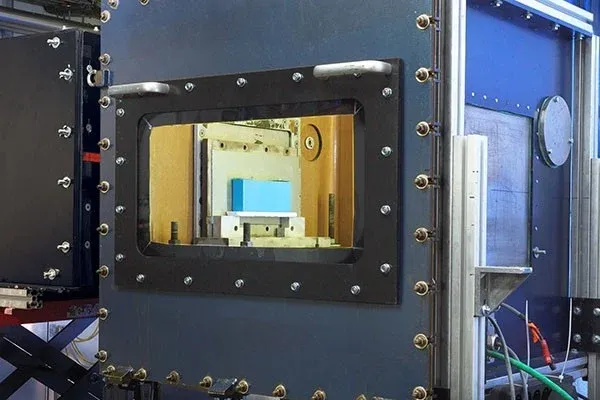
The Fraunhofer EMI has developed a special X-ray technology that makes dynamic processes in large-format prismatic cells visible in real time. Together with Volkswagen's battery subsidiary PowerCo, this technology is now set for industrial application.
The Fraunhofer Institute for High-Speed Dynamics, Ernst-Mach-Institut, describes its innovative X-ray technology as a ‘globally unique high-speed X-ray system’. According to scientists at the institute, it reveals what happens inside large-format battery cells in fractions of a second under stress – and could help accelerate the development of safer cell generations for the European automotive industry.
The approach aims to answer what occurs inside a battery cell when it fails. Until now, cell manufacturers and vehicle integrators have relied on simulations, destructive testing methods, or indirect measurements. However, the method developed by Fraunhofer EMI now enables a direct view into the operating cell. According to the team, the system combines high-performance X-ray technology with a specially developed battery test chamber and comprehensive sensor technology for the simultaneous recording of temperature, pressure, voltage, and gas flow: “Recording up to 1,000 images per second, it reveals processes such as gas formation, material displacement, and crack propagation inside the cell at extremely high resolution—events that until now have remained hidden from view.”
Dr Sebastian Schopferer, Head of Battery Safety at Fraunhofer EMI, emphasises: “Our in-situ method allows us to see what happens inside a cell in fractions of a second—in real time and at the highest resolution. This fundamentally changes how we understand battery design and safety.” A key engineering achievement was the development of a protective chamber that reliably shields sensitive X-ray components from the extreme conditions during the thermal runaway of lithium-ion cells.
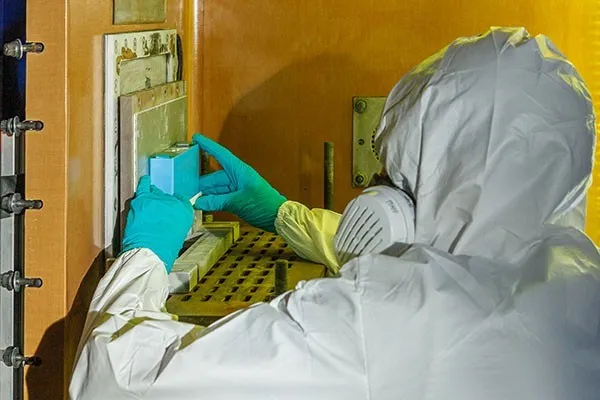
The relevance of this approach is further demonstrated by strong industry interest: Fraunhofer EMI explained it has already characterised material ejection during thermal runaway and propagation behaviour in multi-cell setups for several German car manufacturers, including VW and Audi. According to a statement: “The resulting data enables engineers to assess cell designs based on directly observed processes and refine simulation models with greater precision—delivering direct added value for product development and certification processes.”
The project is closely linked to PowerCo, Volkswagen’s battery subsidiary. During its next stage, Fraunhofer EMI and PowerCo aim to jointly transition the technology into industrial application. The institute contributes its expertise in materials research, battery abuse testing, and high-speed imaging, while PowerCo provides the requirements for series production and access to real cell types.
Initial results from the collaboration are already being incorporated into the development of optimised series cells at PowerCo. While this still involves logistical effort, there’s an end in sight: by 2028, a corresponding X-ray system is set to be installed at PowerCo’s site in Salzgitter. The system is scalable for various cell formats and new cell chemistries – “an important advantage for the development of future battery generations,” according to the Fraunhofer Institute.
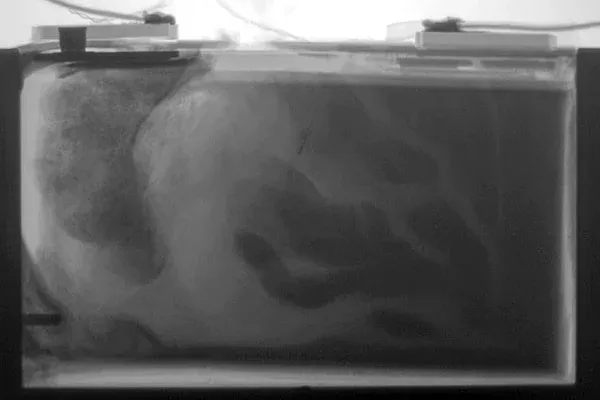
HW Vassen, CTO at PowerCo, commented: “With in-situ high-speed X-ray imaging, we are taking battery research to a new level. For the first time, we can make the dynamic processes inside cells visible in real time and in slow motion. This unprecedented depth of insight allows us to optimize battery cell safety and design in a highly targeted way and bring innovations into industrial use much faster. Together with Fraunhofer EMI, we are advancing high technology made in Europe and are strengthening Europe’s role in the battery industry.”
PowerCo was founded by the Volkswagen Group in 2022 and is responsible for the development and production of the group’s battery cells. The company is based in Salzgitter and is currently building three cell factories with a combined capacity of up to 200 gigawatt-hours per year: in Salzgitter (Germany), Valencia (Spain), and St. Thomas (Canada).