
Fraunhofer ISE increases energy density of battery cells
The Fraunhofer ISE has developed a new architecture for battery cells that is said to enable 10 to 15 per cent higher energy density at the same weight. The approach uses significantly thicker electrodes, which reduces the need for current collectors. This could also potentially be of interest for electric vehicles.
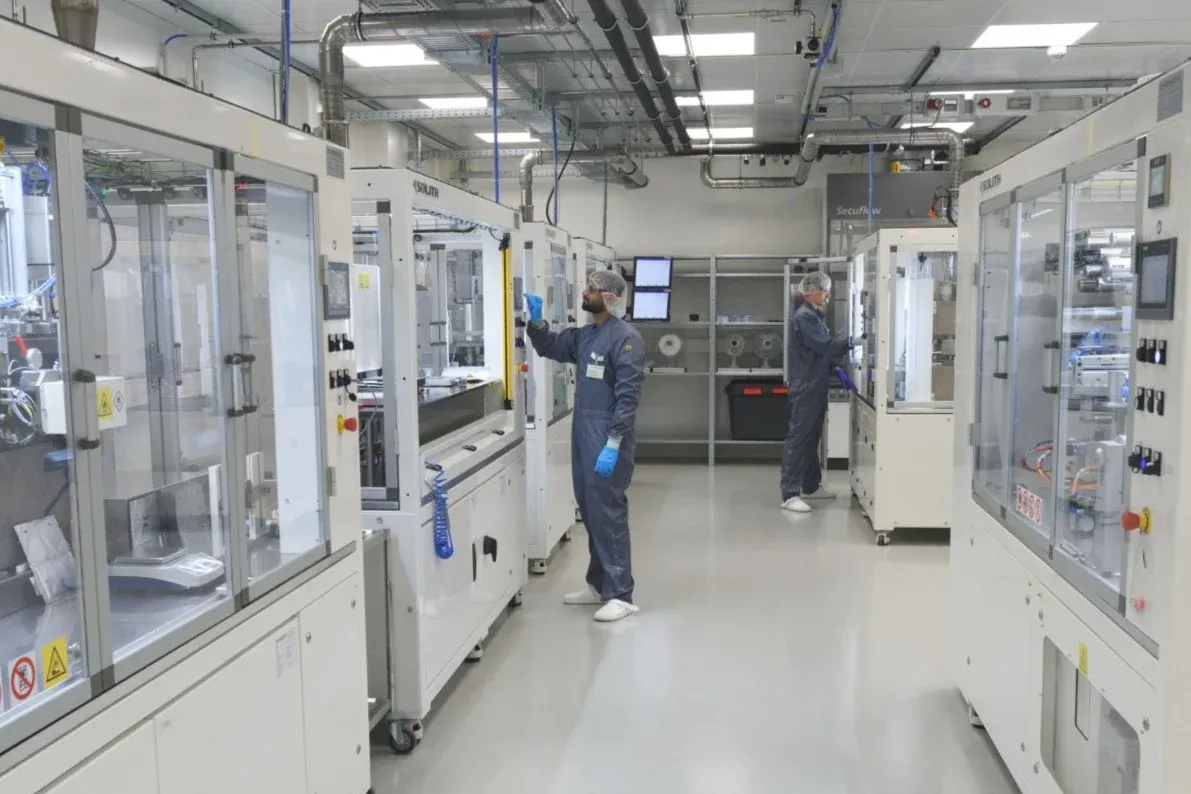
Semi-automated production of battery cells at Fraunhofer ISE
Image: Fraunhofer ISE
Developing battery cells with higher energy density while maintaining the same weight enables more energy to be stored in the same space. This offers advantages for stationary battery storage systems, which were the focus of three research projects funded by the German Federal Government at the Fraunhofer Institute for Solar Energy Systems ISE in Freiburg. The physical insights gained can also be applied to traction batteries for electric vehicles, where higher energy density could extend vehicle range.
In the projects at Fraunhofer ISE, the institute collaborated with various partners to develop a new architecture for battery cells that achieves higher energy density. The researchers focused on the electrodes, increasing their coating thickness by more than threefold: instead of the previously typical 100 to 200 micrometres, they applied coatings of up to 800 micrometres.
Battery cells with 10 to 15 per cent higher energy density
According to the research institution, this has increased the energy density of the cells by 10 to 15 percent, depending on the battery type and design. The reasoning is that, in a battery cell, electrode coatings and current collectors alternate in many thin layers. The coating contains the active material that stores energy, while the current collectors conduct the electrical current. By making the electrodes thicker, fewer of these layers – and thus fewer current collectors – are needed. This leaves more space for active material at the same cell weight.
“Normally, the anode and cathode – the two electrodes of a battery cell -consist of many thin, alternating layers of electrode coating and current collectors,” explains Dr. Oliver Fitz, Group Leader for Battery Cell Technology at Fraunhofer ISE. “We’ve managed to increase the thickness of the electrode coating from the previously standard 100 to 200 micrometers to up to 800 micrometers, thereby significantly reducing the number of current collectors required. As a result, we have much more space for active material, which increases the energy density by 10 to 15 percent, depending on the battery type and design.”
Focus on battery storage system applications
However, the concept is not yet ready for series production. According to Fraunhofer ISE, the project results instead demonstrate a “promising approach toward the future industrialization of this novel electrode and cell architecture”. The new battery cells are particularly interesting for use in battery energy storage systems (BESS), but also in electric vehicles.
The research team developed the new electrode and cell design as part of the projects “VORAN – Innovative Sodium-Ion Battery Storage for Stationary and Mobile Applications” (running until June 2027), “INFAB – Zinc-Ion Batteries for Stationary Energy Storage – Manufacturing and Assembly” (completed), and “WinZIB2 – Globally Deployable, Innovative Zinc-Ion Battery System”, all of which were funded by the German Federal Government.