
Foxconn will pay $727 million for half of Mitsubishi Electric’s division. EVs are part of that business.
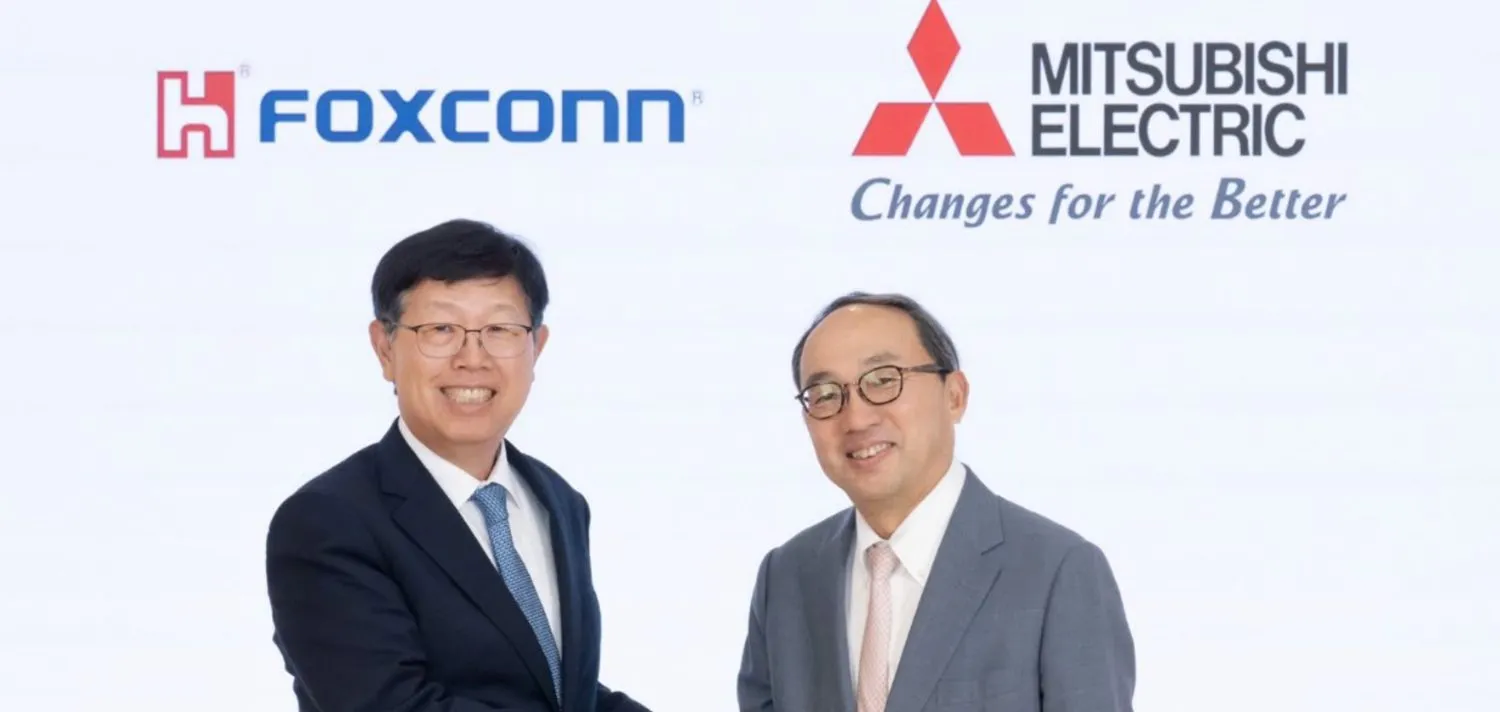
Foxconn agreed in October 2026 to acquire 50% of Mitsubishi Electric Mobility for 115 billion yen, or $727 million. The deal is set to close on October 1, 2027, after obtaining antitrust approvals, with the aim of developing EV platforms for Japanese manufacturers.
Table of Contents
Show
Hide
Formally, the shares will be held by Lin Yin International Investment, an investment firm owned by Hon Hai Precision Industry, also known as Foxconn. The partners will each control half of the company. The total value of the business is estimated at 320 billion yen, around $2 billion, with the equity value at 230 billion yen.
Japanese EV platforms, but traditional business underneath
Foxconn aims to combine its manufacturing scale with Mitsubishi Electric’s electric drives, software, and controllers. Japanese companies are set to be the first clients, with “Made in/by Japan” platforms eventually reaching other markets as well. The goal for the fiscal year starting in April 2030 is to achieve revenues exceeding 1 trillion yen, or about $6.3 billion.
Jun Seki, Foxconn’s strategic director for EVs and a former Nissan manager, described Mitsubishi’s control electronics as the “most attractive element” of the deal. The company is expected to serve as Foxconn’s “anchor in Japan” and a base for collaborating with additional suppliers and automakers.
Mitsubishi Electric Mobility is not an EV platform manufacturer. Established in April 2024, the company produces alternators, starters, ignition coils, internal combustion engine controllers and gearboxes, fuel pumps, EGR systems, sensors, and variable valve timing components. In addition, it manufactures electric steering systems, radars, cameras, ADAS controllers, driver monitoring systems, body electronics, and airbags.
The electrical components include traction motors, inverters, battery management systems, EV controllers, and onboard chargers. Before completion, Mitsubishi Electric will integrate its remaining automotive operations, including its foreign subsidiaries. Foxconn is thus acquiring a major Tier 1 supplier with a substantial portfolio of internal combustion engine technologies.
In the fiscal year that ended in March, the company achieved revenue of 875.6 billion yen and operating profit of 54.4 billion yen. The margin was 6.2%, while sales declined by 43.5 billion yen due to weaker performance of Japanese brands in China and restrictions on multimedia operations in North America. The forecast for this year is 820 billion yen, so reaching one trillion requires annual growth of around 5%. Considering it’s a deal viewed through the lens of EVs, the plan is quite conservative.
Foxconn won’t receive semiconductors
The deal does not include SiC and IGBT power modules used in inverters. Mitsubishi Electric is conducting separate talks for this business to merge with Rohm and Toshiba, which began in March. It also failed to establish the previously announced company with Aisin. The project involving traction motors, inverters, and software was announced in May 2024, but five months later it was reduced to a regular partnership.
The price is equivalent to about 0.37 times annual revenue and six times operating profit. The enterprise value is lower than about 352 billion yen in net assets. Mitsubishi Electric expects to record a write-down of 100 billion yen as a result. This appears more like selling shares in a mature, low-margin business than valuing a rapidly growing EV company.
Foxconn has announced its electric vehicle expansion starting in October 2020, when President Young Liu said the company aimed to serve 10 percent of the global EV market, equivalent to about 3 million vehicles, by 2025-2027. Subsequently, there were prototypes from Foxtron, a factory built after GM’s exit in Lordstown, and the Fisker Pear project. Fisker went bankrupt in 2024, the Pear never entered production, and the facility was sold in 2025 for $375 million. Talks about a partnership with Nissan at the beginning of 2025 also did not result in an agreement.
The first traditional manufacturer to place its logo on a vehicle developed by Foxtron was Mitsubishi Motors, separate from Mitsubishi Electric. The ASX VR-e produced by Yulon will be available in Australia and New Zealand. Foxconn also has a bus company with Mitsubishi Fuso and an interest in the Saudi brand Ceer. Acquiring half of this Japanese supplier makes it its largest investment in the automotive sector, but it will be the orders for new platforms that will show whether these announcements lead to actual mass production.
LovEV Newsletter
Want more content like this?
Sign up — we’ll send you a weekly summary once the newsletter starts.