
Forum Weekly Review KW 42/2026: Blocking Fee and V2L
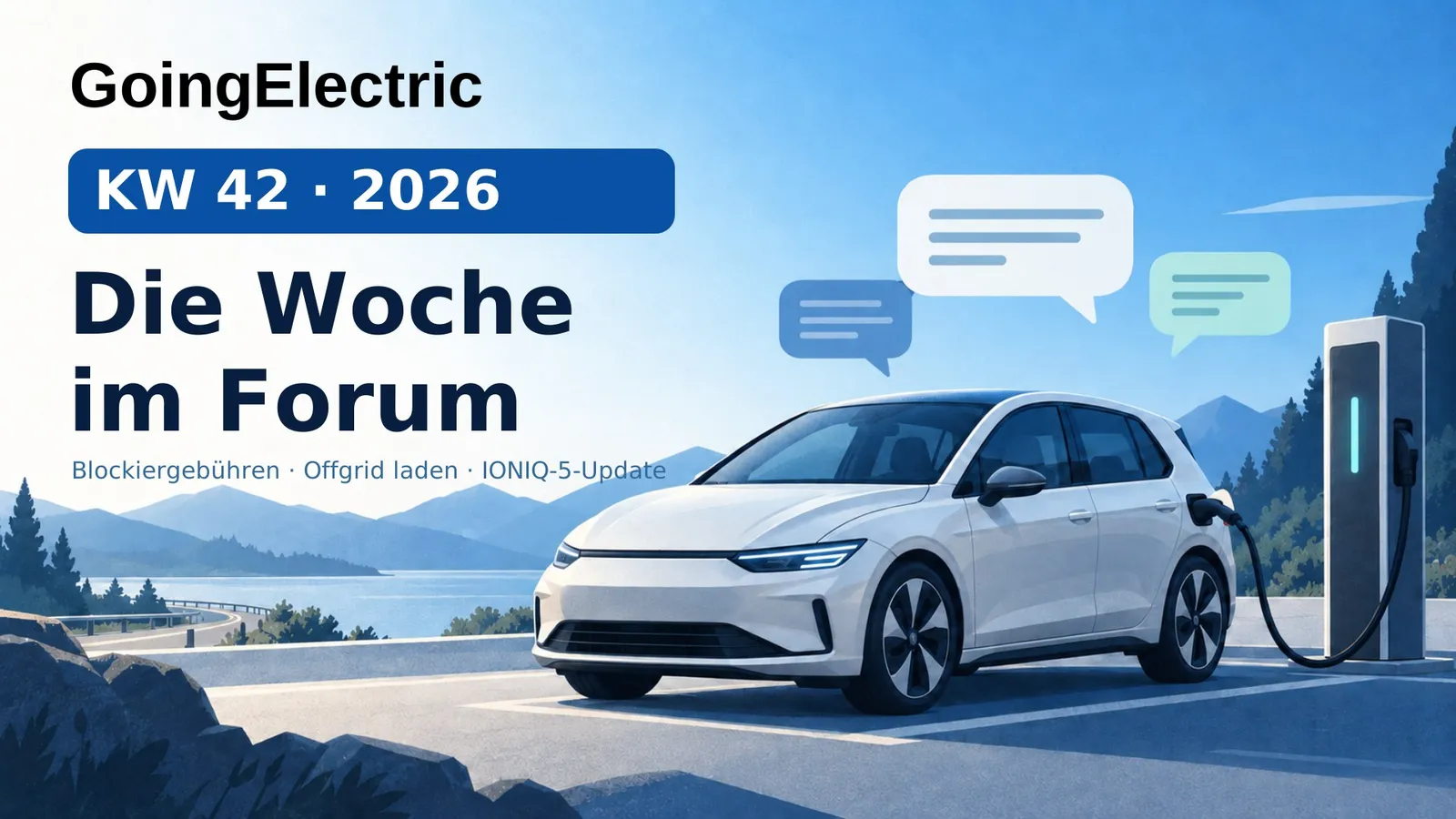
This week on the forum, topics included blocking fees, parking rules at supermarket charging stations, and the verdict in the dispute between DCS and EWE Go over roaming charges. There were also discussions on offgrid charging experiences, a collection of V2L adapters, and reports about battery statistics being deleted after an IONIQ-5 update.
Advertisement
KW 42/2026 · October 11 to 18, 2026
Public Charging: Blocking Fees, Parking Rules, and Roaming Prices
Vienna: Practical test of blocking fees in a garage at Prater
New Topic · 20 Replies · 9 Participants
According to the thread starter, long-term parkers at Best in Parking’s garage in Vienna’s Prater can charge their vehicles at 32 wallboxes for 0.49 euros per kWh. The operator’s website states that a blocking fee equal to half the short-term parking rate applies if the car is not moved within eight hours. It was unclear whether this deadline starts from when the car is plugged in or when charging ends; a query to the operator remained unanswered, per the thread starter.
He decided to test it himself: 9.5 hours parked, just under six hours charging, and no blocking fee. What surprised him was the process at exit. The charging cost is not included in the monthly bill and must be paid in advance at the cash machine using the long-term parking card. In his observation, 30 out of the 32 charging spots were available.
About the practical test at the Prater garage
Supermarket parking lots: App shows “24/7”, but sign does not
24 new replies · 13 participants
In the thread about EnBW charging stations at REWE parking lots with private parking surveillance, a member described a new case from Ludwigshafen. At the Knollstraße location, the EnBW app indicates availability around the clock. However, according to a member who shared a recent photo, a sign allows parking there only from Monday to Saturday between 6 AM and 10:30 PM. He said EnBW refused both verbally and in writing to correct the hours shown in the app. Another member held the property owner responsible, not EnBW.
This led to a debate about whether charging is legally considered parking and whether traffic regulations apply to publicly accessible private parking lots. One member referred to a 2022 BGH ruling regarding a hardware store parking lot. Whether this could be extended to charging remained controversial. Two members suggested marking locations with parking surveillance in apps and charging directories.
On the Ludwigshafen case and the discussion about parking rules
Advertisement
DCS vs. EWE Go ruling: How can higher roaming prices be justified?
18 new replies · 7 participants
The judgment in the DCS vs. EWE Go case addressed whether a charging station operator may charge higher prices to customers using third-party payment cards compared to its own customers. One member cited an industry report stating that EWE Go justified the price differences with administrative costs, customer service, business risks, and customer retention, but the court did not agree. Another member linked to a statement from DCS indicating the decision made by the Munich I Regional Court.
A member mentioned the insolvency risk of the roaming partner with whom the operator settles accounts as a possible factual argument. Another considered this risk real but relevant only in the range of a few tenths of a cent per kWh at most. One member repeatedly emphasized that the judgment is not final.
Discussion on the Judgment
Charging with Own Energy
Offgrid charging: Island systems for electric cars in the garage
New topic · 12 replies · 7 participants
A new member wants to charge his electric car in the garage using an offgrid solar system with storage and is asking for experiences. Two members described existing systems. One of them has been in use for almost three years according to the operator: a 5-kW hybrid inverter, ten solar panels at 400 Wp each, and a storage system that was gradually expanded to nearly 29 kWh. Charging is done at 3.6 kW via a mobile charging unit, with a 11-kW connection available as a backup. According to the meter, the system has generated over 2,000 kWh in twelve months. Another member charges at around 5 kW using a 16-kWh storage system.
The economics of a system whose electricity is used only for the car were also discussed. One member calculated that charging at 16 instead of 10 amps would be more efficient due to the vehicle’s shorter standby time; however, the thread starter still does not want to operate the car and inverter at their maximum capacity. A member pointed out that some chargers will only allow operation once a ground wire is detected, and advised proper grounding for safety reasons.
Experiences with island systems
Advertisement
V2L adapters: Collection organized by manufacturer
New topic · 10 replies · 5 participants
V2L adapters are plugged into the Type-2 connector, causing the vehicle to output alternating current. One member started a summary of how the CP and PP signal contacts are configured in adapters from various manufacturers, including resistance values for MG4, Hyundai, Renault 5, and Smart #. Another member added that the Volvo EX30 works with the Smart #1 adapter starting from a certain software version; upon request, it provided links to two Volvo documents as proof. The entry for newer VW models (MEB+) remains unconfirmed.
According to the thread starter, such an adapter only works if the vehicle has the necessary hardware. It was suggested that the table be added to the GoingElectric Wiki on Type-2 signaling.
Overview of V2L Adapters
Vehicles: Software, batteries, and the ID. Tiguan
IONIQ 5: Drivers report deleted battery statistics after update 26.7.1
7 new replies · 4 participants
Two drivers report consistently that the over-the-air update 26.7.1 on the Hyundai IONIQ 5 deleted the battery management statistics. According to them, this affected the battery’s operating time, the number of AC and DC charges, the energy charged and discharged, and the calculated battery health status. One of them checked this using OBD apps. In one case, the target charge levels were also reset to 100 percent.
A member sees this as a problem for resale because battery certificates read out individual values from the vehicle, and suggests writing to Hyundai. Another recommends calibration so that the health value is recalculated: charge to 100 percent, leave it plugged in for at least half an hour, then discharge to around 10 percent. There is no statement from Hyundai in the thread.
Regarding reports on update 26.7.1
Advertisement
IONIQ Electric: Six weaker cells below 20 percent charge level
New topic · 9 replies · 6 participants
A driver of a 2019 IONIQ electric vehicle with 120,000 km on the odometer recorded cell voltages ranging from 100 to 4 percent. According to his AI-based analysis, six cells were below 20 percent, significantly lower than the others, with a difference of up to 200 mV under load; this caused the battery level indicator to drop much more quickly. Once, he stopped driving because of this. The range display still showed 150 km even with a fully charged battery.
Two members attributed this more to aging than to defects in individual cells. One member reported that multiple low-current AC charges on their vehicle had improved balancing; another advised checking cell behavior at different temperatures and charging older batteries using 50-kW chargers rather than HPC stations. Upon inquiry, the thread starter confirmed longer lifespan at 100 percent charge and attributed the rapid increase in degradation from 4 to 8 percent to a trip to Italy during extreme heat with battery temperatures between 45 and 50 degrees; they now consider this behavior to be normal aging.
About the measurements and tips
Larger battery: When is a TÜV inspection needed?
New topic · 23 replies · 16 participants
The starting point was the question of whether a battery with higher capacity must be registered if it is not listed in the CoC document. Several drivers checked their documents: three i3 drivers found the battery capacity in their registration certificate, two explicitly under item 22, one at 33.2 kWh; a driver of an IONIQ found it listed there in Ah. According to the thread starter, none of his three electric cars had such a specification, and another member found none either in two Renault models. Whether a replacement would affect driving permission remained controversial: one member referred to the StVZO and registration via an expert report, while the thread starter argued that there was no specific legal text on the matter.
A member mentioned an upgrade project for the Mitsubishi i-MiEV, Peugeot iOn, and Citroën C-Zero, in which one of the participants is in contact with a TÜV expert. According to his assessment, as summarized on the forum, the original battery housing should remain intact and the cells must fit within the original module boxes; he would approve minor adjustments if stability is ensured. He does not consider higher capacity to be relevant for EMV issues, but the modified control electronics are; no separate EMV testing is necessary if the components have already been tested in other electric vehicles.
Discussion on installing larger batteries
VW ID. Tiguan: Prices, purchase incentives, and headroom
30 new replies · 9 participants
A member shared a report stating that the ID. Tiguan is now available for ordering, with the configurator showing prices starting at 42,695 euros for the Trend version equipped with 140 kW (190 hp) and a 58-kWh battery; the ID.4 remains available as before. According to another member, the model is now listed in VW’s purchase incentive table, with 4,000 euros for the Trend and Life versions and 5,000 euros for the Style version.
A lot of attention was paid to headroom in the back seat. One member referred to YouTube tests showing it is tighter; another cited a tester who said they could sit comfortably in the back with a height of 1.87 meters. A third found no significant difference in the dimensions from the ID.4 according to the configurator. An ID.3 driver mentioned his brother having issues with the 12-volt battery and slow charging in cold weather while using an ID.4 GTX, and believes the ID. Tiguan addresses many of these problems; however, they consider the list price to be too high. Another member sees the ID. Tiguan as merely a facelift.
Discussion about the ID. Tiguan
Which of these discussions have you followed, and what experiences do you have with blocking fees or parking rules at charging stations?