
Ford is recalling 36,000 units of the electric Transit City due to a defect.
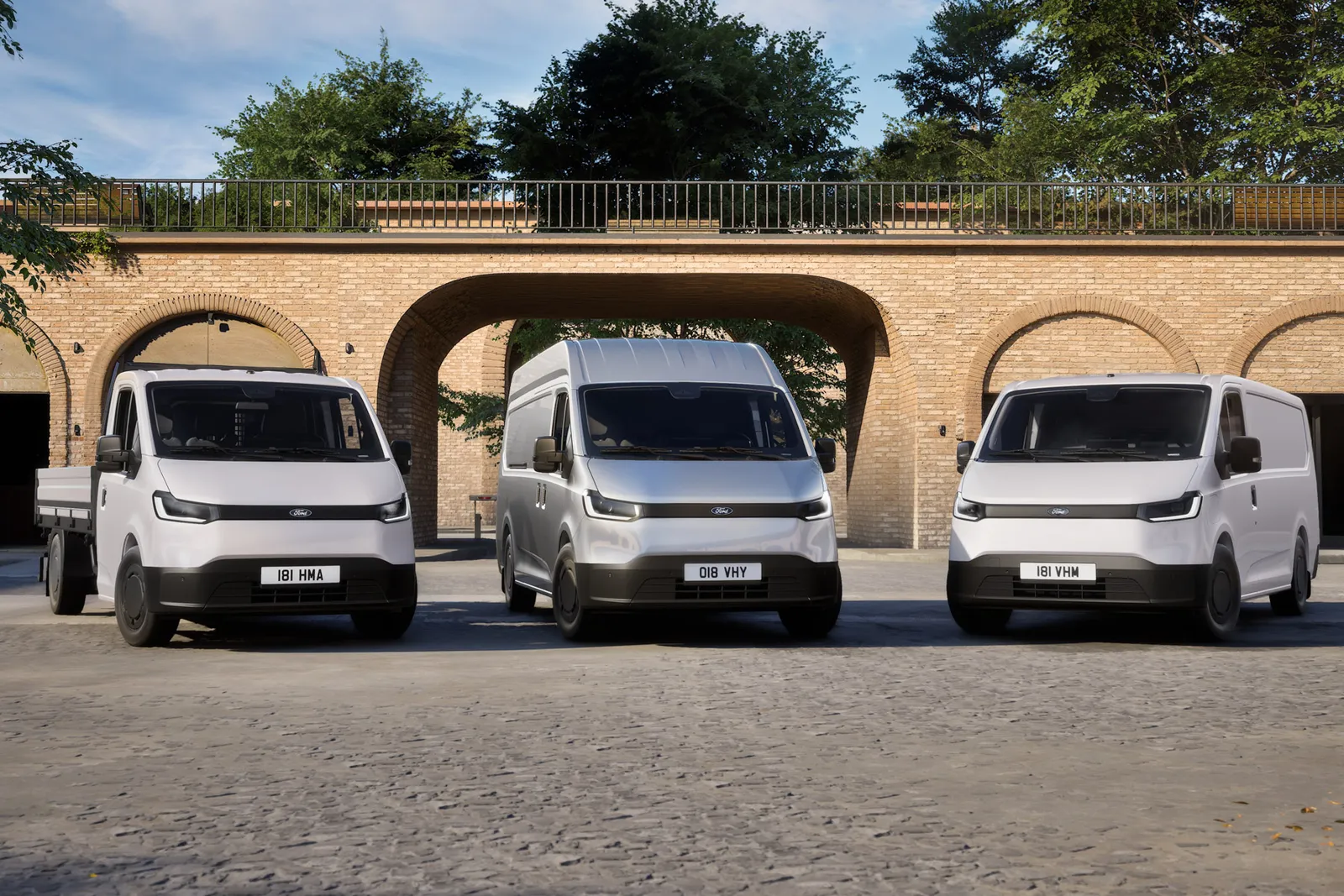
The Ford Transit City is now available for ordering in Germany. Prices for this compact electric van start at 35,990 euros, excluding value-added tax. The new Transit City is already the fifth member of Ford’s Transit family – but the first one available solely as a battery-electric model.
Ford Pro announced the new Transit City in March as a “particularly cost-effective” van. Back then, the American manufacturer hinted that the new model would be a streamlined version focusing on essential features. Now the prices have been revealed: in Germany, the Transit City in L1H1 configuration starts at 35,990 euros net or 42,828.10 euros gross. Ford Pro lists the L2H2 variant with a larger cargo space at 38,490 euros net or 45,803.10 euros gross. Another chassis variant available costs 37,990 euros net or 45,208.10 euros gross.
In background: Ford Pro is in a strong position in the electric van segment: From the large Transit to the Transit Custom, and up to the boxy Transit Courier, the automaker’s commercial vehicle division already offers electric-powered models in various size classes, always identifiable by the preceding “e-” prefix (plus the Transit Connect as a plug-in hybrid). The newly introduced Transit City lacks this “e-” prefix; it is not called the e-Transit City — no distinction is needed here, as the Transit City is available only in pure electric form, without internal combustion engines.
Similar in size to the Transit Custom — but cheaper
In terms of dimensions, the new van is roughly on par with the e-Transit Custom, but it targets a different, more price-sensitive audience. It is intended for delivery and courier services, tradespeople, and service providers in urban areas who have different requirements for their vehicles compared to those used for long-distance travel.
Regarding power, all variants of the new model feature an 110 kW electric motor on the front axle, a 56 kWh net capacity LFP battery in the underfloor area, and a WLTP range of up to 254 kilometers (381 km in the city cycle). Ford emphasizes that this is “more than double the average daily distance traveled by 90 percent of all commercial vehicles in this segment.” In other words, the Transit City is sufficient for daily trips but requires frequent charging.
A 11 kW AC charging point takes 4.5 hours to charge the battery from 10% to 80%, so it will be fully charged overnight. At a DC charging station, the battery can be charged at up to 87 kW, with the standard charge from 10% to 80% taking only 33 minutes—making it feasible during a typical lunch break. Additionally, Ford Pro assists its customers in configuring and installing appropriate charging solutions at home or at the workplace.
Let’s talk about the Transit City’s body style and payload capacity: This front-wheel-drive commercial vehicle will be available by year’s end in a van version with the two different wheelbase and height options mentioned earlier, as well as a chassis with a single cab. The larger L2H2 version (5.29 meters long, 3.36 meters wheelbase) offers a loading length of over three meters, a permissible payload of 1,275 kilograms, and a cargo space of just under eight cubic meters. Like the smaller L1H1 variant (4.99 meters long, 3.06 meters wheelbase), it can transport three Euro pallets simultaneously. The L1H1 provides approximately six cubic meters of loading volume and a payload capacity of 1,085 kilograms.
Standard equipment – no extras
The Transit City being a budget model is evident, among other things, by the lack of a trailer hitch. Those who want to pull loads with their electric van must turn to Ford’s e-Transit Custom, which allows for a towing capacity of up to two tons. To keep costs low, both van versions come equipped with what Ford Pro calls “universal” features—without any optional extras. This unified configuration is designed to reduce complexity; it includes items such as a durable cargo floor, low side panels, and tie-down points. Standard features at launch also include seat heating, a rearview camera, as well as front and rear parking sensors—plus a 12-inch touchscreen in the cabin with Apple Carplay and Android Auto.
What Ford does not specify in the announcement is the origin of the model. It is not a stripped-down version of the e-Transit Custom with an LFP battery and simpler features, but rather a completely different model that is not even originally from Ford: According to a previous report by “Auto, Motor und Sport,” the new Transit City “comes from a Chinese partner” — specifically Jiangling Motors, in which Ford holds a 32 percent stake. With this model purchased from East Asia, Ford Pro aims to reach customers for whom the e-Transit Custom (starting at 57,953 euros gross) is too expensive.
So will Ford Pro, currently the market leader in the van segment across Europe, be able to retain customers within its own brand ecosystem? After all, in the electric vehicle segment, Chinese brands already offer cheaper models, and Kia has the PV5 Cargo — here is our test report on its passenger version — which also comes at a very competitive price. Ford aims to attract existing customers by allowing the Transit City, like its current models, to integrate into its own ecosystem, for example through Ford Pro Telematics.