
Ford exports electric vans from China to Europe
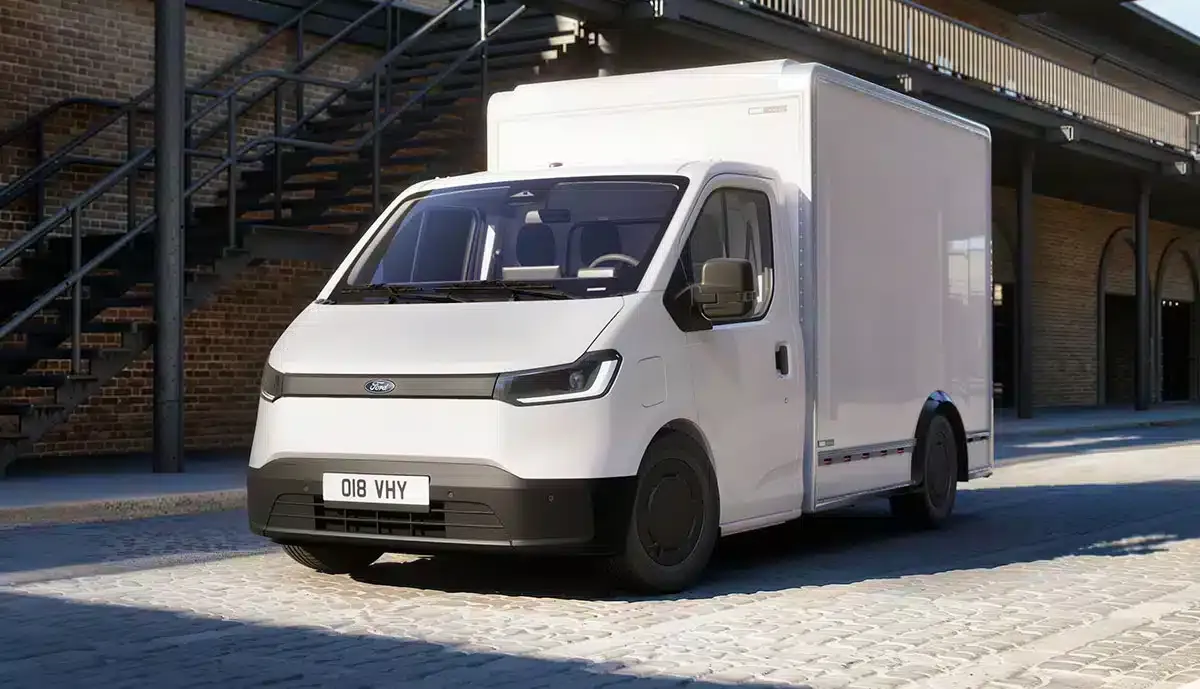
Image: Ford
Ford Motor Co. is expanding its export strategy by delivering the first batch of around 1,000 electric vans produced in China to Europe. According to Automotive News, this move continues the company’s approach of using China as a global manufacturing site.
Under the theme “In China, For the World,” the manufacturer recently announced in the People’s Republic that it plans to expand exports of the Transit City to 52 countries and regions across five continents. The electric van is already available for ordering in the European market, including in Germany, with deliveries to customers set to begin by the end of the year.
The Transit City was developed as a cost-effective model for urban delivery operations. This electric vehicle was created through a joint venture between Ford and China’s Jiangling Motors Group, and it is manufactured at the Xiaolan plant in Nanchang.
The Transit City features a loading length of over 3 meters, a cargo space of up to 8 cubic meters, and a maximum payload of 1275 kilograms. Its electric motor delivers 110 kW (150 horsepower) and is connected to a lithium-iron-phosphate battery (LFP) with a usable capacity of 56 kWh. This gives the electric van a range of 254 kilometers according to WLTP standards. In the city cycle emphasized by the manufacturer, the Transit City is said to achieve a range of up to 381 kilometers. At a fast charging station, it can go from 10% to 80% charge in about 33 minutes.
To keep complexity and costs low, the Transit City is available only with a single powertrain option, battery size, and standard equipment. However, according to the report, Ford aims to offer customers flexibility in Europe by providing three different versions of the Transit City: a version with a short wheelbase and low roof, a variant with a medium wheelbase and high roof, and a chassis-only version.
Ford also utilizes another joint venture with Changan Automobile Co. to produce vehicles for the Ford and Lincoln brands. Exports from both joint ventures have increased since 2022. According to Automotive News, the automaker shipped 184,000 vehicles from China in 2025, which represents more than a doubling compared to 2022.
Also interesting
About the author
Thomas Langenbucher is an expert in electromobility with professional experience in the automotive industry and finance sector. Since 2011, he has been covering electric vehicles, sustainable technologies, and mobility solutions for ecomento.de. Learn more.
Reader interactions