
FlixBus launches long-distance electric bus route between Vienna and Bratislava
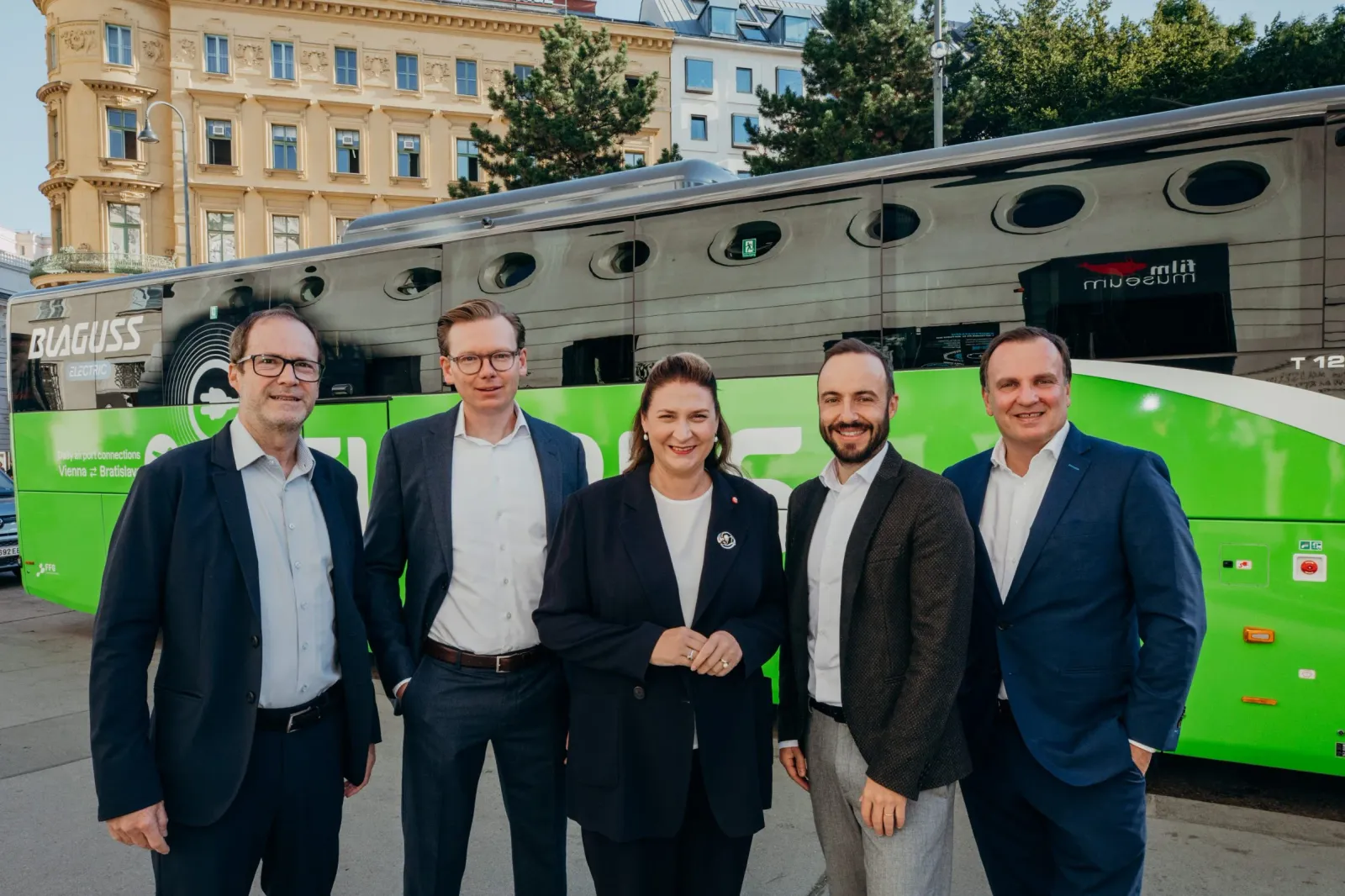
Starting October 1, FlixBus will deploy eight electric coaches in regular scheduled service between Vienna and Bratislava. The approx. 80 km route will offer 66 daily trips.
From left: Thomas Blaguss, Daniel Packenius, Barbara Novak, Hans-Jürgen Salmhofer, Paul Blaguss
Image: Flixbus / Mila Eder
FlixBus will deploy eight battery-electric coaches of the Yutong T12E model. Austrian FlixBus partner Blaguss has procured a total of twelve such vehicles, eight of which will operate on the route between the two capital cities.
The buses are equipped with batteries offering a capacity of 466 kWh. FlixBus states a range of around 500 kilometres. The relatively short distance between Vienna and Bratislava – approximately 80 km – combined with the flat route profile, makes the route fundamentally suitable for battery-electric operation.
The vehicles will be charged at locations in Vienna and Bratislava. According to FlixBus, photovoltaic systems combined with battery storage will be used at these sites. The operator estimates CO₂ savings of around 66 kg per 100 km compared to equivalent diesel operation. The route connects not only the city centres of Vienna and Bratislava but also their respective airports. A total of 66 daily connections are planned.
FlixBus has already trialled battery-electric coaches in several markets. In 2024, for example, the company tested a Yutong GTe14 between London and Cambridge. Previous pilot projects were conducted in Portugal, Germany, and the USA. The Vienna–Bratislava route differs in that the eight electric coaches will be used in regular daily scheduled service from the outset.
The project was financed through private investments from Blaguss as well as public funds from Austria and the European NextGenerationEU programme. FlixBus emphasises that the implementation is made possible primarily by the combination of a suitable route, high demand, and appropriate charging infrastructure.
The route is particularly interesting for electric long-distance bus services because it demonstrates that battery-electric coaches can be used not only in test projects but also in dense scheduled operations. Key factors remain route length, charging windows, and the availability of high-performance infrastructure at the endpoints.
