
Firefly, a small Chinese electric vehicle that might appeal to Italians

Firefly is the compact electric car from Chinese premium brand NIO. It might appeal to Italians, but it isn’t imported yet. Our friend Ivone Benfatto introduces it from Shanghai, where he works and lives with his wife Enrica. This time, he starts with an item that has become essential in China: the smartphone. Think about it—it’s even needed to enter the country. Then there’s the car: at a design exhibition, he encountered a special edition of Firefly and talked to a representative from the brand. He sees a parallel between phones and cars.
By Ivone Benfatto
In China, a smartphone isn’t optional—through its apps, almost all aspects of daily life are managed. This way of living begins even before stepping off the plane.
First things first: a smartphone
For almost a year now (the service has been active since November 20, 2025), the entry form to be submitted at the passport control checkpoint is filled out online. Instead of the old paper form, there is a QR code from the Immigration Bureau that must be scanned with a phone: it leads to a page with all the data to be entered. After submitting the form, a confirmation QR code is received, which must be shown at the entrance to the passport control area. Without that code, permission to proceed with passport control is not granted.
Immigration Bureau QR code for entering China
And who doesn’t have a smartphone connected to the internet? Airlines now provide internet access, along with the option to fill out the form on someone else’s behalf. However, the confirmation code is sent to the person who filled it out, who then has to give it to the intended recipient—essentially, escorting them to passport control. Moreover, at the airport I didn’t see any paper forms; there were only self-service kiosks with screens and touchscreens for filling out the form online on the spot.
In short, either you adapt or you can’t enter—this is a kind of first taste of daily life in China. For Enrica, it was one of her early cultural shocks. She doesn’t like apps or their proliferation and was terrified at the idea of having to remember dozens of passwords, one for each app she signed up for. Here, however, I found an interesting solution: instead of creating a username and password each time, the phone number is used as the username, and security verification is done with a one-time password (OTP) sent via SMS.
Be careful though: it often only works with a Chinese mobile number. If you plan to stay in China for more than two weeks, I recommend coming from Europe with an eSIM, so you can leave the slot for a physical SIM free for a Chinese one. All you need is a passport, an address (such as the hotel where you’re staying), and… an already active WeChat Pay account to pay for the first top-up.
Once in the city, the phone becomes a wallet, ticketing system, and guide. WeChat isn’t just for communicating and paying—it’s also a platform for mini apps, small programs that open within it without any installation needed. The same goes for Alipay, which has its own mini apps. There’s one for everything: to buy tickets for a theater or concert, you use the venue’s mini app; in mid-October, a large Coffee Festival was held in Shanghai with free entry but requiring reservations, which were made through the festival’s mini app. My initial collection is nothing compared to those of some Chinese colleagues.
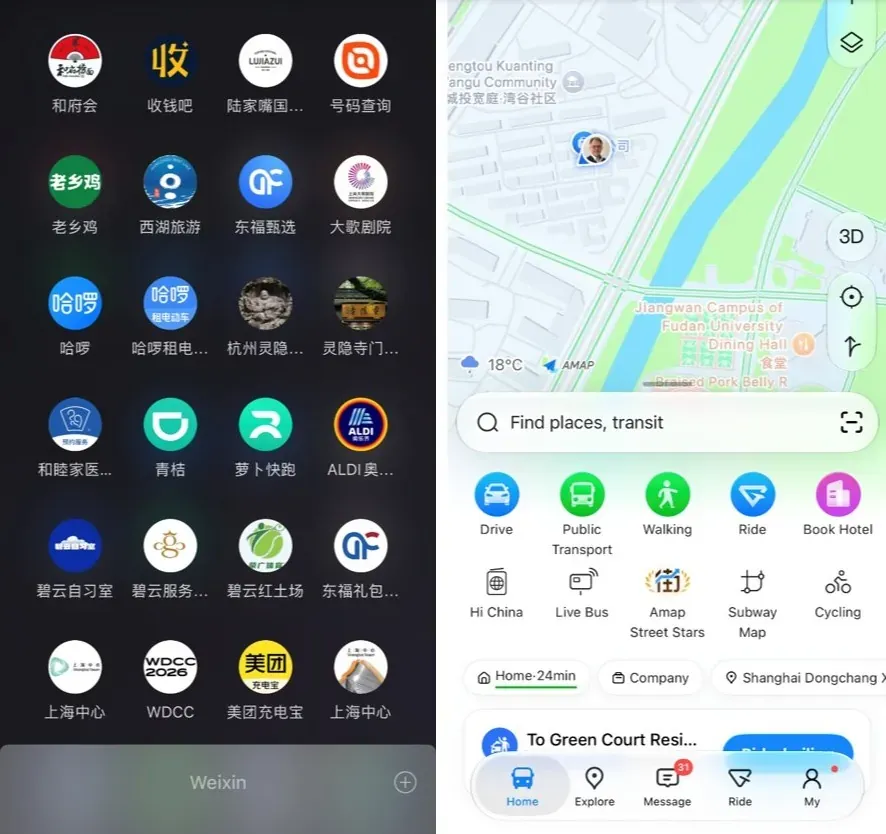
Another example is the navigation app with maps, such as Amap (Gaode): a kind of Google Maps with many additional functions, which also includes car-hailing services, similar to Uber. The difference is that Uber is a separate app, while here this feature is built into the multi-functional navigator.
The result is that in Europe, when I leave home, I make sure to have my phone, credit card, driver’s license, and ID card; here, I actually only need my smartphone and passport. The passport is still necessary because, for now, there’s no feature that allows storing a QR code containing passport details—and in my case, residence permit details—on the phone. But I think it’s just a matter of time: even for foreigners, passports and residence permits will be replaced by QR codes to be shown on their phones.
Battery Life: A Weak Point Even for Smartphones
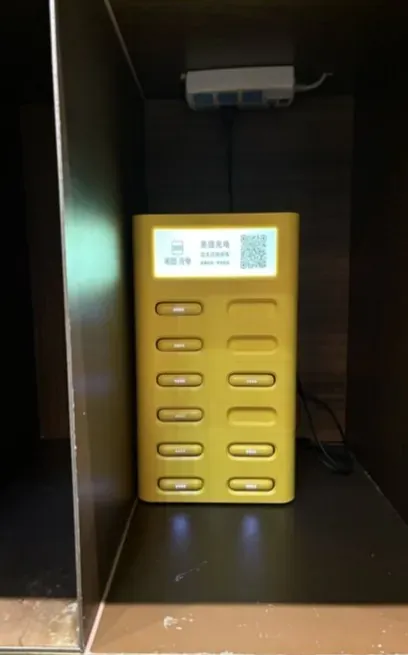
With everything centered on the smartphone, including purchasing public transportation tickets, I realized how important it is for it to function properly, meaning having a fully charged battery. In Europe, if I go out in the morning with 100% battery, I can easily make it until late at night.
Here, during a day of city tours with the screen almost always on for maps, payments, photos, and some short videos, the battery is already drained by early afternoon.
There are two solutions: carry a power bank with you, or rent one. In Shanghai, as in all of China now, there are small “totems” everywhere where you can rent a power bank by paying with your phone, then return it at another totem—in restaurants, on the streets, in shops, at the entrances of shopping malls, in hotels, and even in the residence where we live. So Enrica and I can pick one at the entrance of a large shopping mall and return it when we go home. The cost depends on how long you use it.
A design exhibition and a “research” car
With a charged smartphone (and a power bank within reach), Enrica and I went to visit the World Design Cities Conference 2026, the design exhibition held in Shanghai from September 26 to 30. Entry was free here as well, but it required booking through the exhibition’s mini app: another app to add to the WeChat collection. At the exhibition, design wasn’t limited to aesthetic aspects; alongside fashion clothing and designs for buildings and various products, there was also design as innovation applied to functionality. In other words, creativity aimed at making homes, buildings, or everyday products more functional, whether for personal and domestic use or industrial applications.

We saw a Firefly there, the small electric vehicle from the NIO group’s同名 brand, displayed not to introduce a new model but to showcase a result of research and design work: the Halo “Habitat,” a special edition currently available only in China.
At the booth I met a young and very polite “Firefly Fellow,” as the brand calls its staff who interact with the public. She spoke excellent English, so we were able to converse without an interpreter. She agreed to explain the car and its new features through an interview, recorded both audio and video. Here it is:
Here I’ll try to summarize the key points, starting with those that seem most interesting to us: what’s new about this car compared to the Firefly already sold in Europe.
What’s different from the Firefly sold in Europe
The regular Firefly is available in various European countries since 2025 (Norway, Netherlands, Austria, Belgium, Denmark, Greece, and others) but not yet in Italy. However, note that there are actually three versions of the Firefly. The version sold in Europe, according to European specifications, still has the 105 kW engine from the first Chinese version released in 2025. In China, an upgraded version with a 120 kW engine has been on sale since April 2026, and the Habitat is based on this version. Here are the specifications for the three versions.
Firefly China (2026)
Upgraded version
Available from
April 7, 2026
Price
Starting at 119,800 ¥ (≈ 15,000 €); with battery subscription plan at 79,800 ¥ plus 399 ¥ per month
Traction
Rear-wheel drive, one engine
Maximum power
120 kW (163 HP)
Maximum torque
205 Nm
Top speed
150 km/h
0–100 km/h
7.9 seconds
Battery
42.1 kWh LFP (Sunwoda)
Range
420 km (Chinese CLTC cycle)
Consumption
10.9 kWh/100 km (CLTC)
Fast charging (DC)
30% to 80% in about 29 minutes
AC charging
0% to 100% in about 7 hours
Battery swap
Yes, at fifth-generation NIO stations
Dimensions (W × D × H)
4,003 × 1,781 × 1,557 mm
Firefly Europa
2025 version
Available from
2025 (first in Norway and the Netherlands)
Price
From 29,900–29,990 € (Netherlands, Austria, Belgium); 279,900 NOK (≈ 23,700 €) in Norway
Drive type
Rear-wheel drive, single motor
Maximum power
105 kW (143 hp)
Maximum torque
200 Nm
Top speed
150 km/h
0–100 km/h
8.1 s
Battery
42.1 kWh LFP (Sunwoda)
Range
330 km (EUWLTP cycle; 470 km in urban cycle)
Consumption
14.5 kWh/100 km (WLTP)
Fast charging (DC)
up to 100 kW; 10→80% in 29 minutes
AC charging
7 kW single-phase or 11 kW three-phase
Battery swap
no: incompatible European stations, battery only available for purchase
Dimensions (L × W × H)
4,003 × 1,781 × 1,557 mm
Firefly Halo “Habitat” (China)
Special edition
Available from
July 20, 2026
Price
133,300 ¥ (≈ 16,700 €); with battery subscription: 93,300 ¥ + 399 ¥ per month
Drive type
Rear-wheel drive, single motor
Maximum power
120 kW (163 HP)
Maximum torque
205 Nm*
Top speed
150 km/h*
0–100 km/h
7.9 s*
Battery
42.1 kWh LFP
Range
420 km (Chinese CLTC cycle)
Consumption
10.9 kWh/100 km (CLTC)*
Fast charging (DC)
30→80% in about 29 minutes*
AC charging
0→100% in about 7 hours*
Battery swap
Yes, at fifth-generation NIO stations
Dimensions (L × W × H)
4,003 × 1,781 × 1,557 mm
Note: For the Habitat model, official statements confirm only power, battery capacity, and range, which are identical to those of the 2026 Chinese Firefly version; values with an asterisk refer to the standard version since the mechanical setup is the same. Regarding range and consumption: the Chinese CLTC cycle is more optimistic than the European WLTP cycle, so Chinese and European figures are not directly comparable (with the same 42.1 kWh battery, 420 km under CLTC compared to 330 km under WLTP). Prices in euros are converted at approximately 8 yuan per euro, for reference only.
Club Spiaggia, the Chinese electric car that dreams of Italy and relies on mysticism
Technically speaking, the Habitat is China’s version of the 2026 Firefly: the difference lies in the design, and it costs 13,500 yuan more in China (about 1,700 euros). But there are some aspects that, in my opinion, could make it interesting for Italy:
The aesthetics. The green paint that changes tone depending on the light angle and the colors of the interior seem to match Italian tastes.
The size. It’s a car about 4 meters long: not one of those large models that often come from China, but a size that fits well within European and Italian standards.
The battery swap. In China, the Firefly can use swapping, which I think might appeal to many Italians. However, be cautious: the fifth-generation stations, the first compatible ones, were opened in China in August 2026, while European stations are not suitable for the Firefly. In Europe, this advantage does not exist for now.
Ieri, 23 ottobre, Firefly ha lanciato in Cina una nuova batteria da 60 kWh, con celle al litio ternario, che porta l’autonomia da 420 a 560 km nel ciclo cinese CLTC. La Firefly con la nuova batteria costa da 136.800 ¥ (≈ 17.100 €); con la batteria in abbonamento il canone mensile sale da 399 a 599 ¥. La batteria ha le stesse dimensioni e gli stessi punti di fissaggio di quella attuale da 42,1 kWh, quindi anche chi ha già una Firefly può passare alla nuova con un cambio batteria: la differenza è di 17.000 ¥ (≈ 2.100 €) per chi ha acquistato la batteria, mentre per chi l’ha in abbonamento c’è un costo di servizio di 3.000 ¥ (≈ 375 €). Per l’Europa non ci sono annunci.
How could it make its way to us? Today in China, it’s a special edition: to reach Europe and Italy, it might go through a special European (and Italian) series, and perhaps later on a regular model. Hopefully—based on the announcements I’ve read so far, there’s no mention of Europe.
What the Firefly Fellow told me
Here are, in summary, the main points of the interview:
A firefly as inspiration. This year’s special edition is called Halo and was inspired by a firefly: the green color of the body changes depending on the angle from which it’s viewed, and inside there’s a special combination of natural elements.
A sanctuary in the city. The idea is to offer a place to relax amidst urban life: even while driving through a very busy city, one should feel nature inside the car.
A design that goes beyond aesthetics alone. Firefly and NIO seek a design approach that also considers functionality and user experience. To this end, they organized a ritual design workshop with the School of Creativity and Art at ShanghaiTech University and the Oslo School of Architecture and Design—two design schools where, once again, design means more than just aesthetics; it also involves creativity to make products more functional. Ritual design is a new and unique discipline that explores how to add meaning to ordinary moments in daily life, with its application here being city navigation.
Five scenarios. The user journey was divided into departure, guidance, stoppage, charging, and arrival, with students coming up with different ideas for each stage.
Two examples. The moment one fastens their seatbelt, usually a mundane gesture, enhanced by an on-screen interaction that makes it special; and a car key designed to be taken indoors, so that even the home environment conveys a special feeling.
READ ALSO: “Letter from Shanghai/ Three Huaweis We Might See in Europe and Other Stories” and watch the VIDEO