
VW’s vehicle recycling: Demolition plant opens in Zwickau
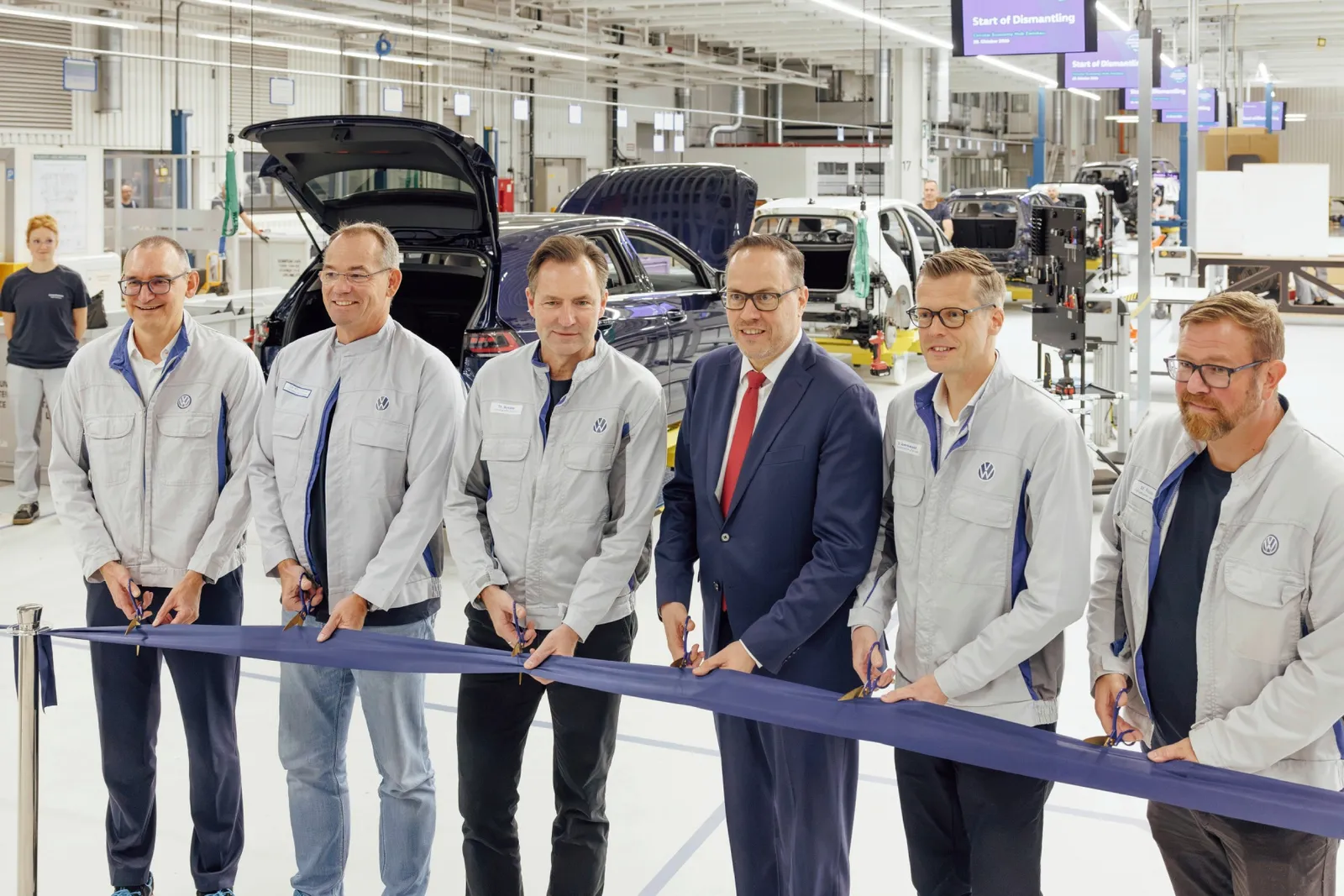
Volkswagen has inaugurated its dismantling facility at the Zwickau plant. Starting in 2027, around 4,100 vehicles are set to be disassembled and recycled at this new plant. In the entire “circular economy” business unit at Zwickau, up to 1,000 jobs are expected to be created from the current 100 new positions.
Image: VW
As announced in early 2026, the VW plant in Zwickau was expanded to serve as a site for dismantling and recycling pre-production and used vehicles, with the new facility officially opening at the end of October. This makes the site the central hub for VW’s circular economy efforts.
After a nine-month renovation and approval phase, operations are set to begin in 2027: Initially, 4,100 vehicles per year will be dismantled using an eight-stage line in a two-shift operation. 100 new employees will be hired for this purpose. The collective bargaining agreement signed in December 2024 calls for the new circular economy business unit at the Saxony site to be expanded over time to create up to 1,000 jobs.
Danny Auerswald, spokesperson for Volkswagen Sachsen GmbH’s management team, said at the opening: “The team at the Zwickau site is taking on this task with enthusiasm. We have leveraged our expertise to maximize all synergies between vehicle manufacturing and disassembly during setup and process design. Shorter communication paths within the site, specialized skills, and years of experience among both employees and in the region enable us to transform disassembly from a workshop-based process into an efficient, scalable operation.”
The concept consists of two value creation areas. Firstly, components such as engines, transmissions, doors, or bumpers are sourced for the after-sales parts business, inspected, processed, and distributed through dealer networks and independent repair shops to enable repairs on older vehicles at their current market value. Secondly, the individual raw materials from the vehicles are recovered as pure as possible to be reused in production.
Material recycling using recycled plastic as an example
The sorting process in Zwickau allows plastics to be separated into pure types before recycling. The extracted material is processed and used as a secondary raw material in the production of new components. This reuse becomes increasingly important due to EU regulations set to take effect from 2032, which require minimum levels of recycled content in new vehicles. Since components for new cars cannot be made entirely from used materials, the secondary raw material is mixed with new material. With this partial use, the plastic obtained from a used vehicle is theoretically sufficient to meet the recycled material needs for three new cars.
Reducing dependencies
To build the dismantling line, 1,200 square meters of space were utilized, with 94 tons of steel installed among other materials, and the floor was repainted to enable environmentally sound storage of raw materials and waste. To keep investment costs as low as possible, VW reused some existing equipment from its previous vehicle production processes. Looking ahead, Volkswagen plans to establish a European network of partners for industrial circular economy initiatives. In addition to meeting stricter environmental and recycling requirements, the company also aims to reduce material costs as well as its dependence on supply chains and imported raw materials.