
Factorial and Tulip Tech partner on solid-state batteries for drones
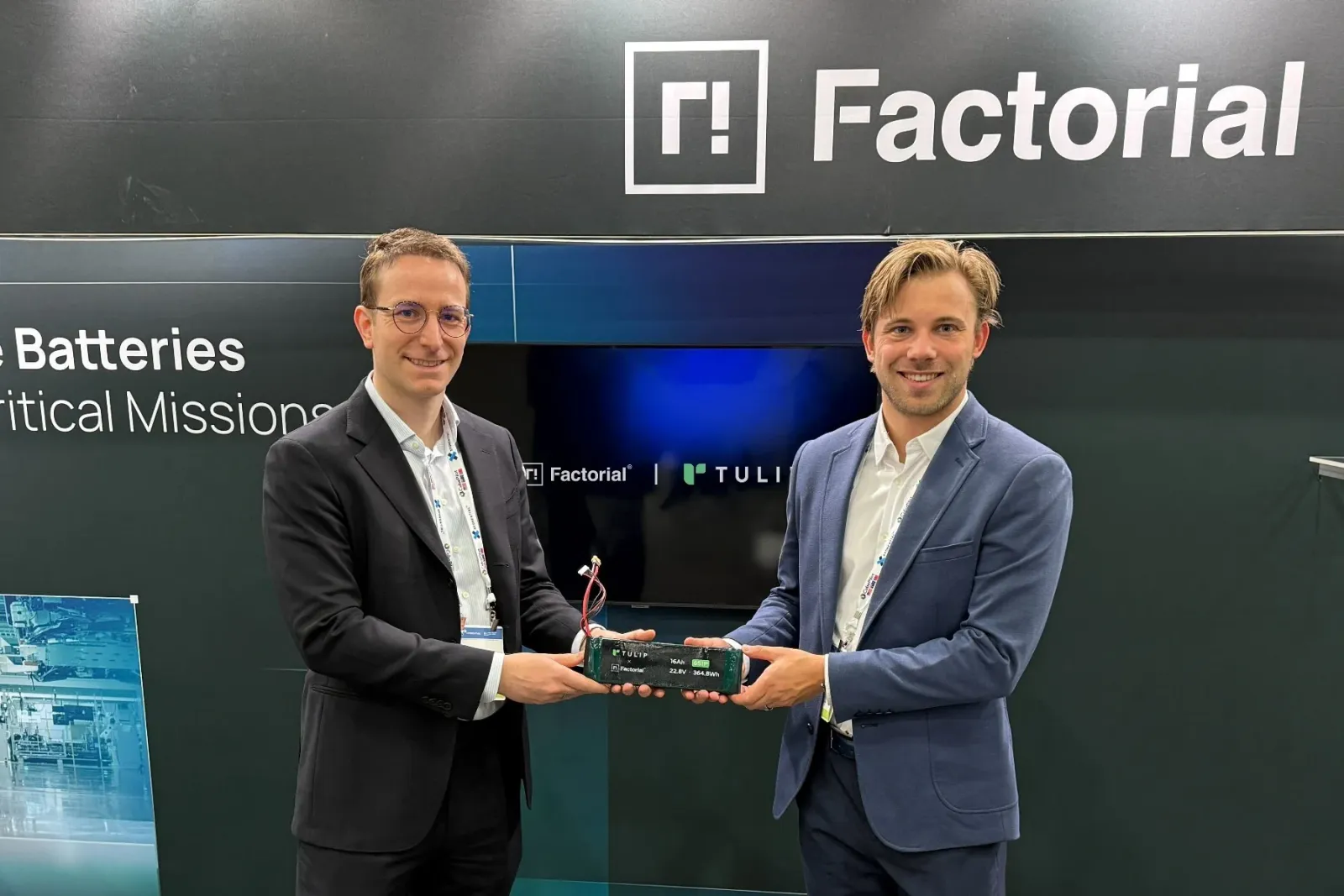
Factorial Energy and Dutch battery specialist Tulip Tech have entered a strategic partnership to commercialise solid-state and lithium-metal batteries for drones. The goal is to accelerate the commercial deployment of solid-state and lithium-metal batteries in unmanned aerial vehicles (UAVs).
The agreement follows successful flight tests in which the partners say the battery technology increased flight range by more than 30 per cent compared to conventional lithium-ion cells. The partners now want to set up a commercialisation framework covering joint customer engagement and a roadmap towards volume production.
The collaboration marks Factorial’s expansion into aerospace applications after focusing primarily on the automotive sector. “Last year our automotive cell platform powered a historic 1,200+ kilometre drive on a single charge. This year it’s the sky,” said Siyu Huang, CEO of Factorial.
Tulip Tech, based in Den Bosch in the Noord-Brabant province in the Netherlands, develops high-density battery systems for drones and supplies more than 250 customers across the defence, security and commercial sectors. The company says it manufactures more than 100,000 battery packs per month and specialises in customised battery systems designed for specific mission requirements.
According to the official statement, the partners see growing demand for longer-range UAVs in commercial, industrial and defence applications, where higher energy density can extend flight times, increase payload capacity and improve mission flexibility. They cite energy storage as one of the main constraints on further advances in unmanned aviation.
Factorial says its solid-state and lithium-metal battery platforms offer higher energy density while reducing weight, making them suitable for applications ranging from road vehicles to aircraft and space systems. The US battery specialist is backed by several automotive groups including Mercedes-Benz, Stellantis, and Hyundai-Kia. All three automotive groups plan to use Factorial’s high-performance, lightweight solid-state batteries in future electric vehicles, which are expected to enable a range of over 1,200 kilometres.metres.