
European companies are not that weak when it comes to electrification. At the level of Chery and Chang'an. Japan is at the bottom end.
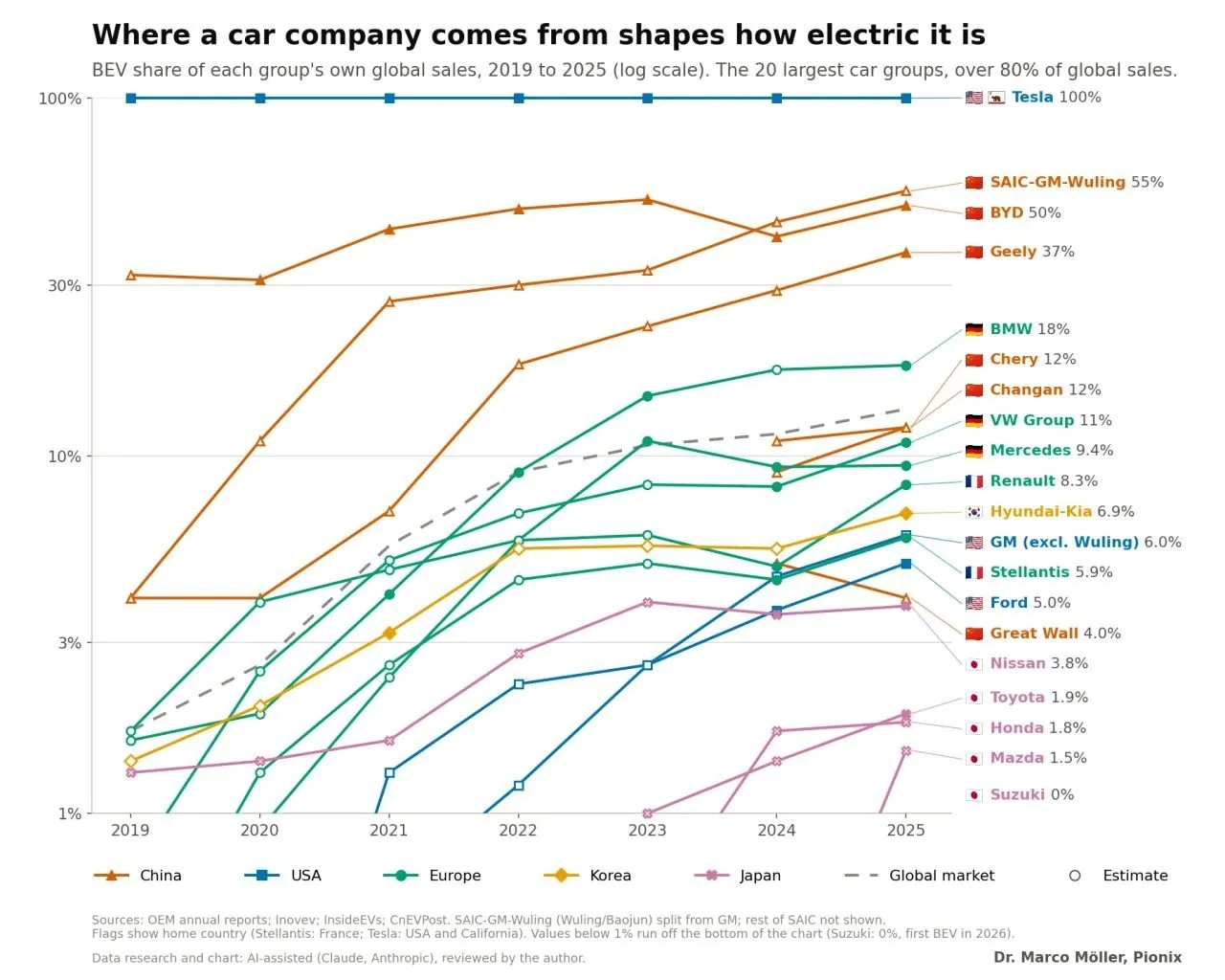
When looking at the share of electric vehicle sales in companies’ overall figures, European conglomerates were not the farthest behind in 2025. On average, we perform better than North America without Tesla and are roughly on par with Chery and Chang’an from China. Some Chinese companies are far ahead, while the Japanese companies are at the bottom. Even Nissan, once a leader in electrification, now performs worse than Ford.
Electric vehicles among new cars, world’s largest conglomerates [logarithmic scale]
The chart was prepared by Marco Moller from Pionix and posted on LinkedIn. It shows the share of pure electric vehicles among all types of powertrains in the world’s 20 largest automotive companies based on 2025 statistics. Note the scale on the left to realize that Geely’s figure is more than three times higher than Volkswagen Group’s, while BYD’s is more than five times higher than Mercedes’. In this ranking, Tesla leads as it sells only electric vehicles:
The ranking highlights two Chinese companies that appear to be leaders even outside of China: BYD (50%) and Geely (37%). Surprisingly, General Motors-SAIC-Wuling (55%), a joint venture that sells small electric vehicles, is also in the BYD vicinity. It should be noted, however, that some of these vehicles would be classified as microcars in Europe, meaning they are not typical cars. The production method results in a lower level of safety but allows for significant price reductions compared to regular vehicles.
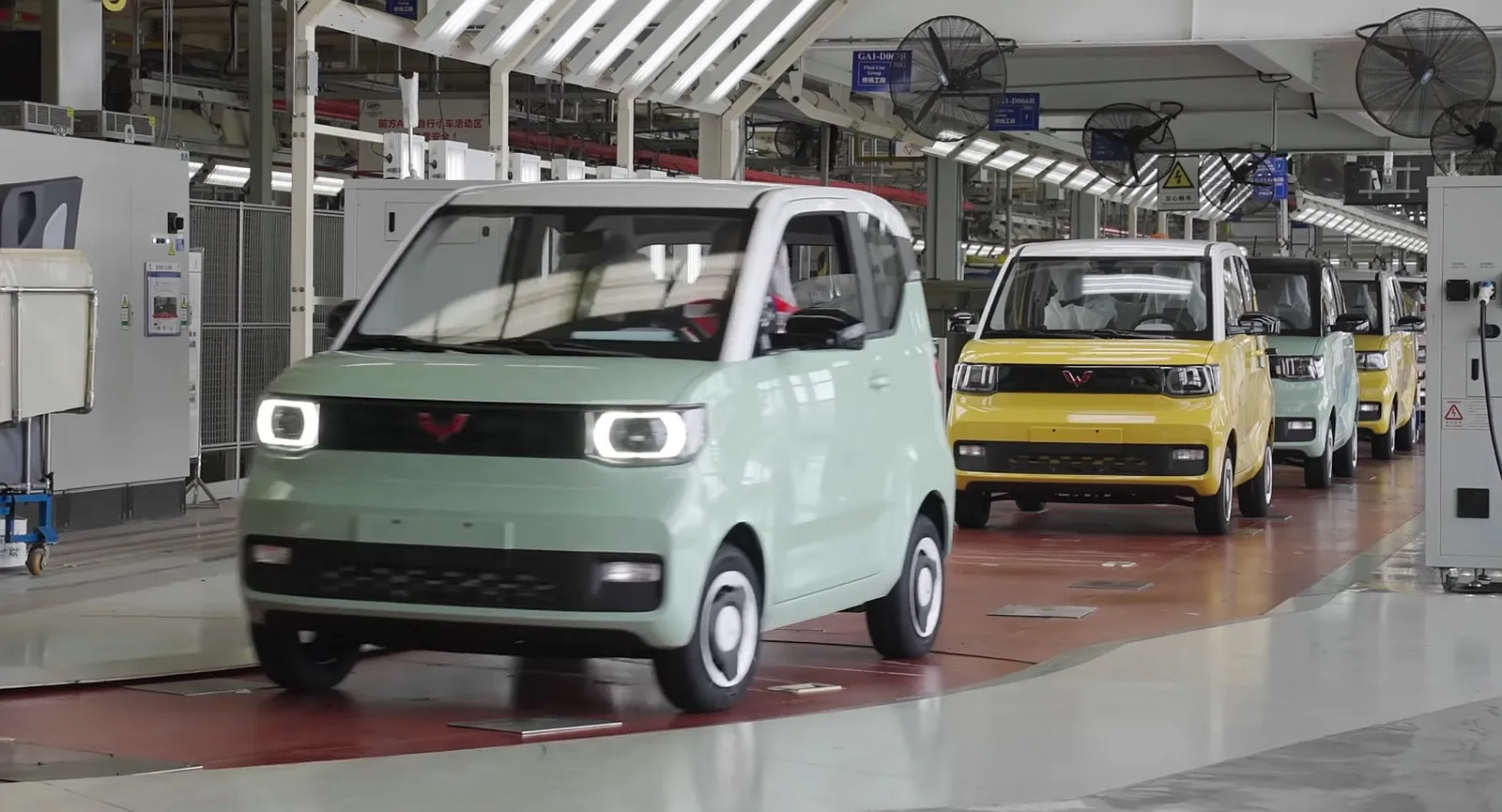
Wuling Mini vehicles leaving the production line (c) Wuling
Among European conglomerates, BMW performs best at 18%, while the Volkswagen Group (11%) is roughly on par with Chery (12%) and Changan (12%). All three companies rely primarily on the sale of combustion engine models, with electric vehicles accounting for only 1/8 to 1/9 of their total sales volume. This is surprising given that both Chery and Changan have developed entire lines of new brands intended to be fully electric (such as Avatr). The potential conclusion is that traditional brands struggle everywhere to convince their customers to buy electric vehicles, since “combustion engine cars still work well.”
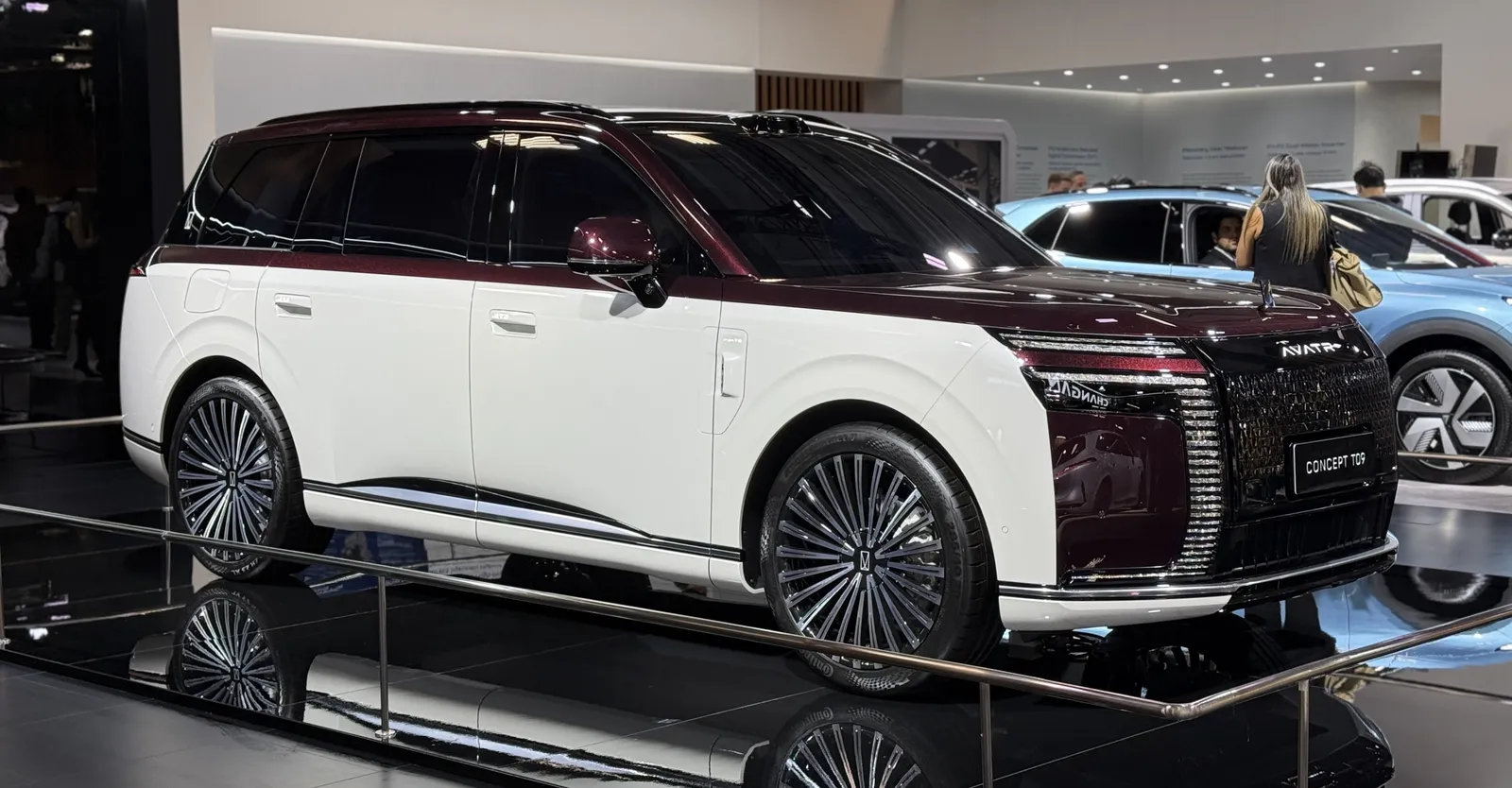
The conceptual Avatr T09 L. This one will be a plug-in hybrid (EREV).
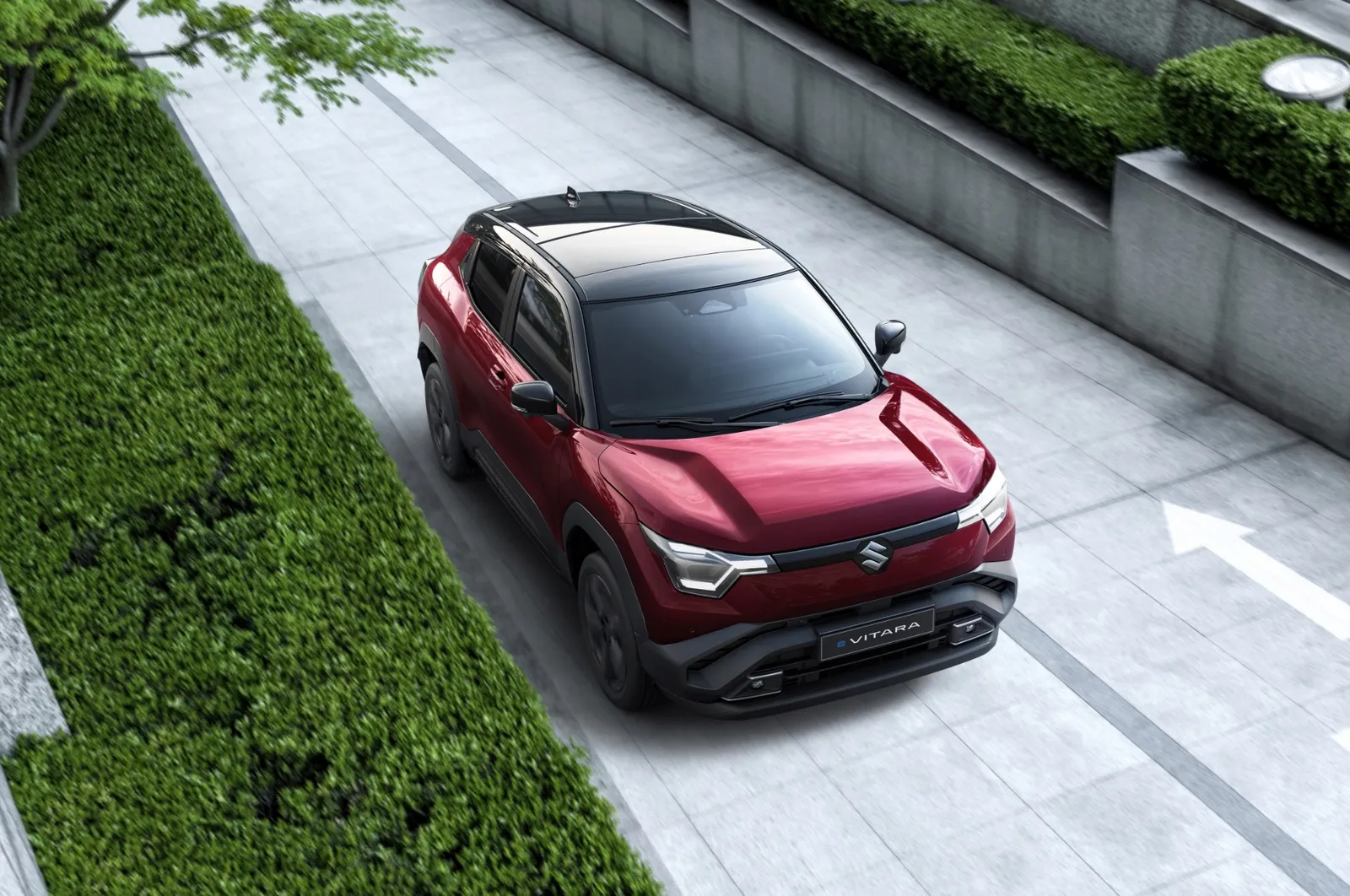
Hyundai Group performs fairly poorly (6.9%), despite its wide range of models under Hyundai and Kia brands. Behind it are older American brands (GM at 6%, Ford at 5%) and Stellantis (5.9%). At the bottom of the list is Chinese Great Wall Motor (brands GWM, Ora, Haval, Wey; 4%), with Nissan following closely behind at 3.8%. Toyota is twice as low at 1.9%, and Honda at 1.8%. Mazda lags further behind at 1.5%, also relying on products from Changan (Deepal). Suzuki has a mere 0%.
Editor’s note from Elektrowozu: If we look at the average sales of electric vehicles in European companies (~9-10 percent) and in Europe as a whole in 2025 (19.5 percent), we can see that the two figures differ by roughly 100 percent. In other words, a completely new market has emerged, and companies from the Old Continent have allowed someone to capture a significant portion of it.
Article rating
Readers’ ratings
[Total: 0 votes Average: 0]
Don’t miss new content — CLICK and FOLLOW Elektrowoz.pl on Google News. You might also be interested in the following ads: