
The European battle over standards. PHEVs emit only 18% less CO₂ than ICE vehicles
In short:
Data from the European market puts plug-in hybrids in a difficult light
The actual CO₂ emissions of these vehicles are now even 4.6 times higher than the official values from homologation – according to ICCT
Studies show that internal combustion engines in PHEVs are used more often than expected
The upcoming update to EU standards (2027) could intensify the conflict between car manufacturers and Brussels
PHEV: theory has fallen short of practice
In Europe’s debate about the future of motorization, an issue that has sparked emotion for years is resurfacing. It concerns plug-in hybrids (PHEVs). Although they were meant to serve as a technological bridge between internal combustion engines and electric mobility, the latest data show that their actual CO₂ emissions are increasingly diverging from manufacturers’ official claims. As the influential outlet Euractiv reports, “the growing gap between official emission figures and the actual pollution caused by plug-in hybrids signals another political battle over EU CO₂ standards.”
Plug-in hybrids, or gasoline vehicles equipped with an additional electric engine and traction battery, were supposed to significantly reduce emissions during daily short trips. The problem is that — as Euractiv notes — “numerous studies over the years have shown that the conventional engine is actually used more often than assumed.” The latest report from the International Council on Clean Transportation (ICCT) confirms this.
The figures are several times higher
The organization analyzed fuel and energy consumption monitoring data (OBFCM) from approximately 920,000 plug-in hybrids registered in the European Economic Area between 2021 and 2023. The results are clear: in 2021, actual CO₂ emissions were on average 3.5 times higher than the homologation values. For vehicles registered in 2023, the gap increased to 4.6 times! ICCT emphasizes in the report: “Actual driving CO₂ emissions from fleets were 3.5 times higher than homologation values in 2021 and 4.6 times higher in 2023,” the text reads.
The main cause of the problem is driver behavior. Although manufacturers are increasing the electric range of new models, drivers are charging their vehicles less frequently and relying more on internal combustion engines. ICCT notes that the proportion of driving in electric mode for PHEVs is declining despite increasing range. As a result, plug-in hybrids actually emit only about 18 percent less CO₂ than conventional internal combustion engine vehicles (ICE) and traditional hybrids (HEV).
At the same time, official emission figures continue to decline because the so-called “utility factor” curve in use across the EU assumes that a greater electric range automatically means more frequent use of electric mode. The ICCT report summarizes this briefly: “The larger the electric range, the greater the discrepancy between actual and official emissions.”
This difference has real consequences
Lowered homologation values give plug-in hybrids an unfair advantage in the EU’s CO₂ standards system, making it easier for manufacturers to meet increasingly stringent requirements. At the same time, they mislead drivers who may expect lower energy costs than what is actually the case. Therefore, ICCT warns that the current system “misleads consumers and unfairly favors PHEVs in incentive and tax systems.”
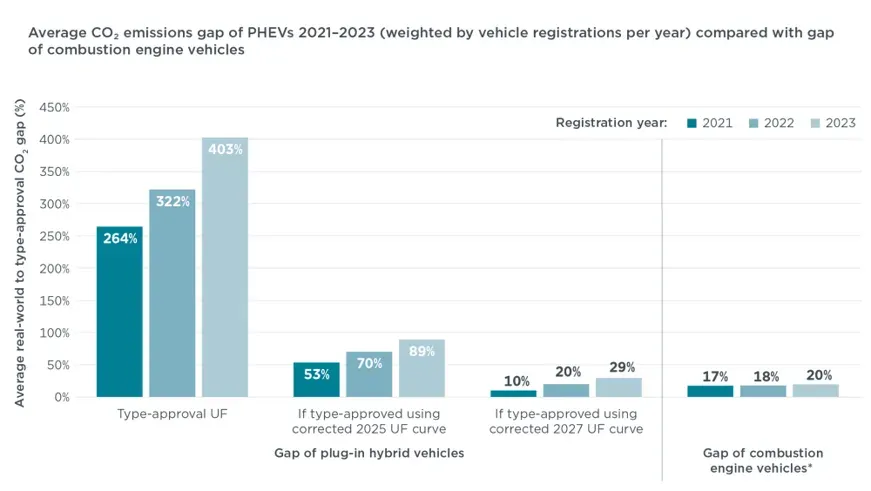
Recall that the European Commission identified this issue earlier, about which we wrote on Elektromobilni.pl/. In 2025, the “utility factor” curve was adjusted for the first time, lowering assumptions regarding the proportion of electric driving. A second adjustment is set to take effect in 2027, but manufacturers—as well as countries supporting internal combustion engines—are trying to block or weaken it. Meanwhile, ICCT is calling for the adjustment to be maintained because: “Weakening or delaying changes in 2027 would perpetuate the current disparities.”
Are BEVs better?
Against this backdrop, it is clear that the European market is beginning to favor fully electric vehicles. According to data cited by Euractiv, the share of electric cars in EU sales rose from 15.6 percent in the first half of 2025 to 20.7 percent in the same period of 2026. Plug-in hybrids only increased their share from 8.5 percent to 9.8 percent. This trend is driven both by rising fuel prices—caused by the war in Iran and the blockade of the Strait of Hormuz—and by growing awareness among drivers.
Peter Mock, director of ICCT Europe, is convinced that the upcoming adjustment to the “utility factor” will transform the market: “The update in 2027 is likely to reduce the appeal of plug-in hybrids as a tool for manufacturers to meet CO₂ targets, leading to further declines in their market share.”
Conclusions
All indications suggest that plug-in hybrids—long presented as a compromise between the old and the new—are now becoming symbols of technological disconnect or even failure. Manufacturers’ official statements increasingly diverge from reality, forcing EU regulations to keep up with actual conditions. Meanwhile, a decision that could determine the future of this technology in Europe will be made already next year.
Oskar Włostowski