
Europe: BEV and PHEV sales rose by over 33% by the end of July
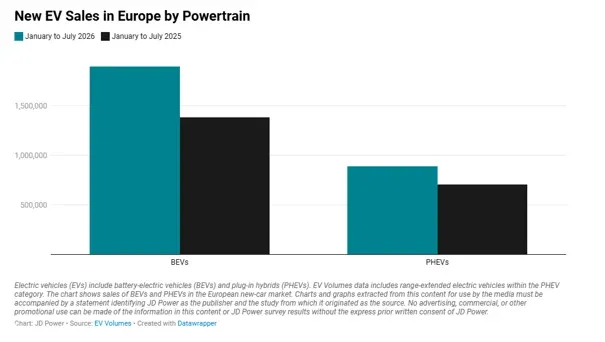
The European electric vehicle market is performing better and better. In the first seven months of 2026, sales of electric cars increased by more than one-third, with traditional leaders such as Germany and the United Kingdom driving these changes. Italy, France, and Spain are also playing an increasingly important role, where subsidies, new models, and rising fuel prices effectively encourage drivers to choose electrified vehicles.
In short:
Sales of electric cars increased by more than one-third in the first seven months of 2026
During that time, 2.79 million new electric vehicles (BEV and PHEV) were sold on the Old Continent, according to EV Volumes
Traditional leaders such as Germany and the United Kingdom are driving these changes
Italy, France, and Spain are also playing an increasingly important role
Europe is placing greater emphasis on electric cars
The electric vehicle market is performing well. According to data from EV Volumes, part of JD Power, 2.79 million new electric vehicles were sold in Europe between January and July 2026, including both battery-electric (BEV) models and plug-in hybrids (PHEV). This represents a year-on-year increase of 33.2 percent.
Fully electric vehicles currently hold the largest share of the market. In the first seven months of the year, they accounted for 68.1 percent of all registered electric vehicles. Their sales rose by 37 percent, reaching over 1.9 million units. June and July were particularly strong, with year-on-year growth exceeding 50 percent.
Plug-in hybrids also maintained an upward trend. Their sales increased by 25.7%, reaching 888.9 thousand units. However, the growth rate was significantly lower than that of battery vehicles.
Importantly, this recovery is occurring despite a partial relaxation of climate policies in the European Union. The European Commission has proposed reducing the target CO₂ emission reduction for new cars and vans from the current 100% to 90%. This means that after 2035, some vehicles other than electric or hydrogen-powered ones might still be available on the market.
In addition, manufacturers have gained greater flexibility in meeting emission targets for the years 2025-2027. Nevertheless, manufacturers are not slowing down investment, and European drivers are increasingly choosing vehicles that can run solely on electric power.
The Big Five shape the landscape
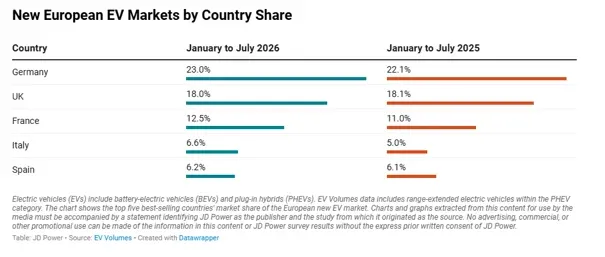
The five largest European automotive markets account for over two-thirds of total electric vehicle sales on the continent. Germany remains the leader, accounting for 23 percent of Europe’s demand for EVs. The United Kingdom comes in second with 18 percent, followed by France (12.5 percent), Italy (6.6 percent), and Spain (6.2 percent). It is these countries that currently determine the direction of electric mobility development, though each does so in slightly different ways.
Italy Unlocks the Potential of Plug-in Hybrids
The biggest surprise among the first months of 2026 is Italy. Battery vehicle sales there surged by 77.1%, reaching 185,300 units.
"This year’s sales spike is partly due to delayed deliveries resulting from an earlier subsidy program whose budget was exhausted within just 24 hours of its launch," explains Edoardo Buffo, analyst at JD Power Europe & Australia.
The expert also points out the impact of high fuel prices. “Rising fuel costs have increased awareness of the benefits of using cars that can run solely on electricity. This is especially noticeable among those who charge their vehicles at home and take advantage of favorable energy prices,” he emphasizes.
The Italian market stands out for another reason. Unlike many Western European countries, plug-in hybrids are more popular there than battery electric vehicles. In the first seven months of the year, their sales increased by 83.8%, reaching nearly 99,000 units and accounting for over half of the entire EV market.
Buffo notes that companies and fleets play a key role here. “Plug-in hybrids are an attractive alternative to fully electric vehicles, while also allowing for tax benefits,” he emphasizes.
Another driver for the market is the expansion of Chinese manufacturers. “New players from China are enriching the product range, and their models are more price-sensitive and better suited to the capabilities of the average Italian customer,” the expert observes.
France bets everything on battery vehicles
While Italy remains a stronghold for plug-in hybrids, France is increasingly promoting battery vehicles. Total EV sales there rose by 51.5%, making up for the weak performance in 2025. The BEV segment is particularly impressive, with sales increasing by 69.1% to 293,000 units.
Ludovico Percier of JD Power believes financial incentives are crucial. “In France, consumers are effectively driven toward battery vehicles thanks to a wide range of financial and regulatory incentives,” he emphasizes.

One pillar of this strategy is the so-called social leasing. According to France’s Ministry for Ecological Transition, subsequent rounds of the program have covered around 50,000 vehicles each. The program allows low-income individuals to use new electric cars under favorable terms.
Percier notes, however, that the success of the program could bring about side effects. “Social leasing is already shifting some customers from the used car market to the new car market today. In the long term, this could lead to pressure on used vehicle prices and a decline in residual values,” he says.
At the same time, plug-in hybrids are losing significance in France. Their sales dropped by 1.7%, and their share of the EV market shrank to 16.1%. This is all due to new tax regulations that effectively only reward fully electric vehicles.
Germany Returns to Subsidies
Europe’s largest electric mobility market remains in good shape. In Germany, EV sales increased by 38.7%, reaching 640,700 units. The reinstatement of subsidies for electric cars had a significant impact.
Since May 2026, the German government has allocated 3 billion euros for this purpose, supporting both the purchase and leasing of new vehicles. “Demand for new electric cars is largely driven by subsidies. At the same time, high fuel prices are increasing interest in used electric vehicles,” says Ina Gronemeyer from JD Power.
Brands from China are also playing an increasingly important role. According to data from the Center of Automotive Management, they already account for 6.2 percent of Germany’s new car market.
“Chinese manufacturers compete with attractive price-to-specs and quality ratios. However, the biggest challenge remains building brand recognition and maintaining residual values,” emphasizes Gronemeyer.
Spain and the UK at a crossroads
Spain recorded a 35.7% increase in EV sales, although the growth rate is significantly lower now than it was a year ago. Similar to Italy, plug-in hybrids account for over half of the market there.
The charging infrastructure remains a problem. AEDIVE data show that nearly 60% of public charging stations are located in just four regions of the country: Catalonia, Madrid, Andalusia, and Valencia.
"Manufacturers must now balance customers’ growing preference for PHEVs with the need to increase BEV sales as required by regulations," comments Juan Andrés Blázquez from JD Power.
In the UK, on the other hand, over 501,000 electric vehicles were sold, a 32.2% increase from the previous year. The local market remains heavily influenced by the ZEV Mandate, which requires manufacturers to account for 33% of their sales to zero-emission vehicles.
"Demand for battery vehicles continues to grow at a double-digit rate, but not fast enough to meet the current targets set by the ZEV Mandate," warns Jayson Whittington from JD Power. As a result, manufacturers are increasingly turning to discounts, favorable financing options, and attractive leasing deals to boost sales of electric models.
Europe faces more challenges
Although the market is doing well, it remains heavily dependent on support systems. Subsidies, tax incentives, and regulations continue to be the most important factors driving sales. At the same time, unevenly developed charging infrastructure is a problem in many countries. Italy and Spain show that concentrating charging stations in the wealthiest regions can slow down the electrification of the rest of the country.
Interestingly, even with some easing of EU regulations, Europe’s electric vehicle market has not entered a phase of stagnation. On the contrary, sales trends indicate that electrification is increasingly becoming a consumer choice rather than merely a result of political decisions. And that’s the goal.
Oskar Włostowski