
Europe reaches a historic milestone: electric cars surpassed diesel and gasoline cars combined in sales.
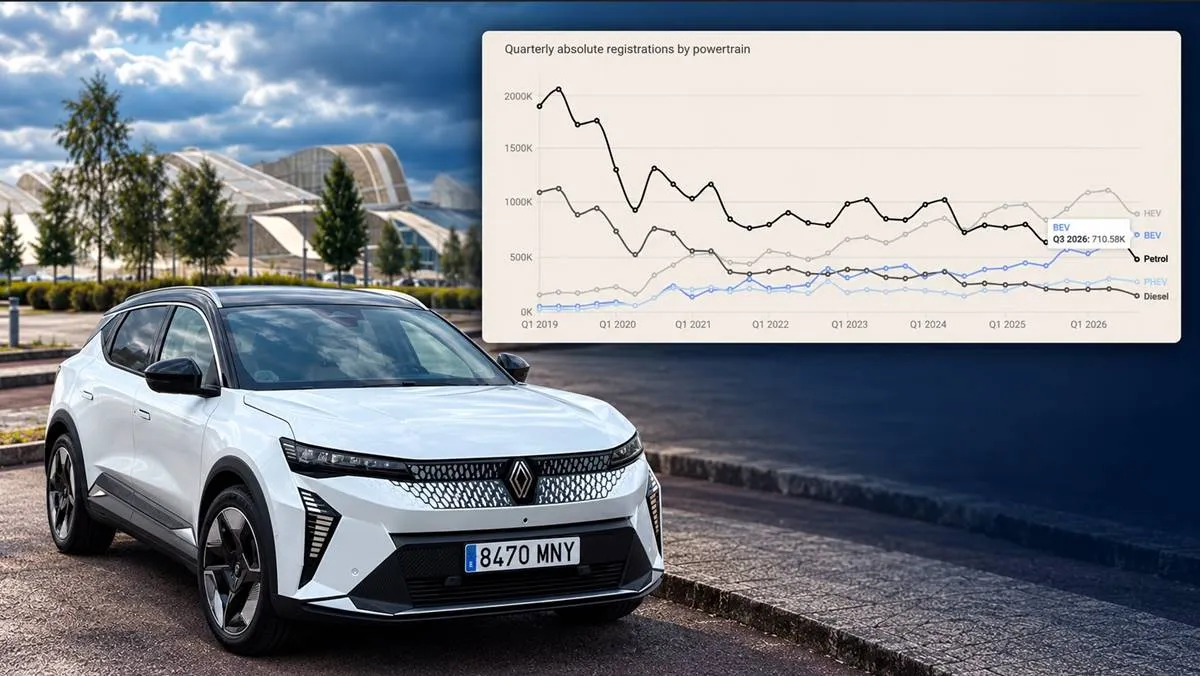
It’s no secret that the adoption of electric cars in Europe is truly taking off. At the same time, gasoline-powered vehicles are also declining sharply. In the third quarter of this year, sales of electric cars in Europe surpassed those of diesel and gasoline vehicles combined.
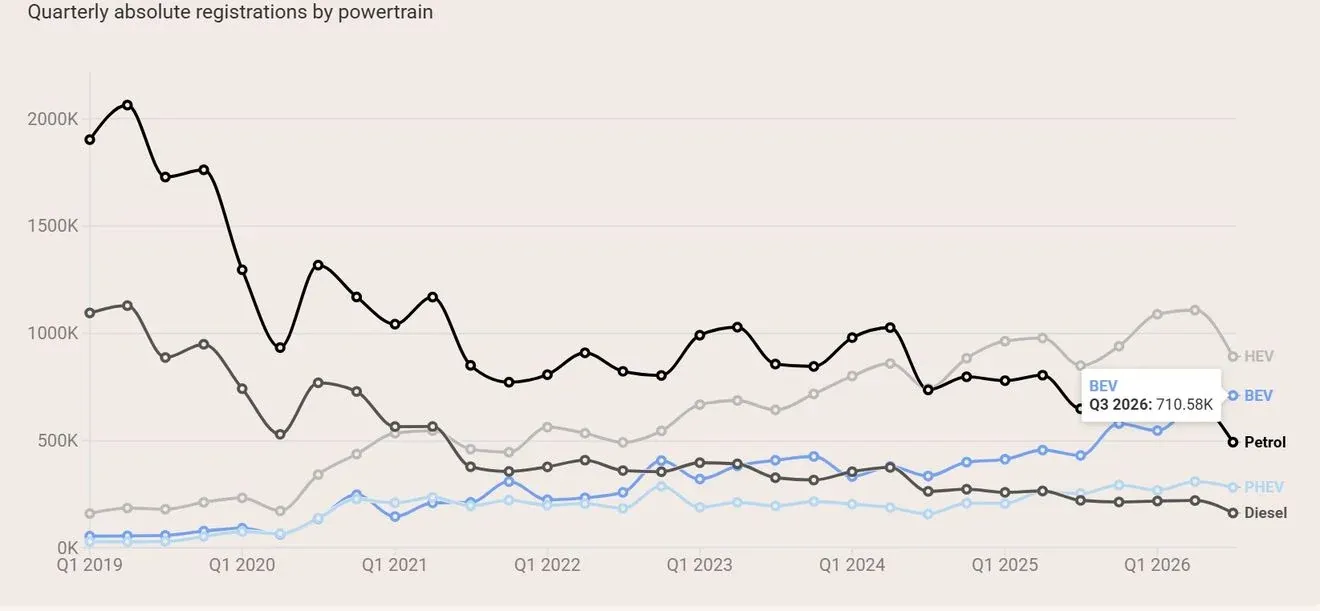
This information comes from Transport & Environment (T&E). Their latest report shows that during the third quarter, car sales in Europe continued to shift toward full electrification. In the second quarter, we learned that sales of electric cars had already exceeded those of gasoline cars. This trend continued to grow in the third quarter; the EU registered approximately 492,930 gasoline cars and 162,610 diesel models, for a total of 655,540 vehicles.
At the same time, the EU registered 710,580 electric cars, meaning that electric vehicles have officially surpassed all types of internal combustion vehicles.
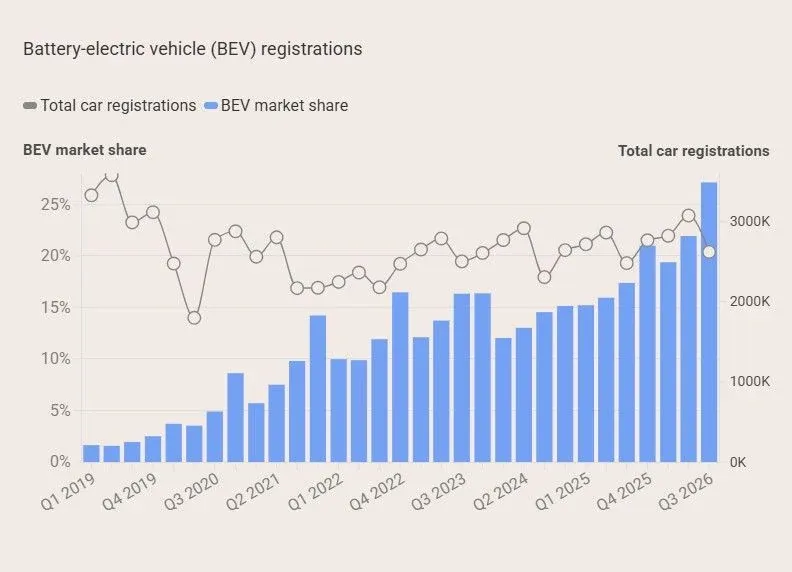
The study shows that it isn’t just one or two countries leading the way while the rest of the continent ignores the need for electrification. Thirteen of the EU’s 27 member states recorded their highest-ever electric vehicle sales. In ten of them, battery electric vehicles (BEVs) were the most sold type of vehicle.
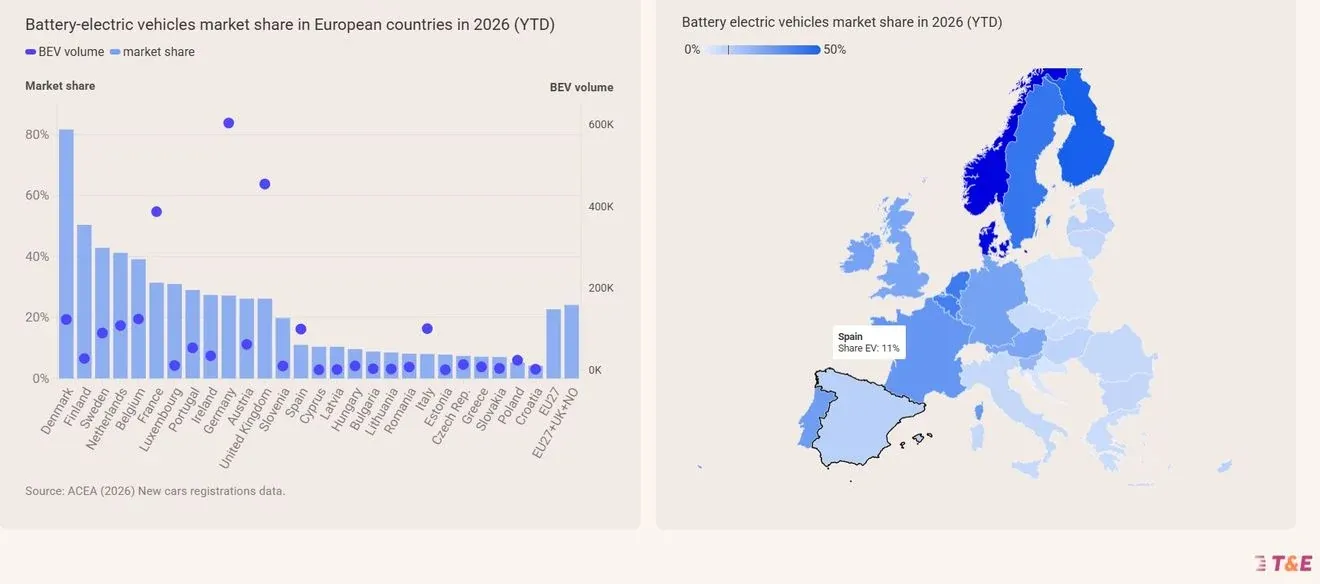
By browsing T&E’s interactive map, one can see the top performers in terms of electric car market share. Of course, Norway’s impressive 97.9% market share is undoubtedly unmatched, though it’s not entirely surprising since we Norwegians have been the global leaders for years.
Sweden and the Netherlands also show an upward trend for similar reasons to Norway—strong tax incentives and a dense network of fast charging stations. However, France, Germany, Belgium, the United Kingdom, Portugal, and Ireland all have a market share in sales exceeding 25%.
Spain remains in the background, at 11% in 2026, far behind the leaders, but also far behind other socio-economically similar markets such as Portugal at 29%, France at 31.4%, or Germany at 27.2%. Among the major markets, only Italy is behind Spain with 8%.
The reasons for this growth, in addition to the increase in fuel prices mentioned earlier, are also the expansion of supply, especially in the entry-level segments. The arrival and growth of Chinese manufacturers such as Geely and BYD have enhanced the appeal of electric car ranges in Europe, driving up sales.
At the same time, traditional manufacturers have also improved their offerings in this sector thanks to new models. Renault, Stellantis, Hyundai, Kia, and Volkswagen have launched affordable compact cars and crossovers, with plans to introduce more in the near future. There are increasingly more and better options to choose from, which boosts sales.
Hybrid vehicles still outperform pure electric cars, but given the continuous upward trend of the latter and the downward trend of the former, it is only a matter of months before electric cars also surpass them. With 892,380 hybrid vehicles sold in the third quarter, the gap between the two figures is only about 180,000 units.