
The EU appears to be pressuring Britain to impose higher tariffs on Chinese electric vehicles.
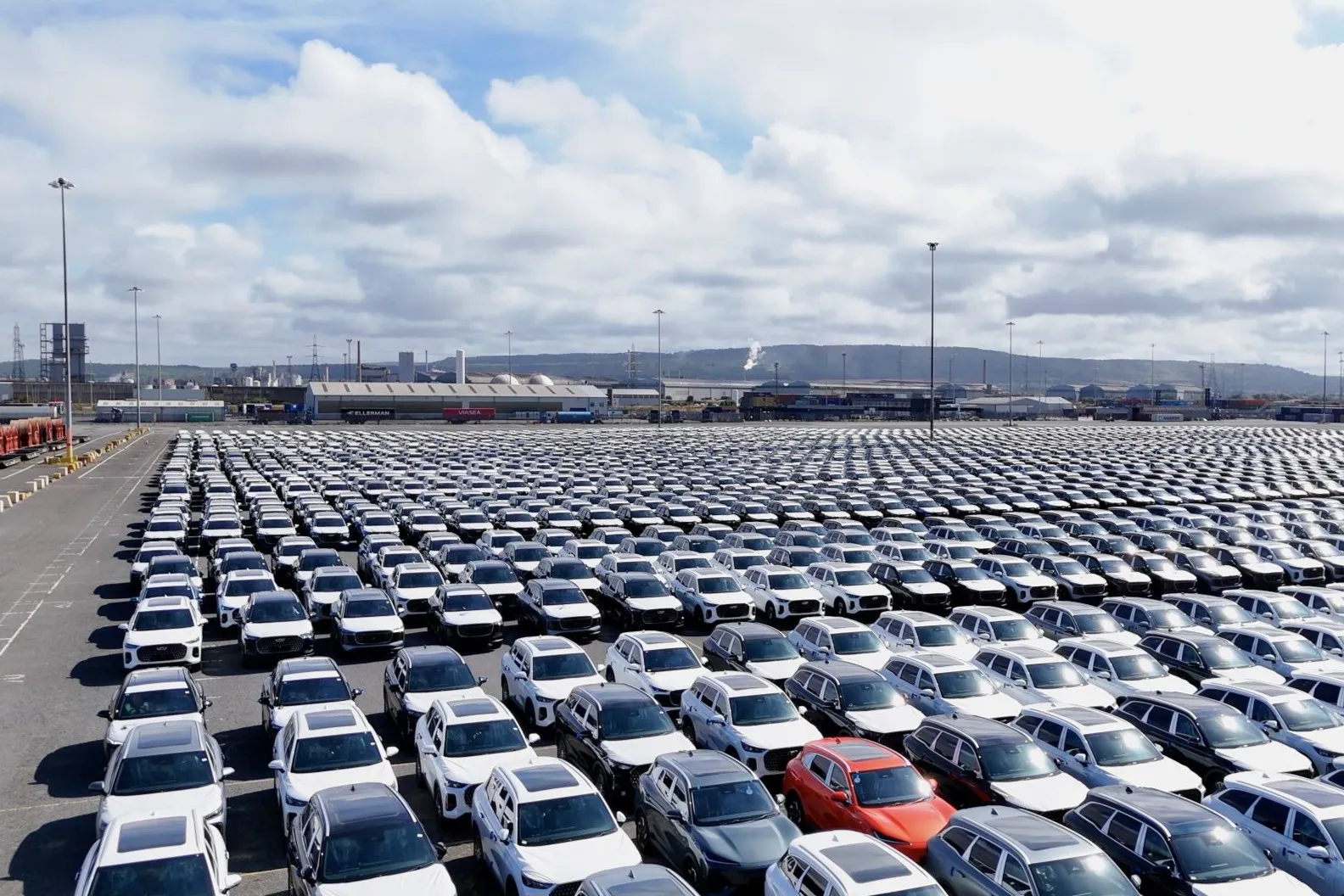
Brussels appears to tie greater integration of the UK into its “Made in Europe” industrial policy to certain conditions: London is expected to align its trade policies toward China more closely with those of the EU. This could mean higher import tariffs for Chinese electric vehicles. The British government explicitly leaves the door open for adjustments.

Chery vehicles imported from China to the UK
Image: PD Ports
The European Union appears to be pressing Britain to raise tariffs on Chinese electric vehicles. This is reported by The Financial Times, citing people familiar with the discussions. According to these sources, Brussels has signaled to London that aligning British trade policy more closely with the EU could be a prerequisite for British companies to benefit from the planned “Made in Europe” industrial policy under the EU’s Industrial Accelerator Act. The most far-reaching solution considered is Britain joining the EU customs union. The European Commission declined to comment on this report to The FT.
The concern is that Britain, with its lower trade barriers, could become a sort of gateway for Chinese vehicles into the EU single market. Since late October 2024, the EU has imposed additional special tariffs ranging from 7.8 to 35.3 percent on battery-electric cars from China, on top of the regular 10 percent import duty, depending on the manufacturer. This can raise the overall cost of imports to as much as 45.3 percent — this applies, for example, to electric cars from the SAIC group with brands such as MG Motor and Maxus. Britain has not adopted these additional anti-subsidy tariffs; regular 10 percent duty applies to Chinese vehicles there.
Chinese cars hold 16 percent market share in the UK
This issue is particularly significant for the British automotive industry. Chinese manufacturers have significantly expanded their market share in Britain this year: according to data cited by the Financial Times, they now together account for around 16 percent of the British new car market, though this likely applies across all types of propulsion. At the same time, London is seeking Chinese investment in local production. For example, Nissan reached an agreement with Chery in June under which the Chinese manufacturer is evaluating a production line at Nissan’s Sunderland plant for its vehicles.
SMMT study shows close economic ties
The British automotive association SMMT has recently released an analysis prepared by Oxford Economics, which shows that British car production supports 24 billion euros worth of economic activity, 250,000 jobs, and 1.6 billion euros in tax revenues in the EU each year. The association argues that excluding British vehicles from EU subsidies and public procurement would also affect the European automotive industry. SMMT calls for Britain to be recognized as a “trusted partner” and for British vehicles to be treated as “assembled in the EU” for the purposes of the “Made in Europe” rules.
Mike Hawes, head of the SMMT, said, “The EU is rightly focusing on strengthening its industrial base. However, restricting British manufacturers’ access to their largest market would be counterproductive—it would significantly reduce demand for components, goods, and services produced in the EU, weaken the competitiveness of both sides, and threaten growth at a time when our industry needs to invest more heavily and faster in zero-emission mobility.”

The current conflict lies in London’s desire to secure access to European markets for subsidies and sales on one hand, while simultaneously wanting to retain the freedom it gained after Brexit in its trade policy toward China. The British government did not introduce EU additional tariffs on Chinese electric vehicles in 2024. However, regarding steel, London has since aligned its trade policy more closely with that of the EU: Since July, significantly lower duty-free quotas apply to certain steel imports; in addition, a 50 percent tariff is imposed.
Tariffs as a difficult balancing act
British Business Secretary Jonathan Reynolds now explicitly believes a change in tariffs on Chinese goods is possible. In an interview with Politico during the Labour Party conference, Reynolds said he was keeping an “even closer eye on” the issue of tariffs on Chinese electric vehicles than many other topics, adding that “different parts of our own industry expect different things from government policy.” He continued, “We are an export-oriented sector. So of course you shouldn’t do anything that threatens export markets, and you must always expect retaliatory measures when imposing tariffs.” Reynolds described Britain’s stance on Chinese electric vehicles as currently “well balanced.”
UK wants to be included in “Made in Europe” rules
Reynolds told Politico that London still aims to remain integrated into Europe’s “Buy European” or “Made in Europe” policies. Excluding the UK, Europe’s second-largest economy, would run counter to the EU’s goals of having a more resilient industrial sector, the minister argued. Talks between London and Brussels over the UK’s future role in Europe’s industrial and supply chain rules continue.
A few days ago, an important statement in support of Britain came from Germany as well. The prime ministers of the automobile-producing states of Baden-Württemberg, Bavaria, and Lower Saxony explicitly called for “Made with Europe” rules in a joint position paper on the Industrial Accelerator Act. These rules are not meant to be limited to EU countries; according to the signatories, Britain, EWR and EFTA states (Iceland, Liechtenstein, Norway, and Switzerland), as well as other established partners, should also be included. At the same time, the three automobile states advocate for a “moderate” local-content industry policy and firm defense against unfair competitive distortions.
The conflict has been simmering for some time
The dispute over Britain’s inclusion in European industrial policy builds on an older conflict. Stricter rules of origin for electric vehicles are set to take effect in EU-British trade by early 2027. These rules require, among other things, a higher European share in battery cells and battery packs. As a result, the automotive associations ACEA and SMMT called for further delays back in June. Now, ACEA has renewed its demand.