
A study says PHEVs have emissions six times higher than reported.
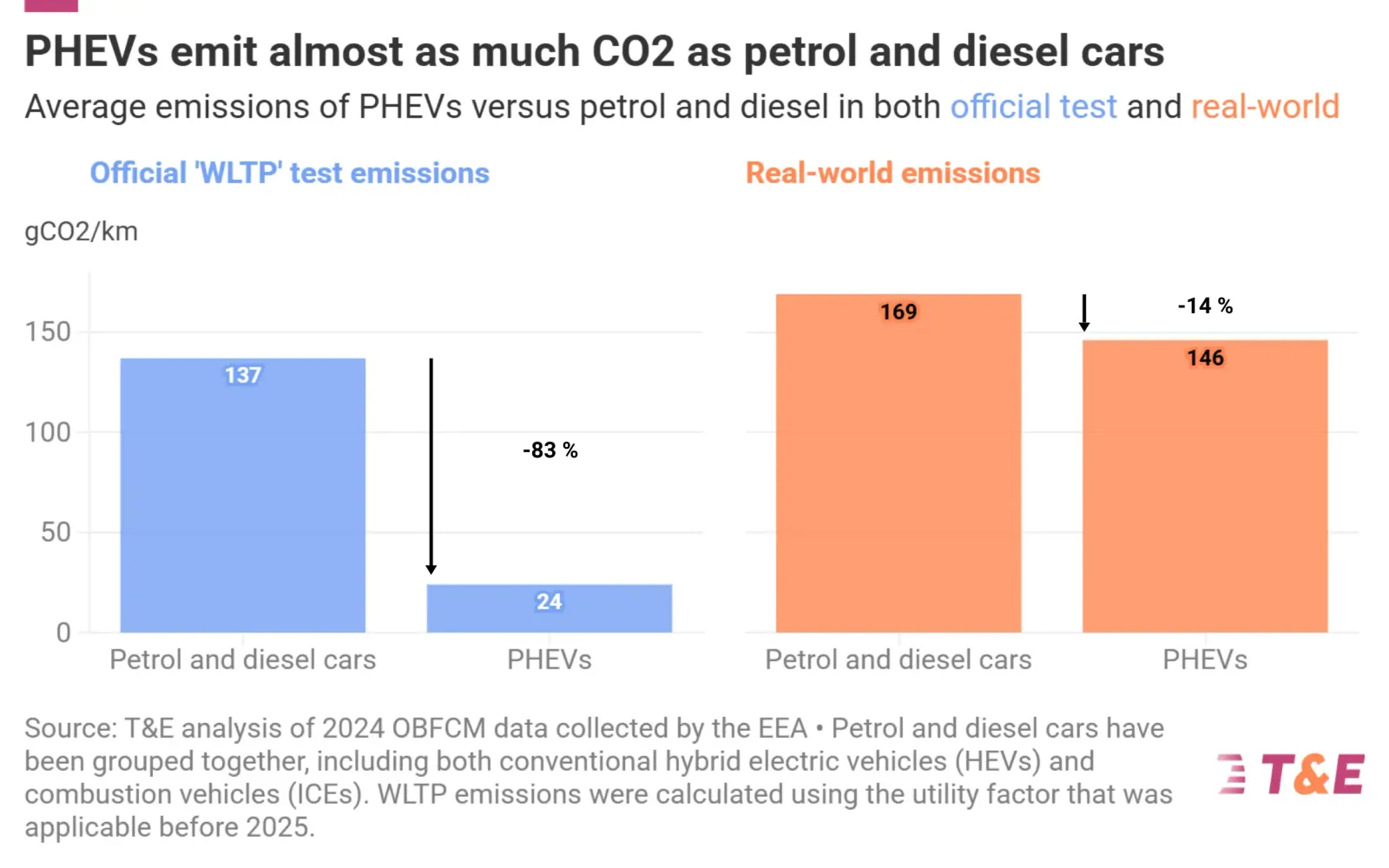
According to the latest study by Transport & Environment, the advantage of plug-in hybrids in CO2 emissions drops from 83% in official tests to just 14% in real-world use.
Plug-in hybrids can be one of the best alternatives for those who are not yet ready to switch from internal combustion engines to 100% electric vehicles but still want to reduce fuel consumption and operating costs.
When regularly charged, they allow drivers to travel dozens of kilometers in pure electric mode, enabling them to complete daily tasks without using fuel. On longer trips, the internal combustion engine ensures greater range, without relying on the availability of charging stations.
However, the benefits of this technology depend heavily on how it is used. The frequency of charging and the distance traveled in electric mode have a direct impact on fuel consumption and carbon dioxide (CO2) emissions.
It is precisely this difference between the certified values and those recorded under real-world conditions that lies at the heart of the latest study by Transport & Environment (T&E), a European non-governmental organization dedicated to sustainable mobility, whose findings are often questioned.
According to this analysis, based on usage data from around 220,000 vehicles, plug-in hybrids registered in 2024 emitted, on average, nearly six times more CO2 than the official figures indicated. In 2023, this difference was approximately five times.
According to this study, actual emissions were around 145 g/km of CO₂, compared to just 24 g/km in WLTP homologation tests. More significantly, the study found that the actual emissions of these vehicles were only 14% lower than those of conventional gasoline cars and hybrids. In official tests, this difference was as high as 83%.
What explains such a large difference?
One of the most revealing data points from the study helps explain this discrepancy: the plug-in hybrids analyzed covered, on average, only 27% of their total distance in pure electric mode.
And even when running on battery power, the combustion engine continued to engage. According to T&E, this occurred in about one-third of the kilometers traveled in the mode that gradually uses up the battery charge.
The discrepancy is also related to the so-called utility factor, one of the variables used to calculate the official fuel consumption and emissions of plug-in hybrids. This factor estimates the percentage of kilometers a vehicle should be able to travel on electricity, based on its certified electric range.
The problem is that for several years, the calculations used in homologation tests were overly optimistic. For example, before 2025, a plug-in hybrid with 100 km of electric range was considered capable of covering about 90% of its total distance using electricity.
With the new Euro 6e-bis rules, introduced in January 2025 for new models and in January 2026 for existing ones, this estimate has dropped to approximately two-thirds.
Greater electric range does not mean lower emissions
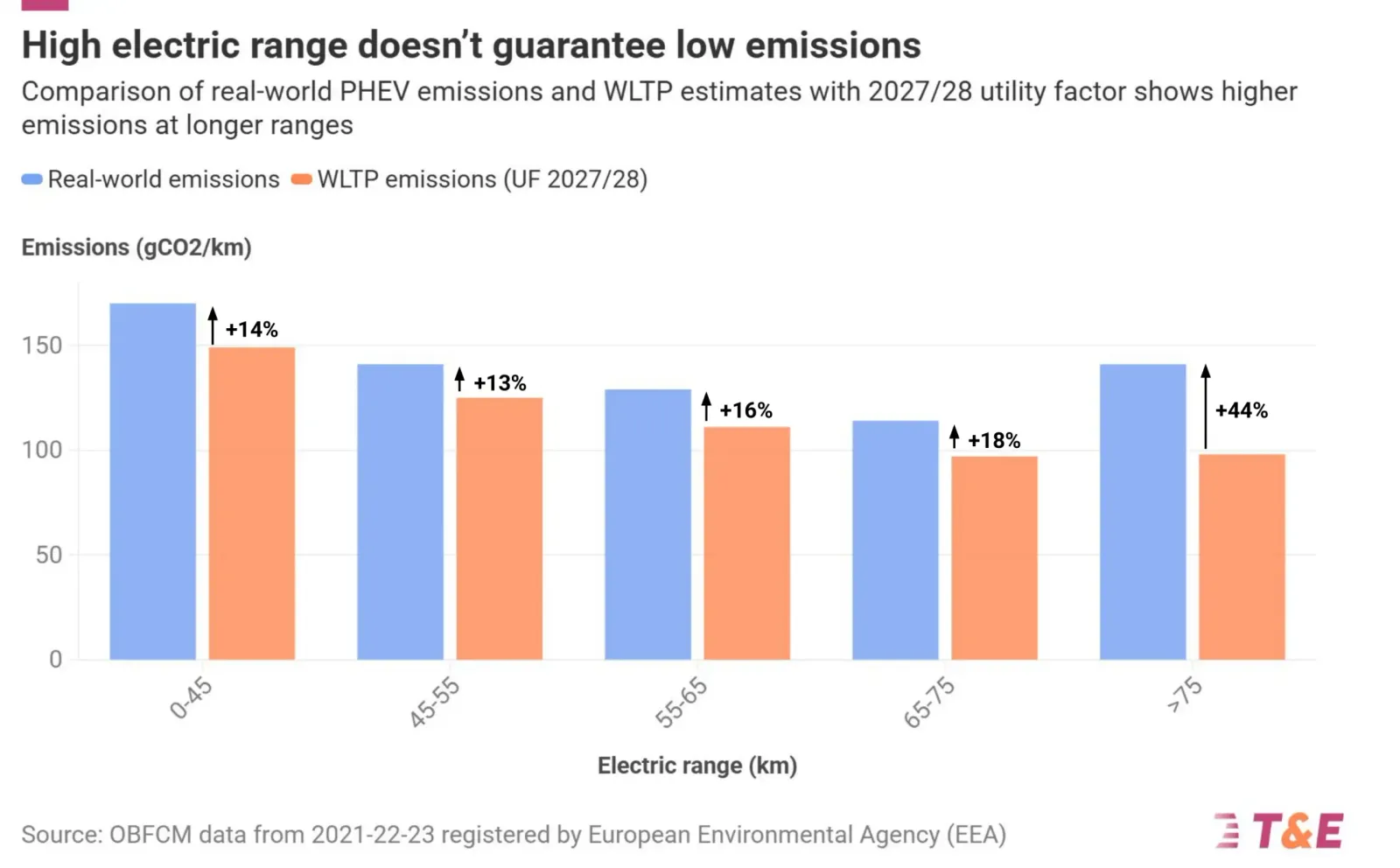
T&E acknowledges that these changes have already encouraged manufacturers to install larger batteries and increase the electric range of plug-in hybrids. But a larger battery alone does not guarantee that the vehicle can run longer without relying on the combustion engine. The power of the electric motor also appears to play an important role.
DO NOT MISS:
Are Plug-in Hybrids a Scam? We Covered 2200 km on a Single Charge
According to the study, plug-in hybrids with electric motors that are at least 25% more powerful than the combustion engine had an average real-world CO₂ emission of 108 g/km. In models where the electric motor is less than half as powerful as the combustion engine, the average rose to 227 g/km.
These are significant differences that, according to the organization, show that increasing electrical autonomy is not enough. It is equally important to ensure that the electric motor can handle a substantial portion of the driving without relying on the help of a combustion engine.
New rules coming soon
In 2027, the calculation method for the utilization factor will be changed again, with Euro 6e-bis-FCM increasing the test distance once more, this time to 4260 km.
ADVERTISING
Electric vehicles up to 20,000 euros
On the Pisca Pisca website, you can find over 840 100% electric vehicles with prices up to 20,000 euros.
The results come at a time when the European Union (EU) is debating whether to maintain these changes. According to the organization’s estimates, abandoning this adjustment could reduce by 13 percentage points the share of fully electric cars that manufacturers would need to sell to meet the emission targets set for 2030.
Transport & Environment argues that the calculations should reflect vehicle performance under real-world conditions. Lucien Mathieu, head of automotive at T&E, believes that going back on the changes to the utility factor would be “deceiving consumers and manipulating vehicle emission calculations.”