
The United States spends $234,000,000 on 8 electric trains that do not require an overhead line to operate thanks to their batteries.
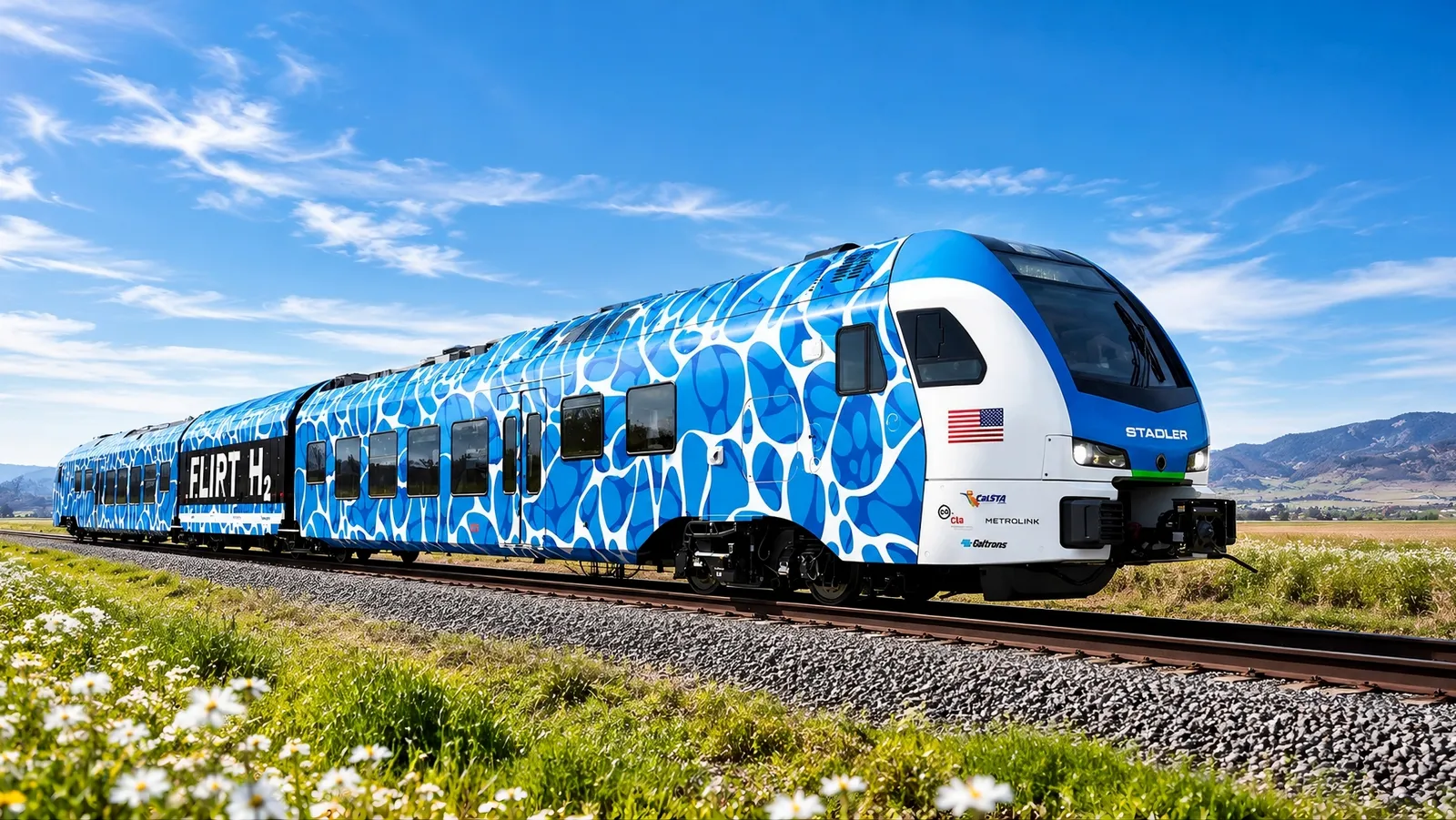
The United States has just unveiled one of its most intriguing initiatives to transform rail transportation. It involves a fully electric train that can operate without being connected to an overhead catenary, relying instead on large batteries to store the electricity needed for its journeys. This solution allows for the elimination of diesel engines without the need to install overhead cables along the entire route.
Behind this project is Metra, Chicago’s commuter rail operator, which will invest $234 million in acquiring eight battery-powered electric trains. These vehicles are manufactured by Stadler, a Swiss company specializing in rail equipment, and represent one of the first applications of this technology developed specifically for the U.S. market.
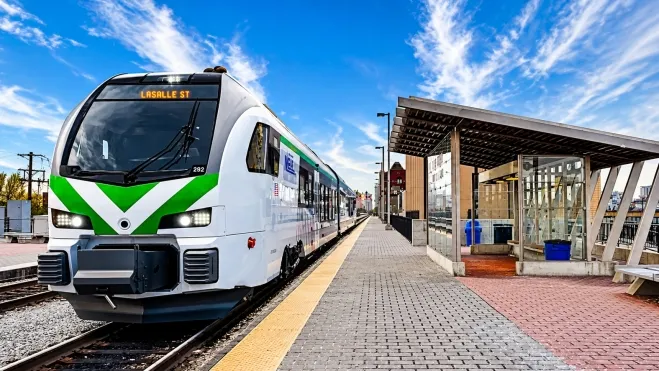
The first convoy was already unveiled publicly, first during the APTA EXPO 2026 trade show held in early October, and later at LaSalle Street Station, where citizens could see it up close. However, various tests remain before the new trains begin carrying passengers, a timeline set for 2028.
Up to 113 kilometers of range without a catenary
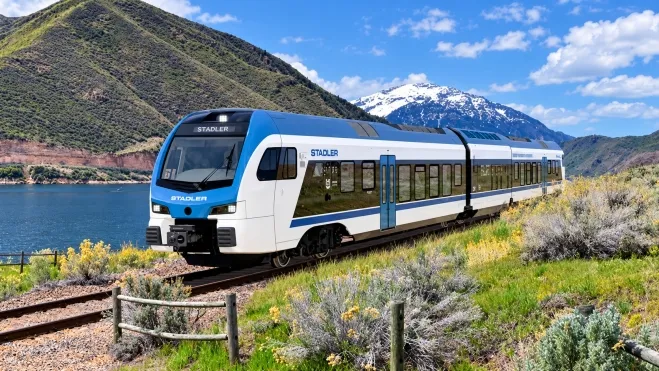
The star of this investment is the Stadler FLIRT BEMU, an electric train equipped with lithium-ion batteries to power its motors. Unlike conventional electric trains, which generally require a continuous supply of electricity from an overhead line or third rail, this model can operate on railway lines that lack electrification.
The expected range is 70 miles, equivalent to about 113 kilometers, a distance sufficient for numerous regional and urban routes. This allows railway operators to replace certain diesel trains without necessarily incurring the high costs associated with fully electrifying a line.
The batteries can be recharged using electrical installations located at stations and depots, as well as through dedicated charging infrastructure. Additionally, the train features regenerative braking, a technology that allows it to recover some of the energy used during operation and store it back in its batteries.
The main advantage is that these new trains can utilize existing railway infrastructure to travel without relying on continuous electrical power supply. This feature is particularly valuable in the United States, where many passenger lines still use diesel locomotives and lack overhead power lines.
The technology also offers environmental and operational advantages. By eliminating combustion engines during operation, trains reduce local emissions of pollutants and significantly cut down noise and vibrations. Additionally, electric propulsion enables faster acceleration, which is particularly useful on routes with many stops.
A $234 million investment to modernize Chicago
Metra plans to debut its new trains on the Beverly Branch of the Rock Island Line, a route that connects LaSalle Street Station in downtown Chicago with Blue Island to the south of the city. This is a route of approximately 26 kilometers, which is considerably shorter than the maximum range expected from these vehicles.
The choice of this line is not arbitrary. Its length, the proximity between stations, and its route through residential areas make it an ideal setting for introducing this technology. Reducing noise and local emissions is one of the main advantages over current diesel-powered rail services.
The new trains will have a four-car configuration, including a module dedicated to batteries. Each unit will offer 208 seating places, along with designated areas for bicycles and luggage. The interior will also feature passenger information systems, USB ports, and accessibility features for people with limited mobility.
Jim Derwinski, Metra’s executive director, believes these vehicles could open up new possibilities for commuter rail transportation. Their smaller size compared to conventional trains and their operational features would allow for higher frequencies during certain times, especially outside of peak hours.
The investment also has a significant economic dimension. The $234 million covers the purchase of the eight trains, although the operator has an option to expand the order with another eight units later. The program is funded by public money and is part of efforts to modernize a railway fleet whose average age exceeds three decades.
The first train has already been unveiled, but it won’t start operating until 2028
Later, the train was moved to LaSalle Street Station, where it remained on display on October 14 and 15. During those days, the public was able to access its interior and learn about the features of vehicles that represent a significant technological advancement over the diesel trains typically used by the operator.
However, the train on display was not yet ready for commercial operation. According to Metra, the vehicle needed to have its batteries installed and other work completed before starting the testing and certification process.
Once those works are completed, the trains will need to undergo safety and performance tests, including trials at facilities in Colorado. The goal is to assess their behavior under various conditions before allowing passenger service. Estimates suggest that the first units could enter service by 2028, with the delivery of all eight ordered trains being completed gradually by the end of that year.
This project also represents an important step for Stadler, which has been developing alternatives to diesel engines for years. Its FLIRT family includes conventional electric versions, units equipped with batteries, and models that use hydrogen—different technologies designed to meet the needs of each railway network.