
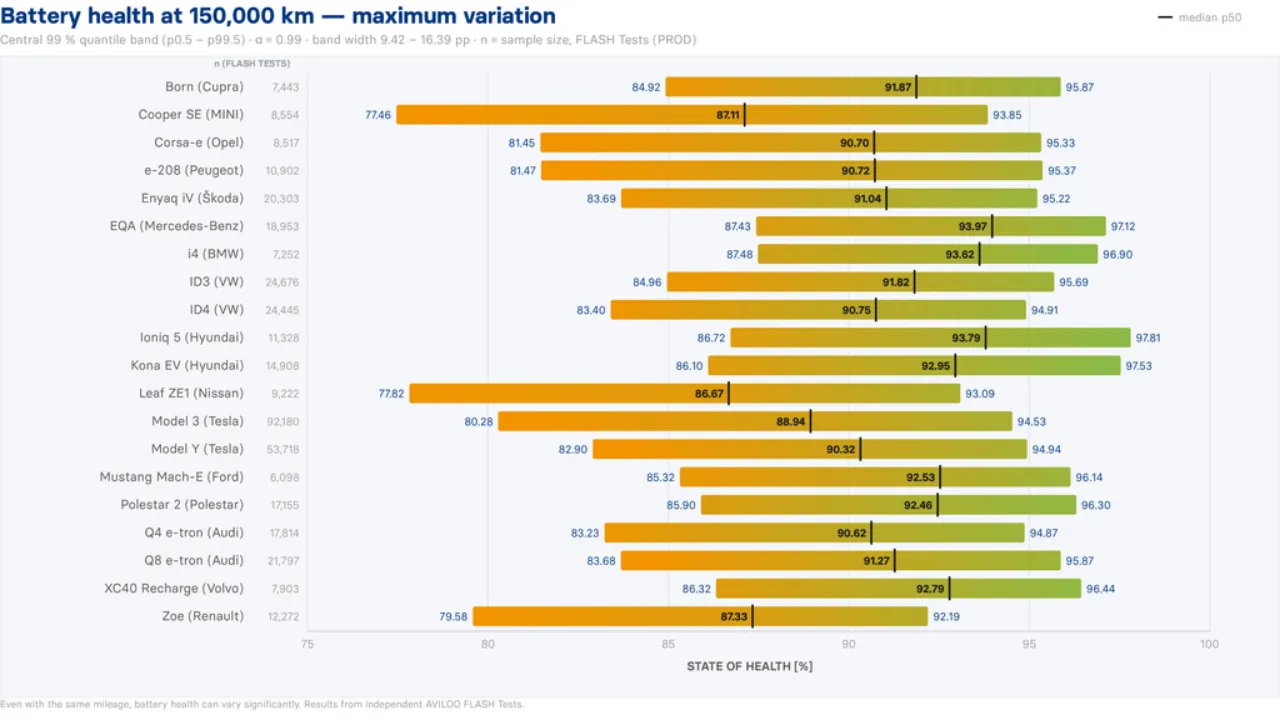
This is the battery degradation of 20 popular electric cars after 150,000 km.
The batteries in electric cars are more durable and retain their capacity much better than many people think. Despite the widespread belief that such vehicles suffer from poor longevity due to the degradation of their most critical component, in reality they perform very well even after extensive mileage.
This has been proven once again in a recent study conducted by battery diagnostics company Aviloo, which analyzed 500,000 electric cars over the past five years. The vehicles examined represented 20 highly popular models. The study was carried out between 2022 and 2026 in Asia, Australia, Europe, North America, and South America.
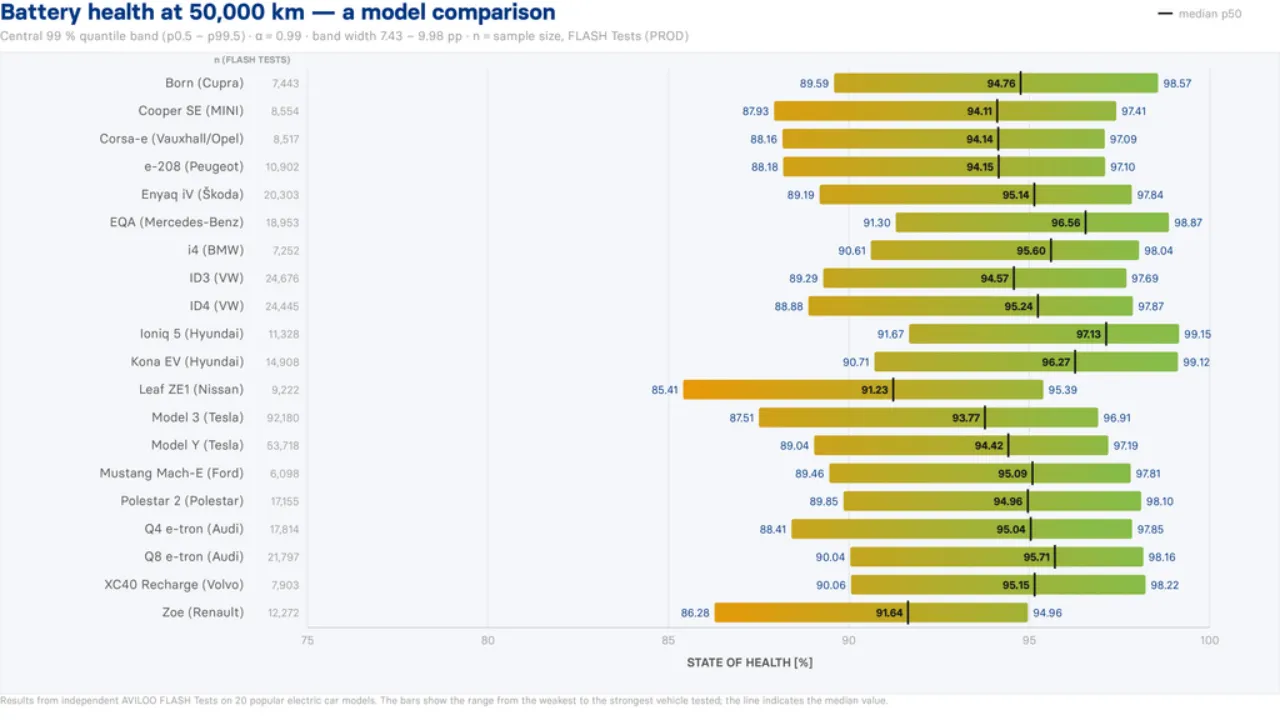
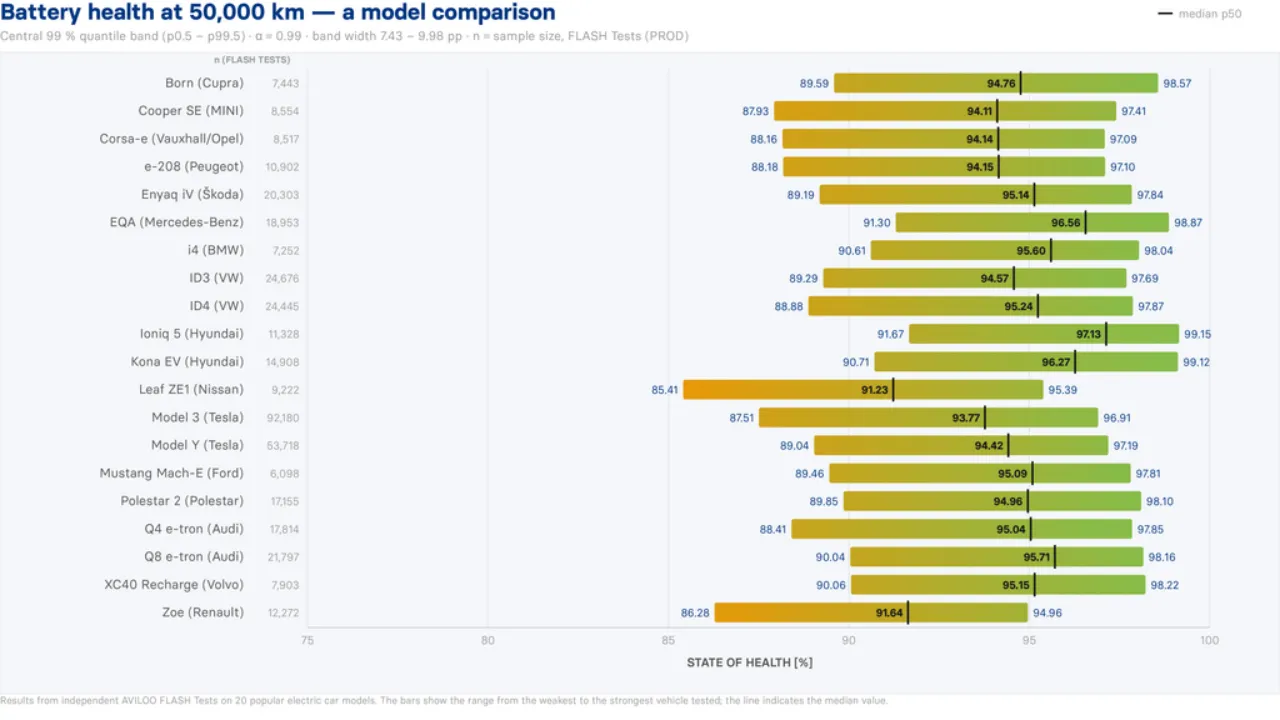
For each model, the company has calculated its average battery capacity compared to the original at 50,000 km, 100,000 km, and 150,000 km. As expected, not all models age at the same rate. For example, at 50,000 km, the model with the lowest degradation was the Hyundai IONIQ 5, achieving an average percentage of 97.13%. Followed by the Mercedes-Benz EQA at 96.56%.
All models analyzed score above 94%, except for the Nissan LEAF at 91.23% and the Renault ZOE at 91.64%. These vehicles use air-cooled batteries, and due to cost considerations, they have lower capacity packs, requiring more charging cycles to cover the same distance. Nevertheless, it’s worth noting that in all cases the average score remains above 90%.
Hyundai IONIQ 5 and Mercedes-Benz EQA perform best
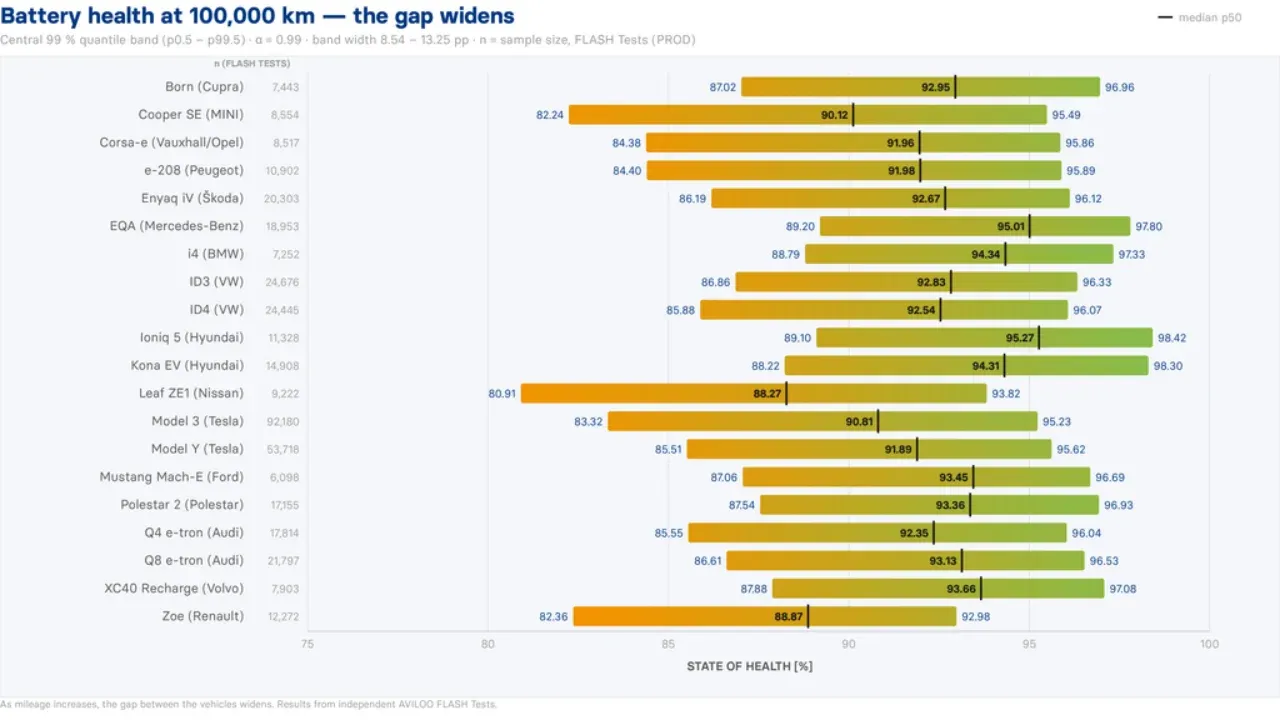
After 100,000 km, the Hyundai IONIQ 5 maintains its lead (95.27%) over the other models, while the Mercedes-Benz EQA (95.01%) holds onto second place ahead of the Hyundai Kona Electric (94.31%). All models analyzed achieved an average percentage above 90%, except for the aforementioned Nissan LEAF (88.27%) and Renault ZOE (88.87%), which were not far behind either.
In the end, after 150,000 kilometers, the Mercedes-Benz EQA takes the top spot (93.97%) ahead of the Hyundai IONIQ 5 (93.79%), followed by the BMW i4 (93.62%). At the bottom of the list are the Renault ZOE (87.33%), MINI Cooper SE (87.11%), and Nissan LEAF (86.67%), which suffer from smaller batteries... but still perform fairly well.
The most interesting aspect is that most of the models analyzed use NCM batteries (nickel, cobalt, manganese), which offer lower durability compared to LFP batteries (lithium-iron-phosphate), whose popularity has grown exponentially in recent times. Combined with the fact that electric cars are increasingly using batteries with higher capacity, this leads us to believe that if this study is repeated in newer vehicles in the future, the results will be even better.
We must also consider that climate conditions and charging habits affect battery aging, which is why two units of the same model can show significantly different levels of degradation after traveling the same distance (for example, at 150,000 km, the best Renault ZOE retained 92.19% capacity, while the worst only reached 79.58%).
Source | InsideEVs