
MG IM5 Review: Can China’s Premium Electric Car Challenge German Leaders?
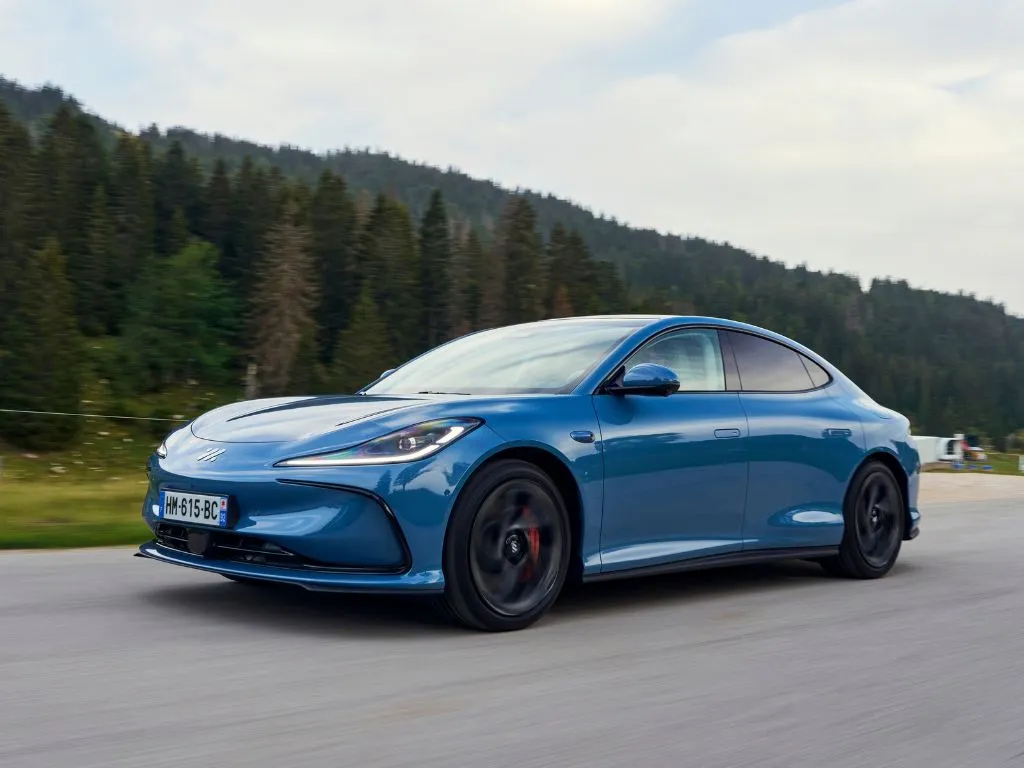
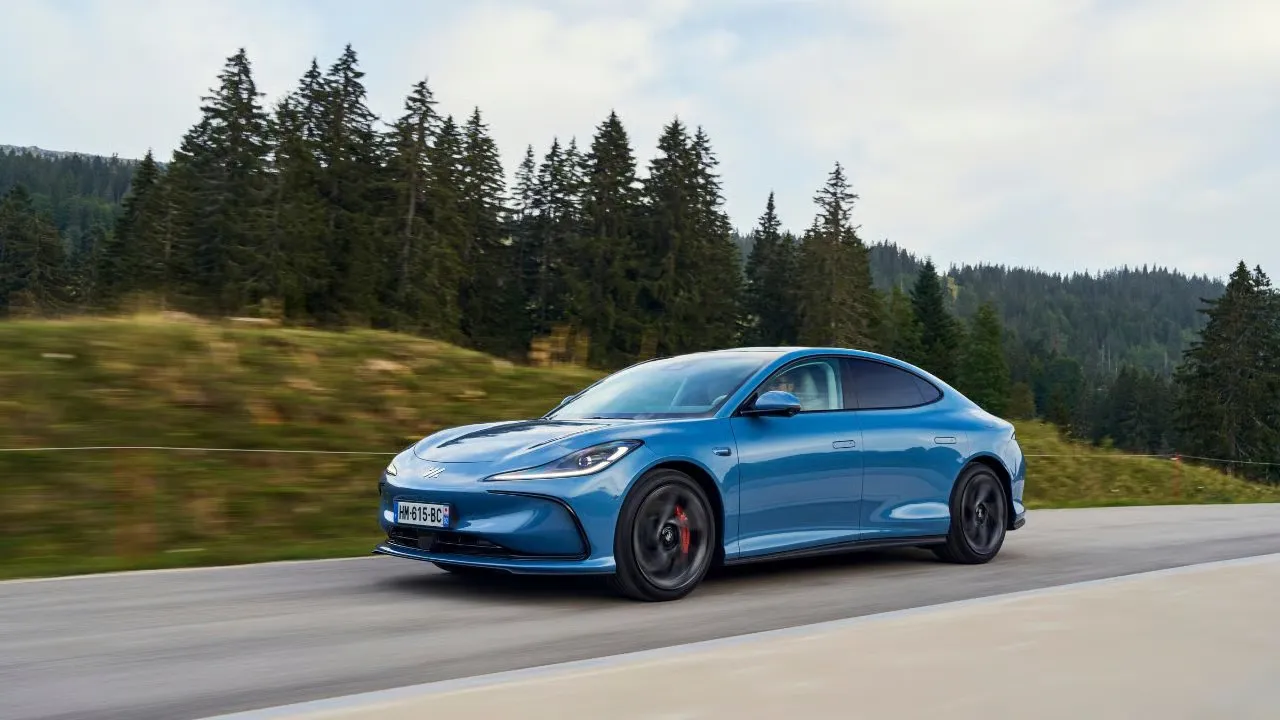
The IM5, sold as an MG in Europe, is a large sedan that is already well-established in its home market and is now arriving in France. In this 4WD version with 751 horsepower, priced at 59,990 euros, it features a 100 kWh battery, an 800 V architecture, and fast charging at nearly 400 kW. While impressive on paper, this large vehicle is thankfully not defined solely by its technical specifications.
Following the IM6 SUV, here comes another “new” model that isn’t really new at all. While the MG IM5 sedan also debuts in the French market today, just like the IM6, its journey began in China in 2024 under the name IM L6. In other words, for the Old Continent, the MG brand serves as a gateway to this already existing Chinese sedan — retaining its IM emblem instead of the MG logo one might expect. And, as with the IM6, its arrival in Europe was gradual as well. Regardless, the ambition is clear: with the IM5, SAIC Group aims to challenge Tesla, BYD, and other major European electric sedans in their own backyard. With this 4WD version delivering 751 horsepower, it’s evident they chose to enter quietly without making a big splash.
Also read
MG IM6 test: 751 horsepower and 396 kW of charging power to challenge the Tesla Model Y
Style and dimensions of the MG IM5
In photos, the IM5 almost appears to be a relatively compact family sedan. However, up close, the impression changes quickly: at 4.93 meters in length, it is nearly 21 cm longer than a Tesla Model 3 and almost as long as a Volkswagen ID.7. Its wheelbase of 2.95 meters is comparable to that of a Mercedes Classe E.
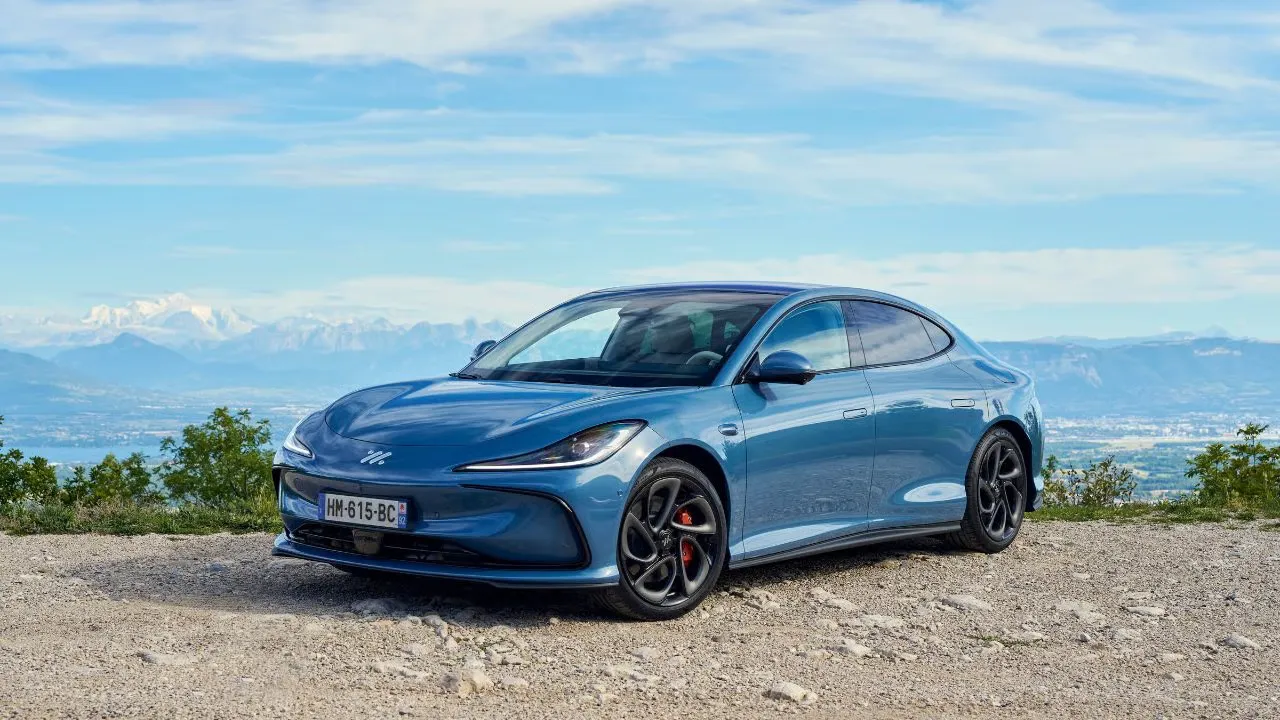
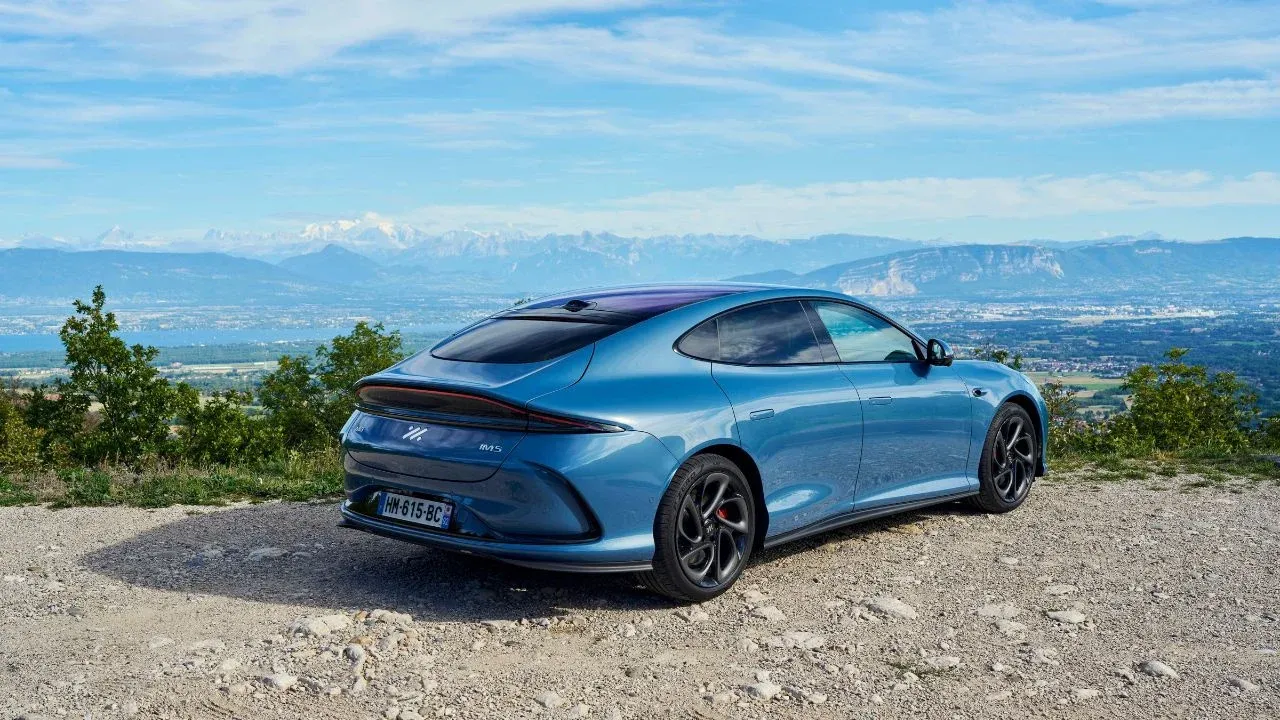
The good news is that these dimensions are quite manageable. Low, sleek, and free of any unnecessary embellishments, the IM5 handles its half-decimeter length much better than its bulk would suggest. Its fastback profile is elegant, with exposed handles and frameless windows adding to its appeal, while the rear end, highlighted by a thin light strip and a slight spoiler, has more character than the front.
The front end, on the other hand, leaves us more skeptical. With its narrow headlights, steep hood, and completely closed front fascia, the IM5’s style relies a bit too heavily on the conventions of Chinese electric sedans. The design is serious, but it lacks that distinctive detail that would instantly make one recognize it as an IM5.
The aerodynamic design is beyond dispute: the Cx value is 0.23. However, just like in the IM6, the downside becomes apparent as soon as you look in the interior rearview mirror—the rear window is extremely small. Elegance and visibility don’t always go hand in hand.
Cabin, trunk, and daily use of the MG IM5
If you step into the IM5 after being in an MG4, you’ll notice a quite dramatic change in atmosphere. After being greeted by a somewhat cheesy symphonic sequence, you’re presented with a much more ambitious design. Abundant foam surfaces and furniture covered in expensive-looking synthetic leather aim to create an atmosphere of a mobile lounge. Everything is well put together, and the heavily padded seats contribute to this upscale impression. Premium? Almost, but not quite. The IM5 certainly impresses with its quantity and visual appeal, but upon closer inspection, some lower-quality plastics and minor finishing details remind you that cost-cutting was the priority. In short, it remains more than adequate and often flattering, but no premium materials are used to justify such a label.
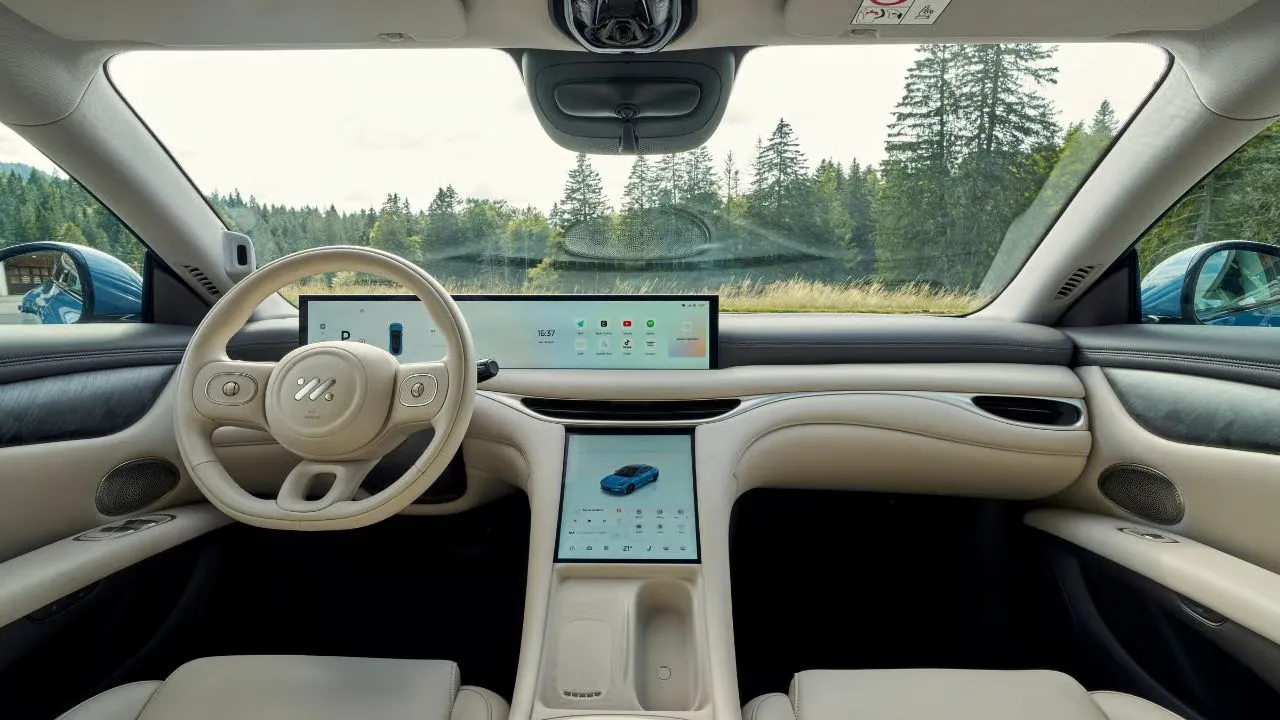
The interior is arranged in exactly the same way as that of the IM6. In other words, it’s impossible to avoid the screens. A giant 26.3-inch display runs along the front of the driver and in the center of the dashboard, while a second 10.5-inch screen is located on the console. Clear graphics, excellent responsiveness, Apple CarPlay, and Android Auto: technically, this device delivers on its promises.
From an ergonomic standpoint, it’s less appealing.
Like the IM6, this car dates from a time when minimalism and the complete elimination of controls were all too often confused. Adjusting mirrors, setting vents, controlling climate, or adjusting lighting are all done through screens. When parked, all of this still appears very modern. On a bumpy country road, it’s far less so. One has to take their eyes off the road to perform actions that could be adjusted instinctively with a simple button.
Some of this digital fascination is understandable when appreciating the equipment. Electric, heated, and ventilated front seats, heated rear seats, a large panoramic roof, 256-color ambient lighting, and a 50 W ventilated wireless charger: MG doesn’t skimp on the standard features. The active noise reduction system is also noteworthy, as the IM5 remains remarkably quiet on highways.
At the back, the enormous wheelbase naturally provides plenty of knee space. However, better posture support was expected. The floor, thickened by the battery, raises the feet slightly, and space under the front seats is limited. As a result, larger drivers end up with their knees raised more than they should in a car nearly five meters long. Fortunately, the large glass roof helps maintain a sense of space.
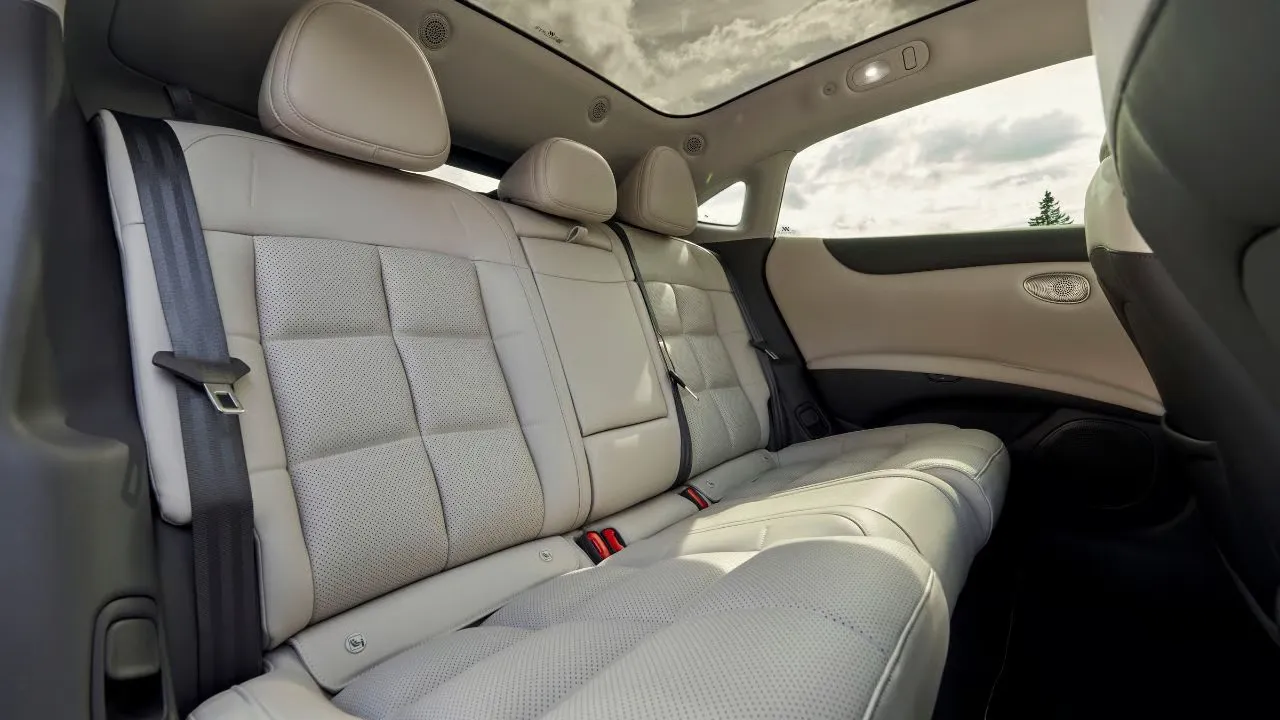
The trunk, accessible via a large hatch, has a capacity of 457 liters, with an additional 18 liters under the front hood. Once again, the vehicle’s exterior dimensions suggested more space: at 4.72 meters long, a Tesla Model 3 makes much better use of the available volume.
On the road: many figures, some nuances
751 horsepower, 802 Nm of torque, and 3.2 seconds to reach 100 km/h: the IM5 Performance’s sleek design hides almost absurd performance potential. Two engines, all-wheel drive, and a top speed limited to 239 km/h (while the Chinese version can reach nearly 270 km/h): this is truly the domain of high-performance vehicles.
With the engine at full throttle from a stop, the horizon truly comes rushing toward you, thanks to the unique intensity of electric vehicles where neither acceleration buildup nor gear shifts interrupt the thrust. Yet the IM5 has the advantage of not constantly trying to overwhelm you. The accelerator response remains gradual, and power builds up smoothly... before becoming utterly excessive.
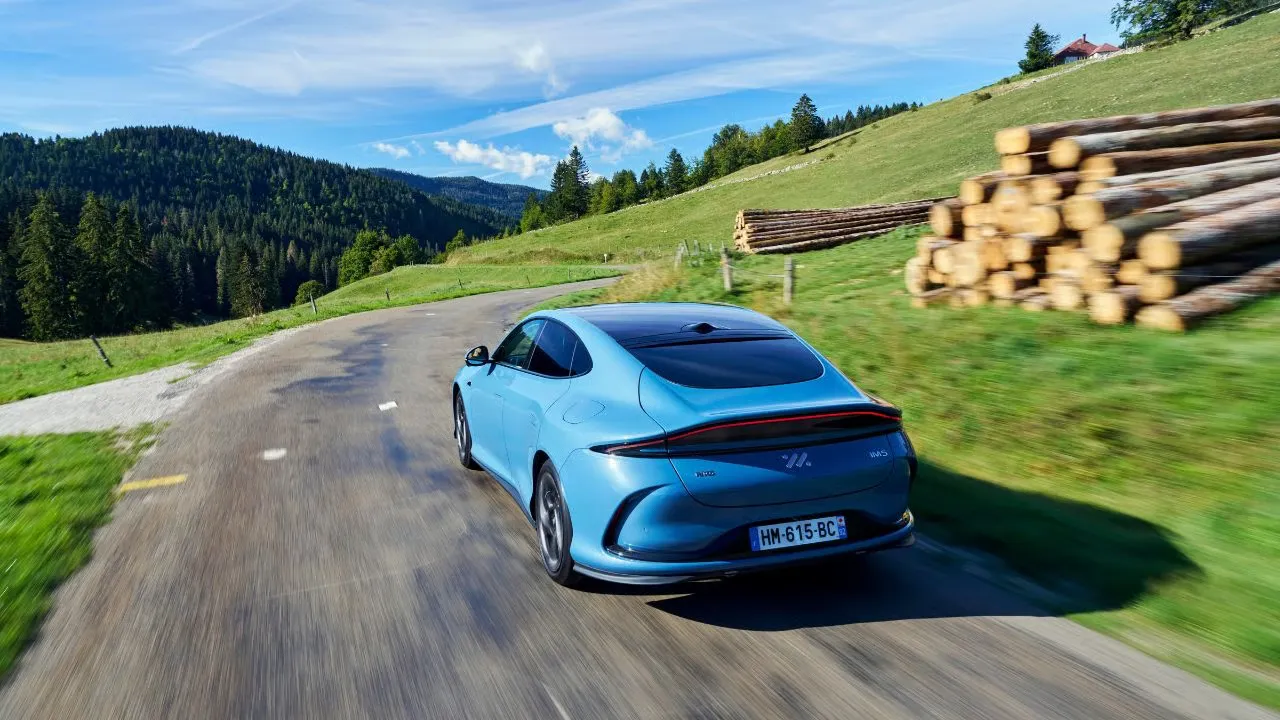
This progressive nature makes the 4WD surprisingly easy to drive. The chassis appears quite balanced, with rear-oriented traction and well-controlled roll. Of course, you can never completely eliminate nearly 2.3 tons of weight, but the IM5 changes direction with agility that its size would suggest otherwise.
The four-wheel steering system plays a major role in this. Up to 12° of rear steering turns the car into a city car for maneuvering — a turning radius of less than 10 meters is sufficient to turn between curbs — making urban driving much less intimidating. Most importantly, its intervention doesn’t create a too artificial feel once the speed increases.
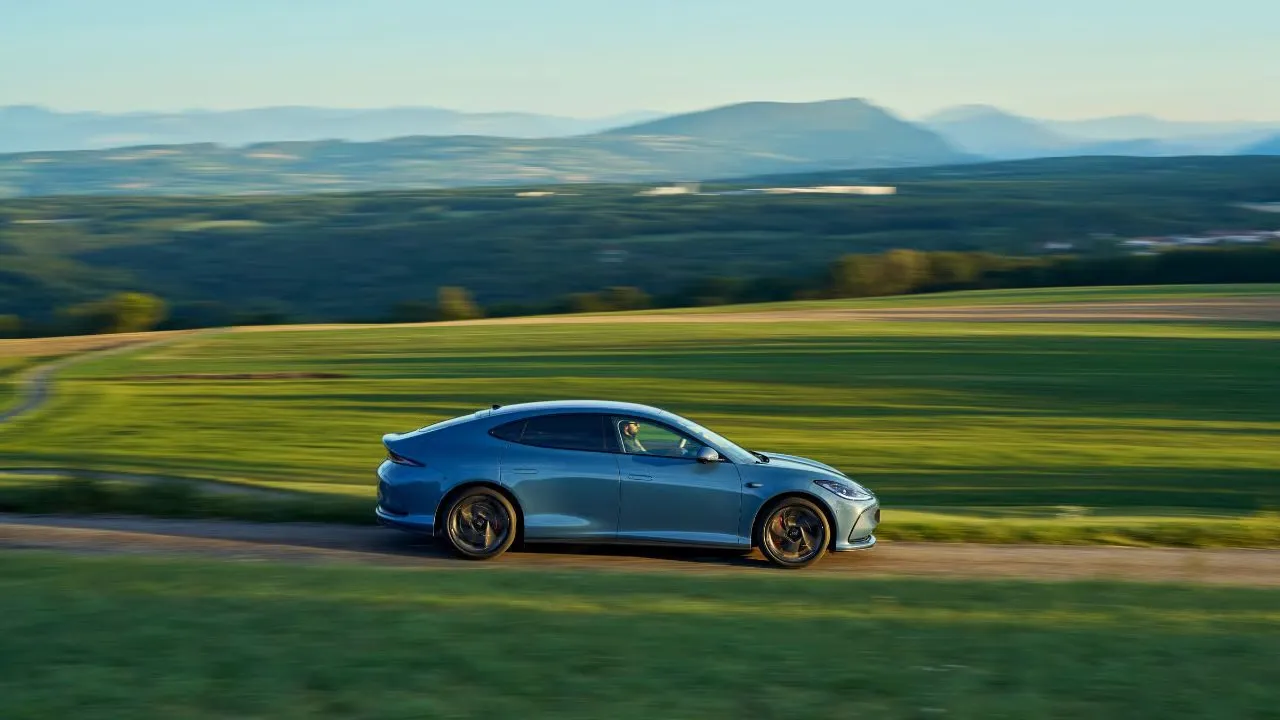
The steering itself lacks naturalness quite noticeably. It’s fast and precise, but its effort and feedback hardly convey any sensation. It’s as if driving a drone—one can effectively steer the car without truly feeling what’s happening under the front wheels. The brake-by-wire system gives a similar impression: powerful and properly integrated with regenerative braking, but not always perfectly consistent in its response to the pedal.
This IM5 isn’t therefore a high-performance electric sports car, but first and foremost an exceptionally fast road vehicle. It truly shines when one stops trying to maximize its 751 horsepower: it remains stable, comfortable, and extremely quiet. Unlike the IM6, it lacks electronically controlled air suspensions, but this ultimately doesn’t harm its performance. Weighing nearly 200 kilograms less than the SUV, it even appears more cohesive as a result. Some vibration occurs on poor-quality roads, but at highway speeds, it excels at isolating its occupants.
Range and Charging
Beneath the floor lies a 100 kWh (96.4 kWh net) NMC battery with an 800 V architecture, which is still far from being widely adopted at this price point. Theoretically, it can accept up to 396 kW of DC current for charging.
Our brief time with the vehicle didn’t allow us to verify this, but under optimal conditions, 17 minutes would be sufficient to raise the SoC from 10% to 80%. In our opinion, this is certainly a figure that truly changes how the public perceives and uses an electric car, far more so than a few tenths of a second gain in 0 to 100 km/h acceleration.
Regarding range, our 4WD version logically has a shorter range due to its two motors and higher performance compared to the 2WD version. Expect around 575 km WLTP, while the 2WD version achieves over 700 km combined range.
Also worth reading
Testimonial – Bruno traveled 76,000 km in a Tesla Model 3 at only 3.33 € per 100 km
In the Jura mountains, on the roads where we conducted our test, we recorded 22 kWh per 100 km. This results in a real range of around 480 km.
In any case, with such a large battery capacity and short charging times, the IM5 has genuine qualities as a long-distance vehicle. It’s a pity that the regeneration levels can only be adjusted from the central screen, rather than through a physical control or buttons on the steering wheel.
Test summary
The IM5 4WD illustrates the progress of China’s automotive industry. Just a few years ago, people would have focused mainly on its price-to-specification ratio, but today doing so would almost be missing the point.
Yes, this two-motor sedan comes equipped with 751 horsepower, a 100 kWh battery, all-wheel drive with steering capability, an 800 V architecture, and up to 396 kW of charging power. However, the IM5 isn’t just about stacking impressive numbers. It’s also quiet, comfortable, incredibly fast, and well-engineered enough to make one consider driving across Europe in it without hesitation.
That said, its digital cockpit bothers us, the trunk fails to make full use of its nearly five meters of space, and the rear passengers could benefit from a better seating position. As for steering and braking, they still lack the precision that separates a good sedan from an excellent one. By trying to digitize and sanitize everything, they also eliminate the sensory experiences that bring joy to driving.
The 751 hp version is fun and impressive, but honestly, completely unnecessary. We’ll need to try it out, but it’s highly likely that if forced to choose, we’d prefer the “long range” 2WD version—less spectacular on paper but more consistent.
Still, the IM5 shows once again that Chinese manufacturers no longer need to compete solely on price: they also know how to challenge Europeans in terms of technology.
MG IM5 4WD Technical Specs
Dimensions (L/w/h: 4.93/1.96/1.47 m)
Weight: 2,298 kg
Powertrain: 2 synchronous electric motors
Power: 554 kW (751 hp)
Max torque: 802 Nm
Battery capacity: 100 kWh gross, 96.4 kWh net (875 volts)
Transmission: all-wheel drive
0 to 100 km/h: 3.2 seconds
Top speed: 239 km/h
WLTP range: 575 km
Measured fuel consumption: 22 kWh/100 km
AC charger: 11 kW
DC charger: 396 kW
Trunk space: 457 l/18 l
Starting price of the series: 53,990 €
Price of the model tested: 59,990 €
