
Test BYD Dolphin G DM-i: a rechargeable super hybrid city car, but why?
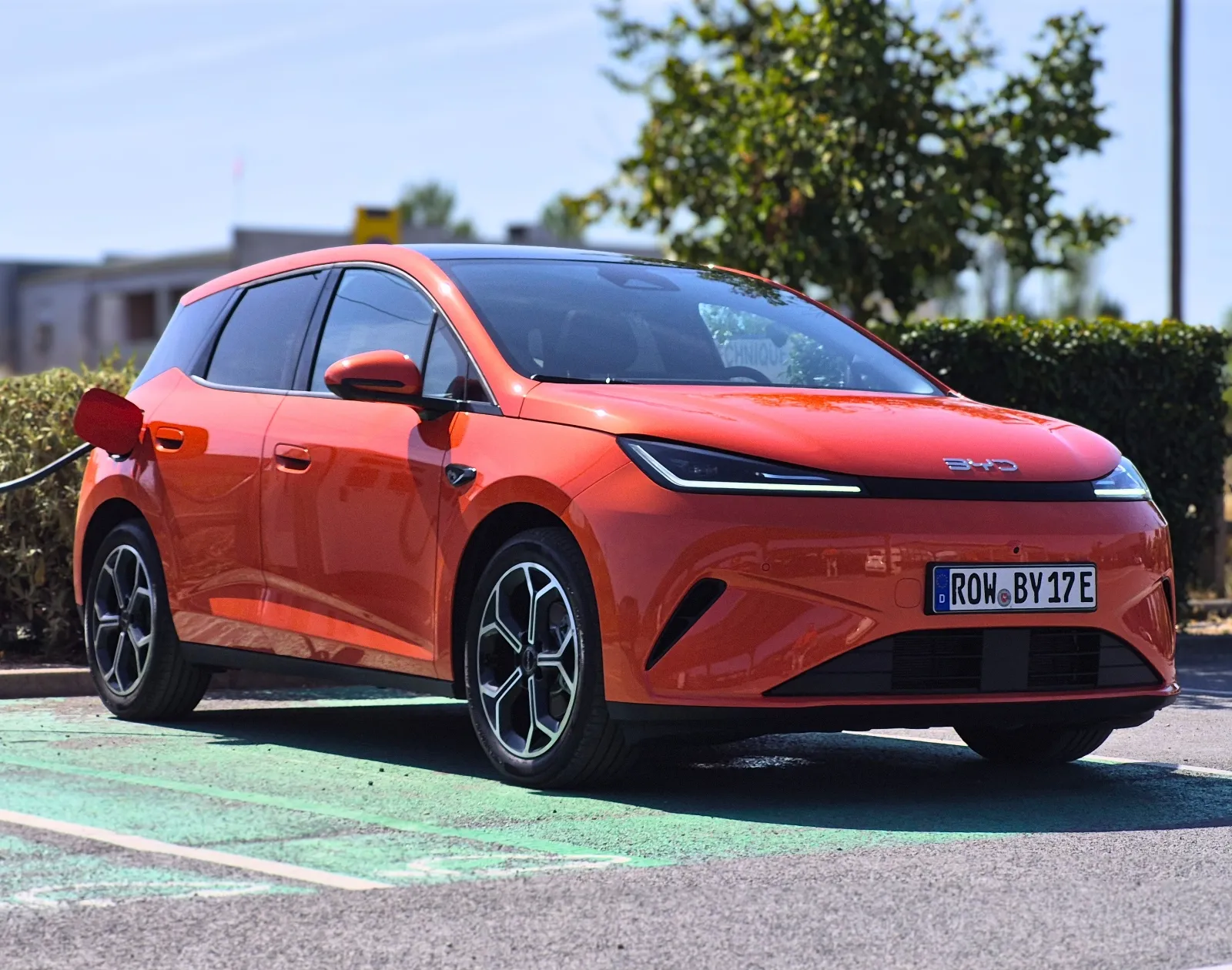
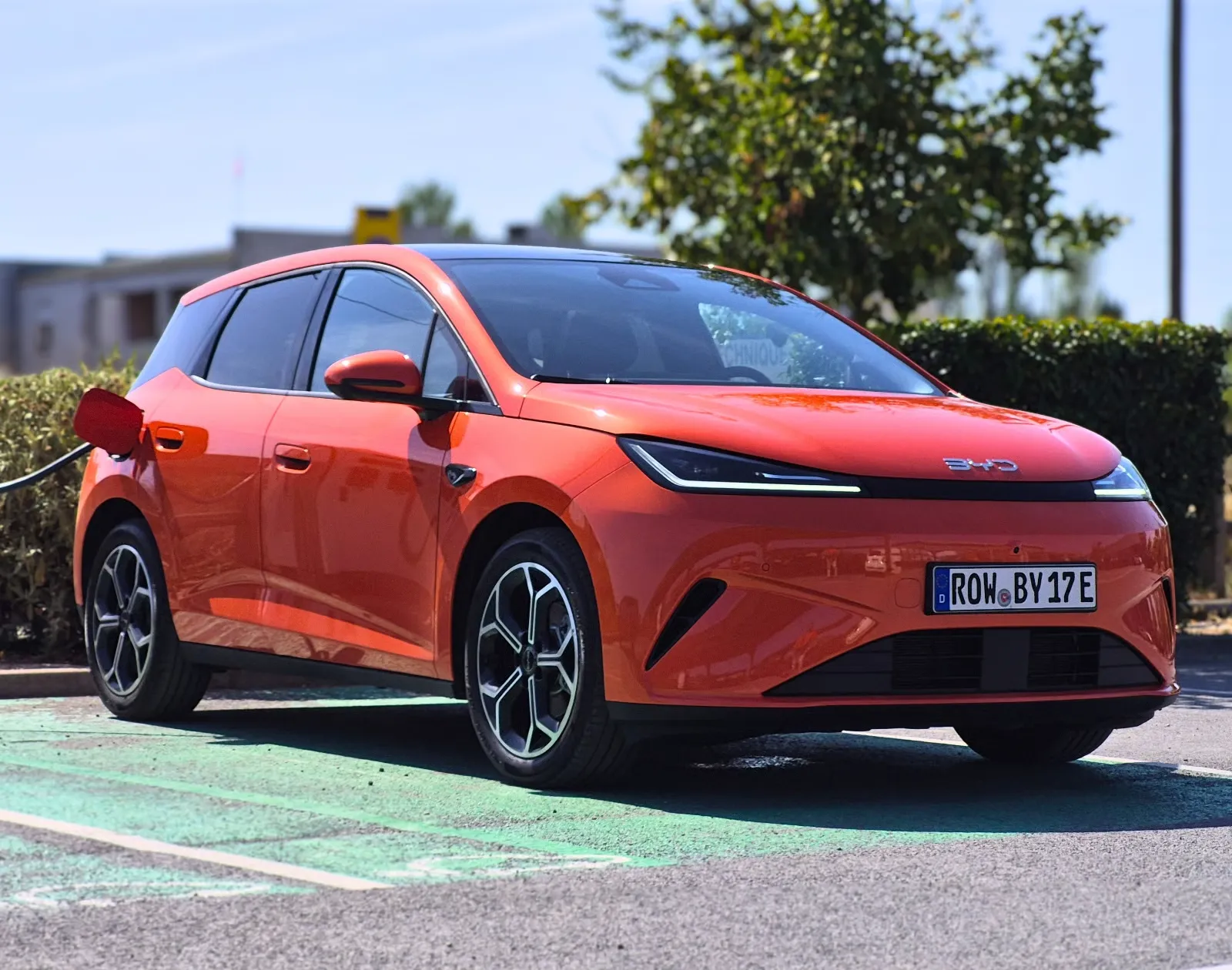
The 100% electric car has not yet eliminated rechargeable hybrids, far from it. As Europe moves slowly to fully adopt pure electric vehicles, China’s largest automaker BYD has launched a model specifically designed for the needs of our old continent: the Dolphin G DM-i. With its relatively large battery, this “super hybrid” city car allows for daily commuting on electricity while still having a gasoline engine as a backup. But be careful for those who don’t play by the rules of charging.
The topic of rechargeable hybrid cars is highly controversial. With one foot in electric power and the other in gasoline, these vehicles are often criticized for their complexity and highly variable environmental impact. For BYD, which is launching its Dolphin G DM-i, a rechargeable hybrid city car intended solely for the European market, this powertrain is seen as a stepping stone toward 100% electric vehicles.
Our brief test summary
️ Fuel consumption measured at 130 km/h with an empty battery in hybrid mode: 7.7 l/100 km
⚡ Fuel consumption measured at 130 km/h with a full battery in electric mode: 21 kWh/100 km
️ Fuel consumption measured in hybrid mode on small roads: 3.9 l/100 km
Measured DC charging performance: 47 kW peak, 16% to 88% charge in 26 minutes.
Excellent road handling
Very stiff suspension
Dashboard and HUD partially obscured for tall individuals
A low-cost rechargeable hybrid city car shaking up the market
While rechargeable hybrids have traditionally been reserved for relatively large vehicles with expensive high-end trims favored by professionals, the Chinese giant’s model could redefine the market. For the first time, this powertrain is available in a standard city car at particularly attractive prices.
With a commercial discount, it’s possible to get a Dolphin G DM-i in the “Active” version for less than 22,000 €, offering 42 km of electric range with its 7.4 kWh usable battery. For under 25,000 €, the higher-end “Boost” version comes with a 18.3 kWh battery providing 109 km of zero-emission range. This puts it in competition with the non-rechargeable hybrid Clio, which starts at 24,600 €.
A pleasant interior, despite a few minor issues
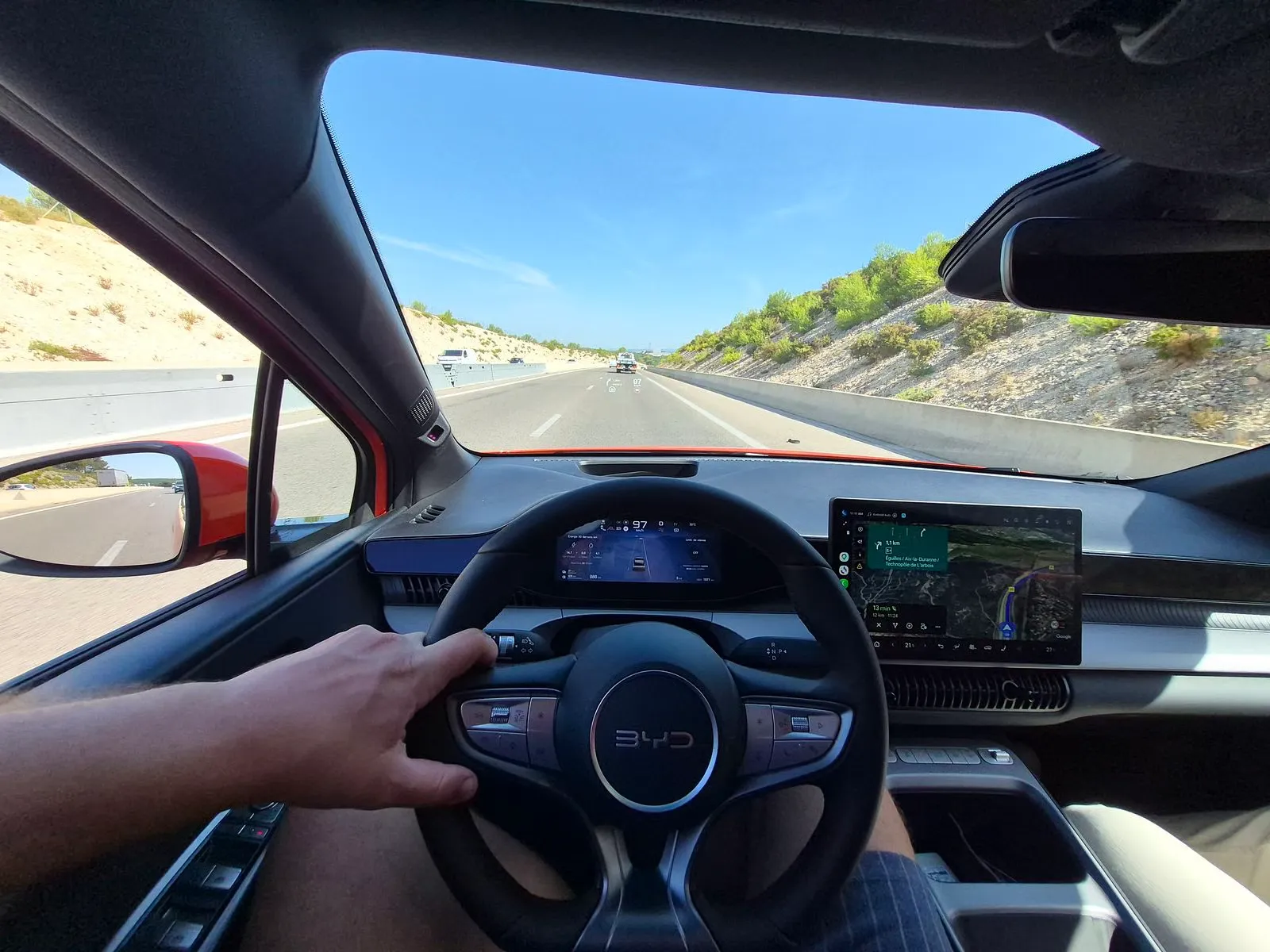
The overall impression inside is comfortable. Despite our 190 cm height, we had no trouble fitting into the driver’s seat of the Dolphin G DM-i “Comfort” model we tested. A large 12.8-inch infotainment tablet sits at the center of the dashboard, along with an 8.8-inch instrument screen.
The only drawback is the steering wheel adjustment (height and depth), which is not suitable for tall individuals. It constantly blocks the upper part of the dashboard screen, and no adjustment, not even that of the seat, fixes this issue. The same applies to the overhead display, which, although adjustable, remains partially obscured.
While the tablet boasts a very high resolution and satisfactory responsiveness, the layout of the menus and the description of certain functions are not outstanding. At times, it seems as though a careless translation was used when setting some options, and we struggle to understand certain technical details.
Despite its compact size (4.16 meters long, 1.82 meters wide, and 1.57 meters high), it offers satisfactory interior space even in the rear seats. Its 425-liter trunk is more than sufficient for daily use and can be expanded to 1,225 liters by folding down the rear seats. The cabin is very bright thanks to the glass roof (with electric sunshade), which is standard on the “Comfort” trim level.
Key features of the BYD Dolphin G DMi
Active trim
Boost, Comfort, and Sport trims
Total power and torque
(internal combustion + electric)
175 hp
210 Nm
212 hp
210 Nm
Useful battery capacity
7.4 kWh
18.3 kWh
Electric-only range
(WLTP mixed cycle)
42 km
109 km
Total range
(gas + electric, WLTP mixed cycle)
1,020 km
1,040 km
Average electricity consumption
(WLTP mixed cycle)
15.8 kWh/100 km
16 kWh/100 km
Average gasoline consumption
(WLTP mixed cycle)
4.3 l/100 km
4.5 l/100 km
AC charging
3.3 kW
6.6 kW
DC charging
–
39 kW
Empty weight
1,440 kg
1,550 kg
Price including tax in catalog
23,990 €
26,990 to 29,490 €
Monthly lease payment
(NO DOWN PAYMENT LOA, 48 months, 15,000 km)
325 €
Not configurable without a down payment
The gasoline engine, useless most of the time?
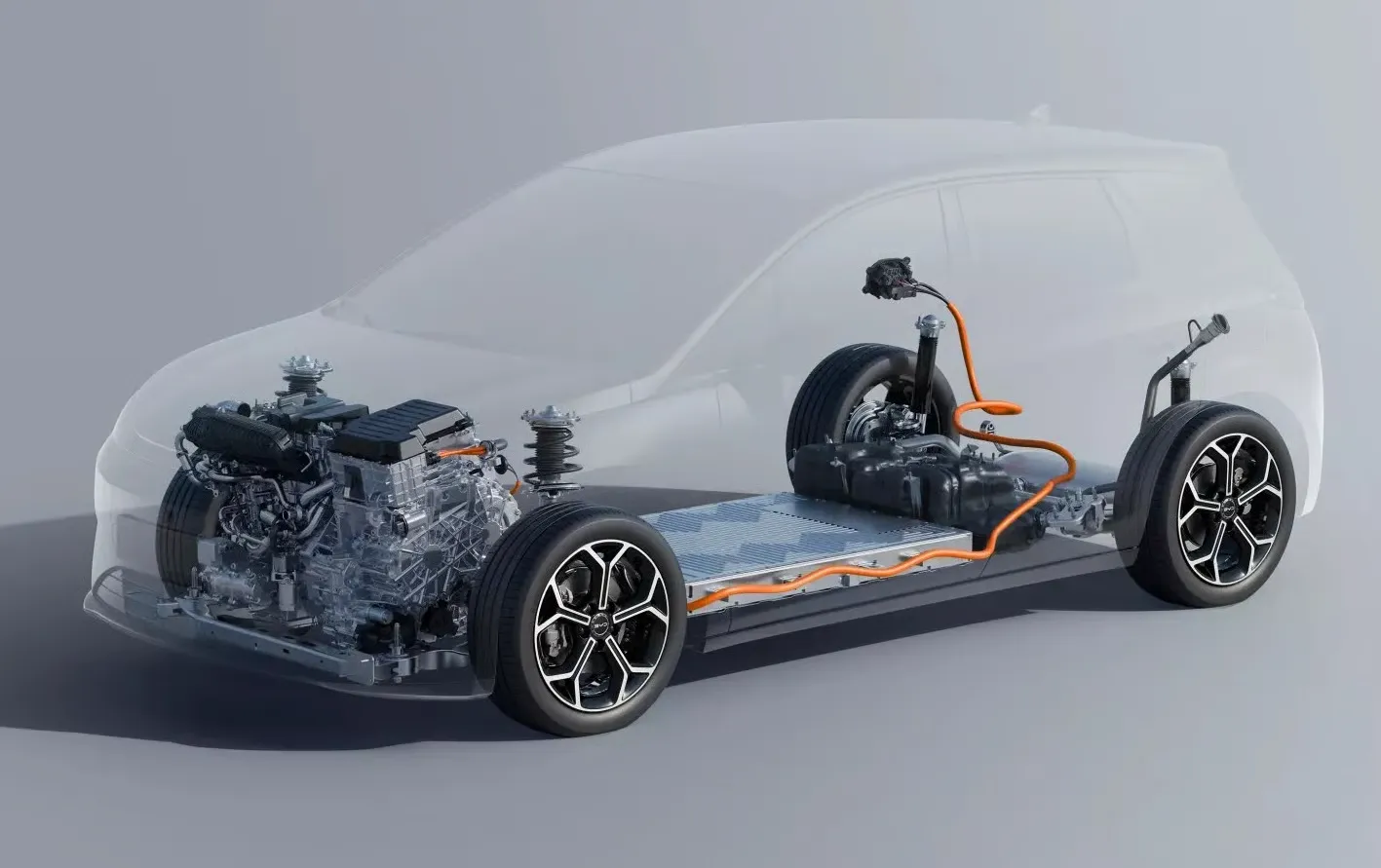
Under the hood, it’s somewhat of a hybrid setup. There’s a 4-cylinder gasoline engine producing 95 horsepower and an electric motor delivering 163 horsepower, combined into a single unit that yields 212 horsepower and 210 Nm of torque in the “Comfort” version tested. Some might say this is too complex for a simple city car. That’s true to some extent, as in reality, the gasoline engine should only be used for a few days a year.
With a range of around 100 kilometers on pure electric power, the Dolphin G DMi can cover the vast majority of daily commutes if charged every day. The internal combustion engine is only useful for longer trips: vacations, weekend getaways, or long business journeys.
Excellent road handling
In terms of performance, the engine delivers a 0 to 100 km/h acceleration time of 8.3 seconds. It’s not particularly dynamic, but that’s not what you expect from a city car. When pushed to its limits, the electric motor’s immediate torque is clearly felt, though it doesn’t press us firmly into our seats. To achieve stronger performance, the “Sport” driving mode must be activated, as the “Normal” and “Eco” modes slightly restrict performance. Be careful not to engage the kickdown feature either, as it could activate the internal combustion engine and ruin the Dolphin’s quiet operation and low carbon footprint.
The McPherson suspension at the front and simple torsion bars at the rear offer a handling experience that lives up to its name. It’s quite rough when passing over potholes and bumps, especially since the vehicle’s weight doesn’t help—1.55 tons empty. It almost makes you want to sit up in your seat, just like a motorcyclist.
Fuel consumption on departmental roads
Apart from a few tests of full acceleration, fuel consumption drops to as low as 3.2 L/100 km, which is a very respectable figure. However, this isn’t fully representative. A rechargeable hybrid vehicle can perform either well or poorly depending on its battery charge level and usage patterns. So we decided to take it to a fast charging station to recharge it.
Recharging a rechargeable hybrid at a DC fast charging station? It’s possible.
The BYD Dolphin G DM-i is one of the few rechargeable hybrids capable of being charged using direct current (DC) at relatively high power. This feature is standard only on the model with a 18.3 kWh battery, starting from the “Boost” trim level. In addition to a 6.6 kW AC charger, it supports up to 39 kW DC via the CCS combo port, allowing the battery to reach 30% to 80% charge in 26 minutes.
We arrive with 16% battery left at an ABB fast charger located in a Lidl parking lot. To our great surprise, the city car quickly exceeds the advertised DC charging capacity, reaching a maximum of 47 kW. That’s 8 kW more than specified in the technical specs. After 12 minutes of charging, we already have 60% battery, with 8.9 kWh charged. The power drops gradually after that, around 65%, before finally dropping to about 17 kW once 80% is reached.
We unplug the car at 88% after a 26-minute charge that added 16 kWh of energy. The cost using Lidl’s app rate is 6.24 €, enough for about 100 kilometers of pure electric driving. This is slightly more economical than driving on 100% gasoline, which would have cost exactly 9 € (at 4.5 liters per 100 kilometers).
As long as the fast charger doesn’t charge an exorbitant rate per kWh, quick charging is economically worthwhile during a break on the highway. Time to refuel, use the restroom, and you’ll have enough charge to significantly reduce fuel consumption for the next leg of the trip.
Electricity consumption on the highway at 130 km/h with a full battery
It is on the highway that the rest of our test takes place. We take the A8 near the La Barque toll booth (still in Bouches-du-Rhône) heading toward the Côte d’Azur with 88% battery charge. The EV mode is activated, traffic is smooth, and we drive at a constant speed of 130 km/h until the battery runs out.
How effective are driving aids?
We take the opportunity to test the driving aids, which are not outstanding. There is no true lane-keeping assist, but rather an anti-road-winding system, as the car keeps bouncing back and forth between the two lanes. It’s not pleasant at all.
The same is true for the adaptive cruise control: while it adjusts the speed well to vehicles ahead, it frequently applies unnecessary brakes when there are no obstacles in our lane. Even with the automatic speed adaptation function activated using speed limit signs, our vehicle never adjusted its speed (which is good in a way, since it does read forgotten construction signs or those for exit ramps correctly...).
After traveling 71 kilometers without any use of the gasoline engine, the battery in our Dolphin G DM-i dropped below the critical 20% mark. The EV mode automatically switched off to switch to HEV (hybrid) mode. The electric engine’s consumption was 21 kWh per 100 kilometers, which is not extremely high for a rechargeable hybrid traveling at an average speed of 122 km/h.
Gasoline consumption at 130 km/h with an empty battery
The battery of the Dolphin super hybrid can never reach zero. A 10 to 20% reserve is always maintained to allow operation in hybrid mode, as the gasoline engine alone is not powerful enough to move the vehicle under optimal conditions according to BYD. Thus, in HEV mode, this city car is capable of switching between parallel and series operation: depending on the needs, the internal combustion engine acts as a generator or a propeller, always assisted by the electric motor.
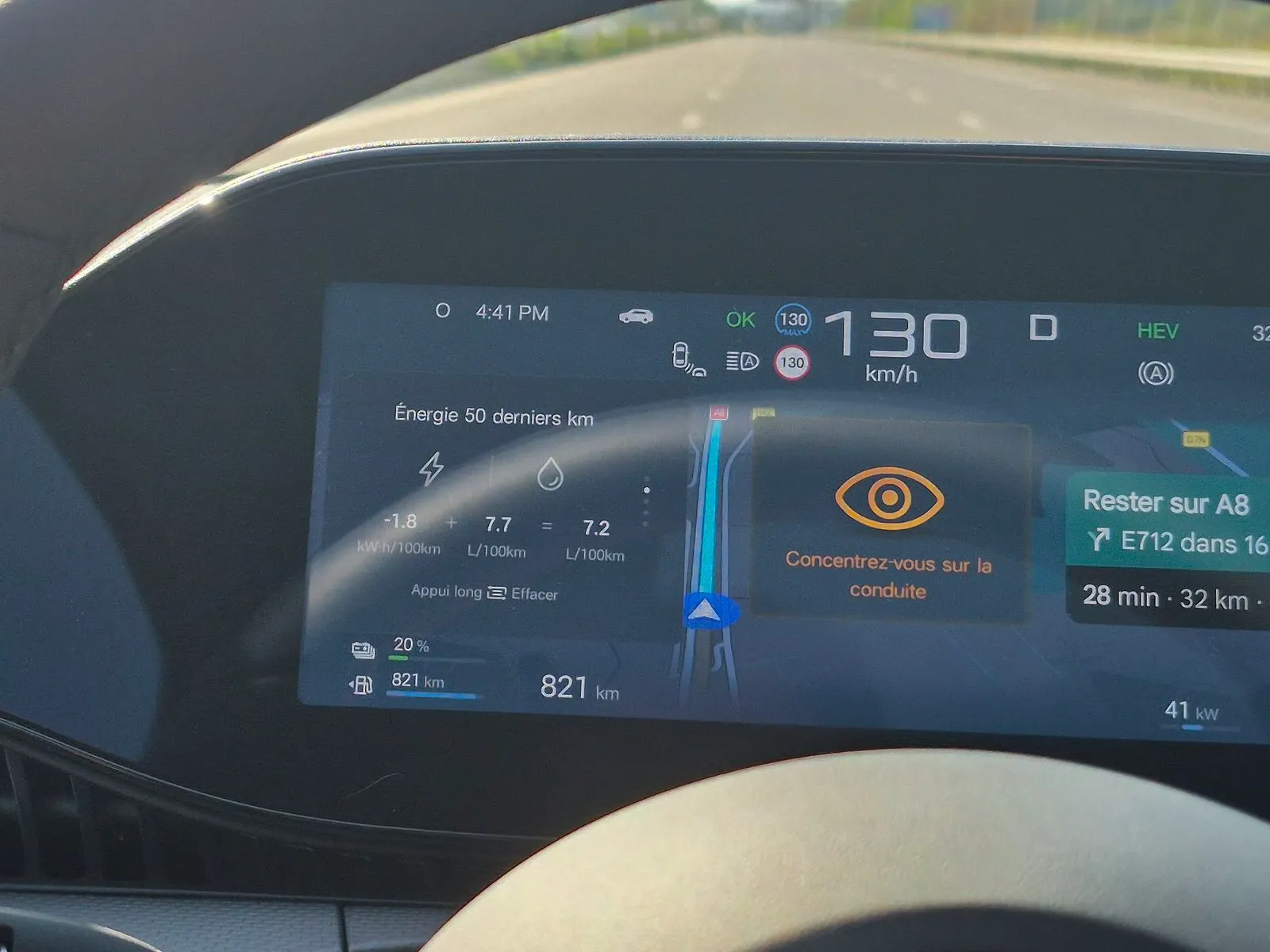
We begin the return trip from the Luc toll booth to the La Barque toll booth, with hybrid mode activated by default since the battery is no longer fully charged. Gasoline thus becomes our main source of energy to cover these 71 km. The engine runs almost continuously, though it isn’t always audible. We drive at the same speed as on the way there: 130 km/h with the cruise control on.
The result isn’t impressive, but it’s not surprising either: 7.7 l/100 km. We didn’t expect less, as rechargeable hybrids not regularly recharged are rightly known for being very fuel-intensive in such situations. All the advantage of this technology disappears if one refuses to plug the car into a charger regularly.
What is the purpose of the BYD Dolphin G DM-i?
This raises questions about the usefulness of such vehicles. Why not go straight to electric cars? One common argument is the difficulty in accessing charging ports or stations on a daily basis. In that case, a rechargeable hybrid car isn’t very useful either, as it needs to be charged frequently to enjoy low fuel consumption.
The other main argument is autonomy, which is considered low in 100% electric cars. This applies in certain situations: long-distance business trips, or for those who enjoy traveling to remote locations. Still...
With a BYD Dolphin Surf 100% electric model in the “Active” trim priced at 20,000 euros (thus cheaper than the Dolphin G DM-i), one can travel 322 km on a mixed WLTP cycle. Expect slightly less than 200 km on the highway, with a 10% to 80% charge taking 25 minutes. It’s entirely possible to travel from Marseille to Lyon with just one charging stop, or from Lyon to Strasbourg with three short stops. This isn’t a problem for occasional trips.
Catching the Last Holdouts
The Dolphin G DM-i still seems useful in certain niche markets. For example, sales professionals who drive hundreds of kilometers daily and can (and want) to recharge regularly, although this professional group generally has no interest in city cars. We also think of drivers who have a charging station at home but firmly refuse to switch to all-electric vehicles for their long trips, even occasional ones.
For these few people, indeed, the rechargeable hybrid can serve as a stepping stone toward a fully electric vehicle. They will enjoy sufficient electric range for daily commutes, along with 900 km of driving distance using the gasoline engine. A small luxury given current fuel prices.