
Spain sets a record for electric car sales, but only reaches 13.4% compared to Portugal’s 36.1% and France’s 38%.
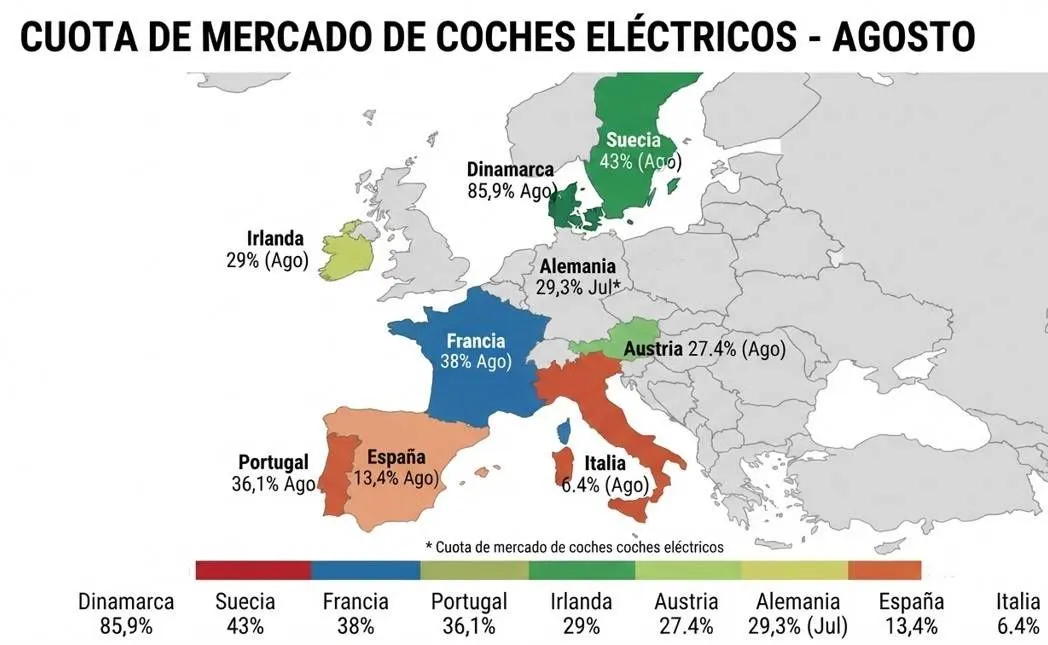
The registration data for August paint a picture that is increasingly hard to ignore. Spain, France, Germany, Denmark, and Portugal show vastly different rates of electrification, to the point where what in one country still appears to be a niche technology has already become the clearly dominant option in another. And what’s most interesting is that the difference seems to lie less in buyers’ interest and more in the conditions they encounter when making a purchase.
In Spain, electric cars accounted for 13.4% of registrations in August, setting a new record for the domestic market. This figure comes at a time of strong overall market growth, with 68,544 passenger cars registered during the month.
The comparison with our neighbors is particularly striking. Portugal reached 36.1% share of electric cars in August, meaning more than one out of every three new cars sold. The Portuguese association ACAP also confirms that registrations of electric cars grew sharply during the month, as the overall market expanded as well.
And here lies one of the key insights from these figures: Portugal’s share of electric cars is almost three times higher than Spain’s. We’re not talking about two markets with huge cultural differences or countries located at opposite ends of Europe. They are two neighboring markets with fairly similar car industries and offerings, but with very different adoption rates.
France sees another significant leap forward. Electric cars accounted for 38% of new vehicle registrations in August, with over 42,000 units sold — an 84% increase compared to the same month last year. This means nearly four out of every ten new cars are electric, making electric vehicles a fully integrated technology in the French market.
The French case is particularly significant because it’s not a small market. France is one of Europe’s major markets and holds substantial influence in the continent’s automotive industry. The fact that electric cars account for 38% means manufacturers can no longer design their strategies by treating electric vehicles as a secondary part of their product lineup. An increasingly larger proportion of the cars they must sell in France need to be electric, which ultimately affects decisions regarding production, investment, and the launch of new models.
Denmark is directly part of another league. Electric cars accounted for 85.9% of new registrations in August, with 13,887 units out of a total of 16,165 passenger cars. In other words, barely one in seven new cars registered in the country was not fully electric. FDM notes that this represents a new historical high for the Danish market.
The consequence is very significant: when a market reaches 85.9% penetration, electric cars stop competing on equal terms with gasoline-powered vehicles. Electric cars become the standard market segment, while the rest become exceptions. This changes the decisions of manufacturers, dealers, and even buyers, as available options, prices, and even resale value begin to adapt to this new reality.
Germany is also making rapid progress, though a clarification is needed in this case. As of September 3, the official registration data for August in Germany are not yet available, so it would be incorrect to assign a specific figure for that month. The most recent official data comes from July, when electric cars accounted for 29.3% of Germany’s market, up from 18.4% the previous year.
The German figures are likely the most significant from an industrial perspective. Nearly one in three new cars sold in Germany was already electric in July, and this occurred in Europe’s largest automobile market. Additionally, electric cars made up 25.5% of total registrations from January to July.
The comparison among the five markets yields a fairly clear conclusion. Spain, at 13.4%, continues to show progress, but it is far behind Portugal’s 36.1%, France’s 38%, and especially Denmark’s 85.9%. Germany, with its most recent available figure of 29.3%, is clearly above Spain and getting closer to the European markets that are accelerating their transition.
Country
Share of electric cars
Denmark
85.9% in August
France
38% in August
Portugal
36.1% in August
Germany
29.3% in July*
Spain
13.4% in August
*Germany’s official August figures had not yet been published as of September 3, 2026.
The figures show not merely that some countries buy more electric cars than others. They reveal which models work while others fail. Spain has struggled to get off the ground mainly due to a poorly designed subsidy program that has become a chronic problem no government can resolve. Programs that take almost a year to launch, with limited funding and slow implementation, end up being more of a burden than a help. This is unlike subsidies for fuels, which are approved quickly and allow customers to receive immediate discounts at the point of sale, without any paperwork or waiting for transfers.
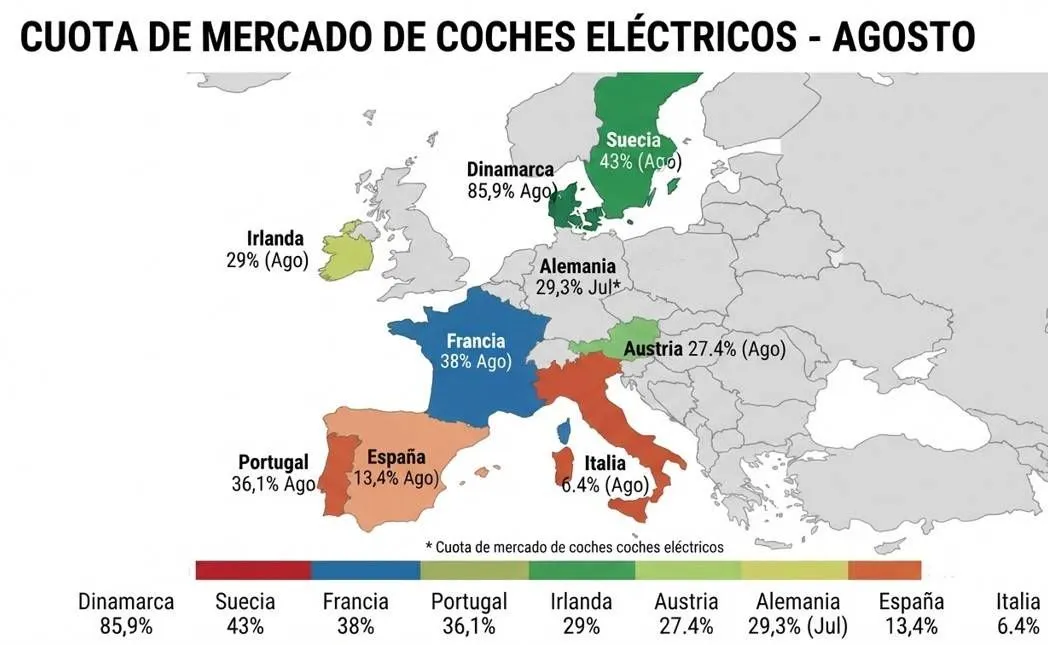
Spain is therefore not facing a complete lack of interest in electric cars, but rather an market that still develops at a significantly slower pace than other European countries. The 13.4% figure for August is a record and should be viewed as such, but it also helps put the number in perspective: while Spain has just surpassed 13%, other European markets are already close to having four out of ten new cars be electric.
And this gap could have increasingly severe consequences for manufacturers. If France, Germany, Portugal, and Denmark continue to raise their electricity demand while Spain maintains a slower pace, brands will need to adapt their product lines and marketing strategies to markets where electric cars are no longer a future bet but a core part of current business operations.
The strongest message from the August data is precisely this: Europe is not advancing toward electric cars at the same rate, but some markets have already clearly crossed the point of no return. And the greater the gap between countries, the harder it will be for markets like Spain to justify a strategy that still relies on internal combustion engines for many years to come.
Electric car sales in Spain: August 2026
Position
Model
Registrations
Fee
1
Kia EV3
433
4.6%
2
BYD Atto 2
373
3.9%
3
BYD Dolphin Surf
343
3.6%
4
Leapmotor B10
332
3.5%
5
Citroën ë-C3
303
3.2%
6
Toyota C-HR+
291
3.1%
7
Škoda Elroq
284
3.0%
8
Kia EV2
260
2.8%
9
BYD Seal
242
2.6%
10
Deepal S05
235
2.5%
11
Renault 5
224
2.4%
12
XPENG G6
197
2.1%
13
Volkswagen ID.4
185
2.0%
14
MG4 Urban
182
1.9%
15
Tesla Model 3
170
1.8%
16
Mercedes-Benz CLA
167
1.8%
17
Renault Twingo
150
1.6%
18
BYD Atto 3 EVO
141
1.5%
19
Mercedes-Benz GLC
138
1.5%
20
Tesla Model Y
134
1.4%