
Spain was going to invest over 1,000,000,000 euros in its roads, but the plan is on hold due to legal issues.

Spain faces a paradox on its roads: while the deterioration of road surfaces, bridges, and safety elements requires more investment in maintenance, one of the key programs planned for 2026 has been halted.
Transport Minister Óscar Puentes had prepared contracts worth 1,006 million euros, excluding VAT, but legal challenges to the bidding conditions forced a suspension of the process.
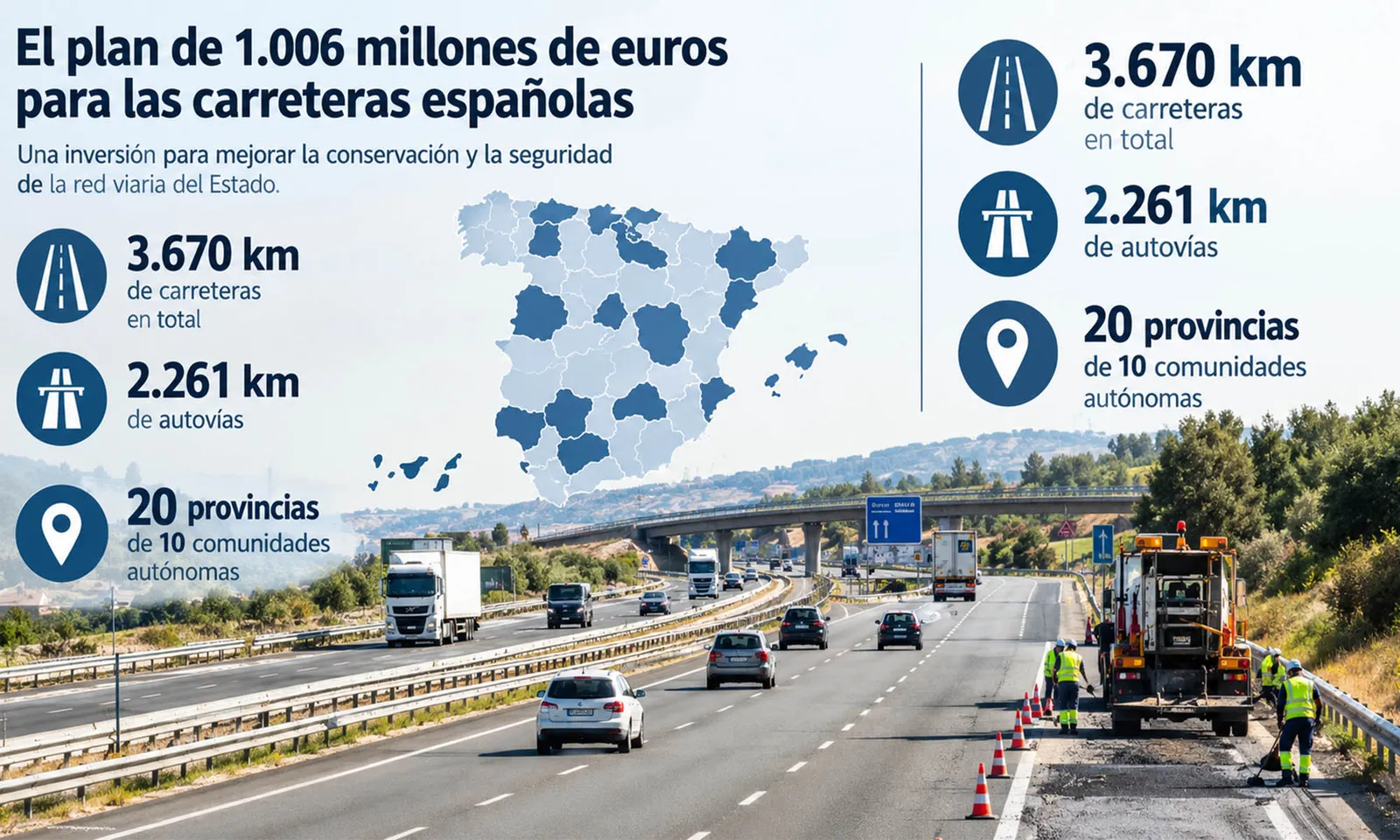
1,006 million and 3,670 kilometers at stake halted at a critical time
The program designed by the Government included 29 lots for the maintenance and operation of the State Road Network. The works covered nearly 3,670 kilometers, including 2,261 kilometers of motorways, in 20 provinces across ten autonomous communities.
The goal was not merely to repair the asphalt. The contracts covered surveillance and accident response, winter road conditions, facility maintenance, communications, and various other measures aimed at improving road safety and driving conditions.
The problem arose with the contracting model. The Association of Companies for Infrastructure Conservation and Management (Acex) challenged the bidding documents, arguing that the system gave excessive weight to price and could turn tenders into a form of auction. Labor union organizations and companies also filed objections regarding certain lots.
The Central Administrative Court for Contractual Disputes (TACRC) suspended the process, and the Ministry decided to halt it as well. Thus, the 1.006 billion does not disappear from the budget, but its allocation remains pending resolution of the contractual conflict and development of a new solution.
This suspension is particularly significant because the state is about to significantly expand the road network it will have to manage directly.
In 2027, around 1,000 kilometers of roads are expected to be transferred to state ownership as a result of the liberalization of several sections currently under concession models, commonly known as shadow toll roads. Additionally, certain historical concession contracts are set to expire soon, requiring plans for their maintenance once the roads come under public management.
The timeline is therefore particularly demanding. The state needs to have maintenance contracts in place before taking over these new infrastructure projects to avoid periods of transition without proper planning.
Among the available options are using emergency contracts for especially urgent repairs or temporarily extending current contracts while new ones are negotiated.
Spain Suffers from a Conservation Deficit
The problem extends beyond this bidding process. The Spanish Road Association (AEC) estimates that the cumulative investment gap needed to restore Spanish roads to proper condition is around 13.000 million euros. Acex, on the other hand, claims that approximately 5.000 million euros per year would be required to address existing deficiencies. These are sectoral estimates and do not correspond to the government’s official budget.
Official data also show that investment in roads is not limited to the central government. In 2024, 5.040.9 million euros were allocated to roads by the General State Administration, autonomous communities, provincial governments, city councils, and other agencies. Of this amount, the Road Directorate implemented 2.281.4 million euros.
Conservation also constitutes an increasingly important part of government spending. In 2024, the road maintenance and operation program under the General Directorate of Roads amounted to 1,459.6 million euros, compared to 821.9 million euros allocated to the program for building new infrastructure.

The government is preparing a preventive maintenance strategy
The suspension of these contracts does not mean that investment in conservation has been abandoned. In April 2026, the Ministry presented a plan worth 1,629 million euros to improve 5,000 kilometers of roads between 2027 and 2031.
The strategy aims to change the traditional approach: shifting from taking action mainly when problems arise to implementing preventive maintenance that extends the lifespan of roads. According to the Ministry, the plan could generate an impact of around 1.2 billion euros on GDP and create 18,500 jobs, in addition to reducing fuel consumption associated with poor road conditions.
The question now is how to align this investment effort with immediate maintenance needs and the expansion of the road network that the state will have to undertake.