
Spain reaches 54,275 charging points, with high-power charging growing by over 30%
Public charging in Spain continues to grow, much more slowly than the rest of the continent, but the most interesting aspect is how it is growing. For those who regularly travel in electric cars, the number of available charging points is important, as is their power capacity and their reliability when it’s time to charge. AEDIVE’s latest report identifies ultra-fast charging points as the key drivers of this development.
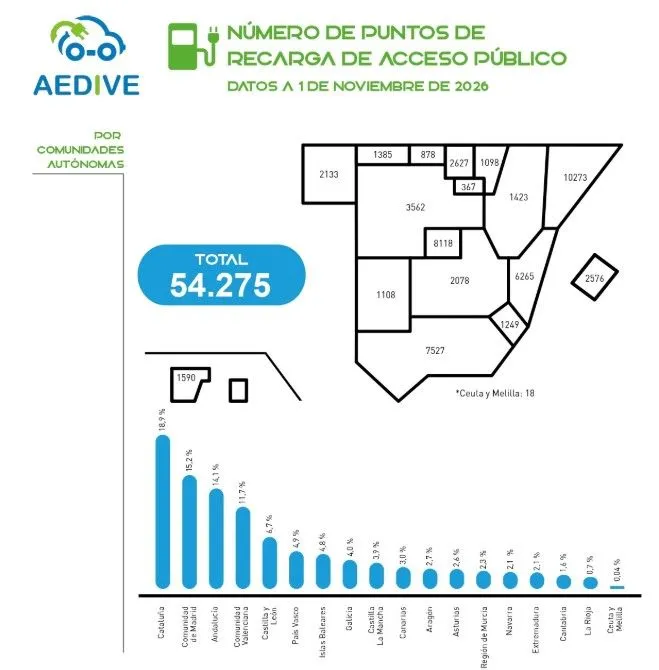
According to the association, Spain had 54,275 public charging points in operation as of November 1, 2026, an 8.55% increase from the end of 2025. This data was collected from national operators and reflects the state of the network at the time of collection, rather than just the total number of chargers installed.
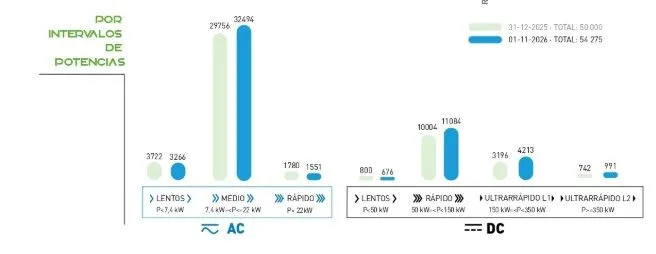
The growth is much more pronounced in the higher categories. Points with a capacity of over 350 kW increased by 33.56%, while those between 150 and 350 kW saw a rise of 31.82%. The 50 to 150 kW range experienced an increase of 10.80%. Thus, the infrastructure capable of providing higher power levels is growing far faster than the overall network.
This is good news for long trips, where a charging stop can determine the success of the journey, as well as for those without a garage space or professionals who occasionally need faster charging speeds.
Faster charging and a count focused on active stations
Geographically, Catalonia, Madrid, Andalusia, and the Valencian Community remain the regions with the most public charging stations. Together, these four areas account for nearly 60% of the total nationwide. This distribution highlights that the combined figure alone does not reveal what charging options are available to drivers on a specific road or in a particular location.
Arturo Pérez de Lucia, general director of AEDIVE, believes that infrastructure can no longer be used as an obstacle to electric mobility. His view is supported by the steady increase in high-power charging stations and a network that, according to the association, is improving in quality and reliability to keep up with rising vehicle registrations.
AEDIVE itself also emphasizes the need to continue expanding AC charging in urban and suburban areas. Not all charging needs can be met through quick stops on the road. Being able to charge while the car is parked for several hours is particularly important for those who do not have a home charger.
Another important aspect of the report relates to the method of calculation. AEDIVE has updated its methodology by incorporating reference European databases and analysis tools to cross-check and validate information from operators. According to them, the system follows the criteria of the European AFIR regulation and aims to maintain consistency with the European Alternative Fuels Observatory, known as EAFO.
This work is also related to coordination among the association, operators, and Red Eléctrica for configuring the REVE map. The key point is that only active points are counted at the time of data collection. It serves as a snapshot of the operational infrastructure, so the results can change from one measurement to the next.
Therefore, a decrease in the count does not necessarily mean that chargers have been removed. It could be due to malfunctions, maintenance work, or decisions made by the operators. Changes can also occur between different power categories. It is important to keep this in mind before interpreting any monthly decline as a regression in deployment.
Finally, AEDIVE calls for promoting eCredits to encourage investment in charging and ensure their use remains in Spain. The changes it proposes include removing time restrictions, adding guarantees regarding energy origin, and expanding the mechanism’s scope to private charging. These are the association’s suggestions to boost infrastructure development.
The growth of high-power charging is an important step, but drivers ultimately value something much more tangible: having a charging point available where they need it, ready to start charging as soon as they connect the cable.