
First subsidy assessment: Massive rush for German truck charging subsidies
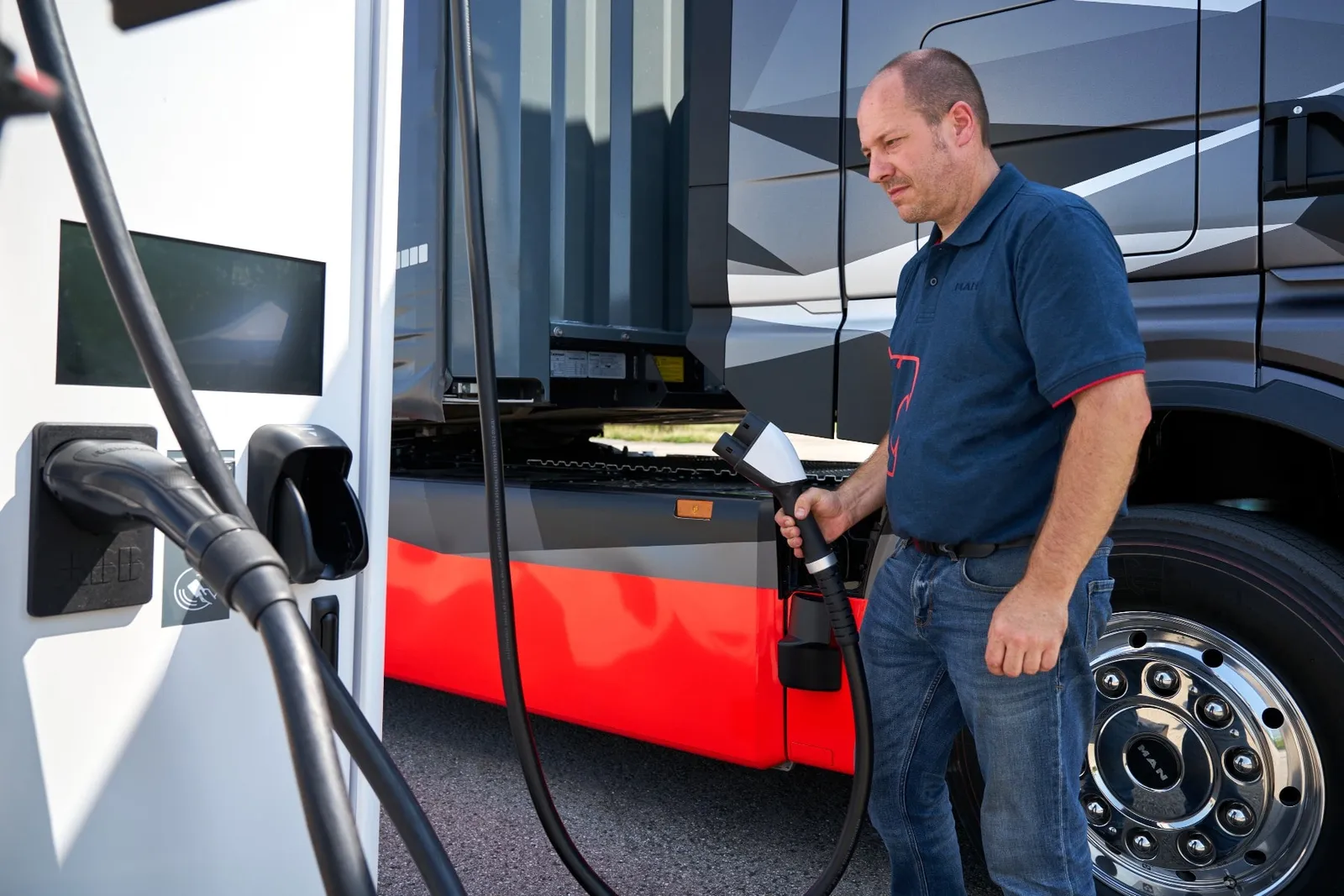
The federal government has been supporting public and private truck charging infrastructure this year. The project organizer in Jülich has now provided an initial assessment of the first three funding calls from early summer: All three rounds, with a combined budget of around 300 million euros, were significantly oversubscribed. Further calls are set to follow soon.
A brief overview: At the beginning of May, the Federal Ministry of Transport announced that it would heavily subsidize the development of electric truck charging infrastructure. The new funding guideline targets both companies that build charging infrastructure in their own depots and operators of publicly accessible charging stations. Upon launch, the ministry released three separate funding calls:
Call A – Grant call for non-public charging infrastructure for small and medium-sized enterprises: This focused on charging stations for company-owned vehicles or for a limited user group. Applications could ultimately only be submitted on June 5, 2026, as the funding round was filled up within hours. The approval of the flat-rate subsidy is now granted in the order applications were received (there is no selection process). At least 50 kW of capacity must be installed per charging station, with each installed kW subsidized by 500 euros net.
Call B – Grant call for non-public charging infrastructure for all companies: This focused on charging stations for company-owned vehicles or for a limited user group. Applications could be submitted from June 12 to July 7, 2026. Approval is now granted through a competitive selection process. At least 50 kW of capacity must be installed per charging station, with each installed kilowatt supported by up to 500 euros net.
Call C – Grant call for publicly accessible charging infrastructure: This targeted charging stations at rest areas, charging hubs, or public transfer points. Applications could be submitted from June 12 to July 7, 2026. Approval is also granted through competition here. At least 100 kW of capacity must be installed per charging station, with each installed kilowatt supported by up to 500 euros net.
While call A was conducted on June 5 and completed on the same day, officials had to postpone the deadline for submitting applications for the other two calls: they were originally scheduled to open on May 26, but due to technical issues, they actually started on June 12. Applicants thus had only a little over a month until July 7 to submit their documents for calls B and C.
In its assessment, the project organizer Jülich states that it is now coordinating the allocation of around 300 million euros across the three funding calls. Overall, the federal government plans to allocate approximately one billion euros over four years for funding truck charging infrastructure. As a key conclusion from the first funding rounds, Jülich notes: “Demand far exceeds available funds in all three calls, highlighting how important this funding program is. It is also positive that new funding calls are scheduled to be announced soon.” The strong interest in all three funding calls underscores that the industry is not only contributing to the transformation but also actively pushing for it.
According to the Jülich analysis, the high demand is particularly evident in Funding Call A: Around 430 applications were submitted, requesting a total funding amount of approximately 150 million euros. “The initially available funds of 50 million euros were exhausted within just a few hours. Even after a short-term increase in the available funds to 150 million euros, the funding call had to be closed on the same day,” states the project organizer’s summary. It also adds, “All applicants who submitted an application through the portal on that day are expected to receive a funding decision after review, subject to verification of completeness and eligibility.”
Jülich also confirmed this to us in a recent electrive interview shortly after the funding round. However, entrepreneurs informed us later that due to technical issues with the application process, they never got the chance to upload their applications at all. Dissatisfaction that participants didn’t even get a chance to be considered for funding was expressed, among other places, on LinkedIn. There were likely many potential applicants who ended up with nothing. In our interview, Jülich at least hinted at a new application system for future rounds, one overseen by the Digital Minister, which gives hope that such frustrating experiences won’t repeat themselves.
For Call for Subsidies B, which focused not on speed but rather on specific competition criteria, approximately 1,050 applications were submitted, requesting a total of around 400 million euros in funding. However, only about 67 million euros are available here — roughly 17 percent of the total amount sought.
Those applicants who request the least funding per kW (known as funding intensity) are most likely to receive support here. “The competition for subsidies resulted in 206 projects, requesting around 230 euros/kW or less, being selected for funding once the available funds were exhausted,” said Jülich. “With the same funding intensity, applications with higher charging capacities are given priority.”
In funding call C—the only one for publicly accessible truck charging infrastructure—the competition for grants was also very weak: Jülich reports around 380 applications submitted, totaling half a billion euros in requested funding. However, only 83 million euros are available in this round—meaning again, just about 17 percent.
"An objectively determinable priority score was calculated for each submitted application," Jülich states. Seventy percent of the score comes from the requested level of funding support, but other factors considered include whether the eligible chargers will be installed at AFIR locations and whether they support the so-called bypass model, in which users bring their own electricity contract to the charging station. These two additional criteria account for 20 percent and 10 percent of the priority score respectively.
Jülich summarized: “The applications were then sorted according to the priority score. Based on this ranking, applications are approved up to the amount of funding available; these have a priority score of 58.1450 or higher.” Currently, 67 applications are eligible for funding, of which 75 percent relate to the establishment of AFIR sites and 50 percent involve the integration of the transmission model. The funding intensity is 289 euros/kW or less (those unable to provide either an AFIR site or a transmission model had to offer less than 129 euros/kW).
The project organizer’s assessment reflects the situation as of early August. Jülich emphasizes that applications may still be found ineligible upon closer inspection, and the thresholds for the specified funding levels could accordingly change. The officials also state: “These three calls for applications mark the beginning of the funding guideline for e-truck charging infrastructure, for which a total of one billion euros is allocated over the four-year period. Given the high demand in all three calls, further applications will be released soon.” Jülich does not specify exactly when.
ptj.de (PDF) via linkedin.com