
First drive in the Leapmotor B03X: Plenty of space, room for improvement
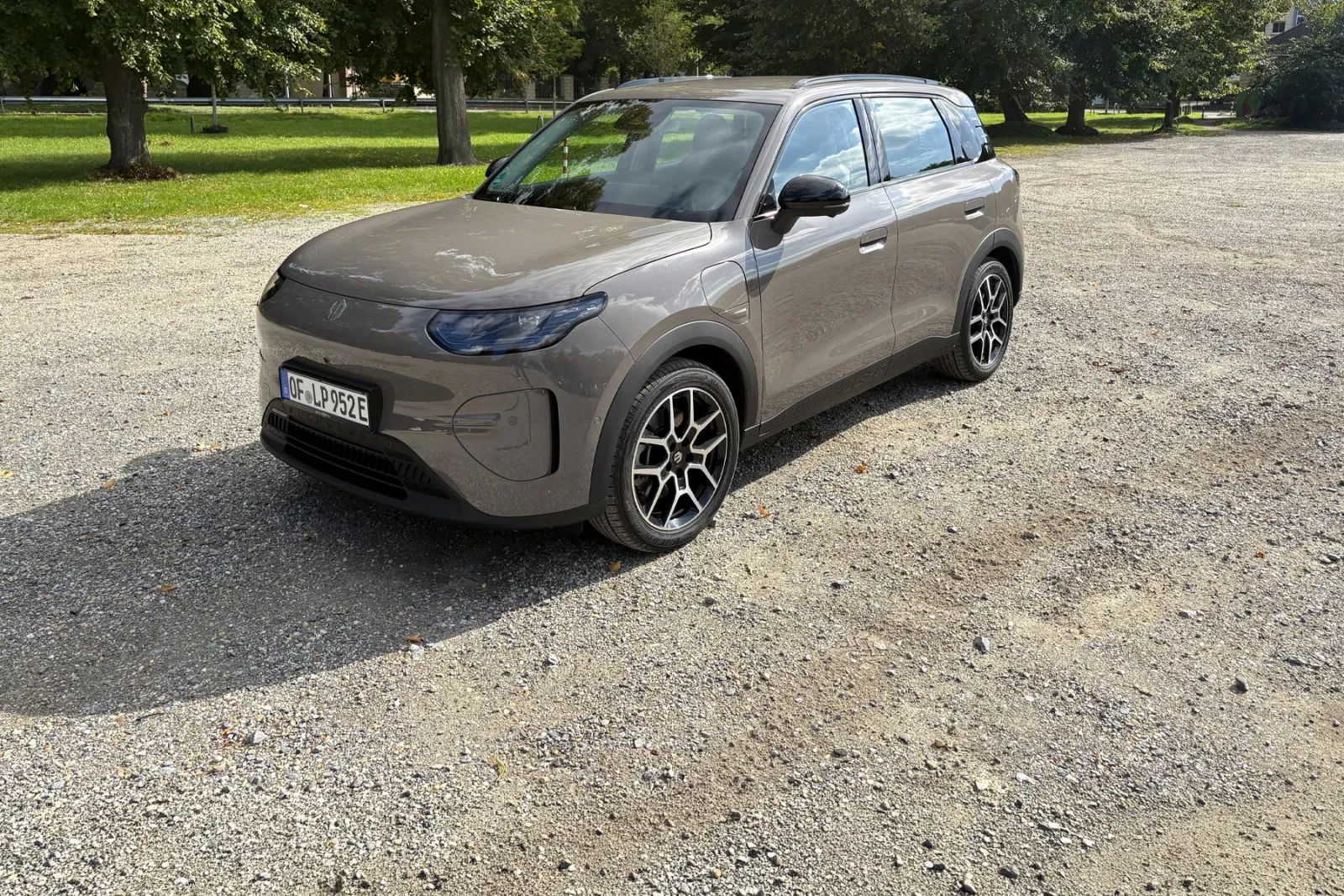
Leapmotor has only been operating in Europe for two years, but the brand is growing rapidly: from January to August, 12,558 fully electric Leapmotor vehicles were registered in Germany, already more than double the total from the entire previous year. The manufacturer benefits from Stellantis’ dealer network for distribution. Its own showrooms in selected partners such as Fiat, Opel, or Peugeot have helped Leapmotor reach over 1,020 locations in 36 European countries.
The model lineup is also expanding. In addition to the T03 and C10, the compact SUV B10 (our test report is available here) and the electric hatchback B05 have been added. The B03X now fills the gap between the smallest car T03 and the two larger B-models. Pre-sales began in July. During national test drives around Düsseldorf, I had the chance to drive two units, both equipped with the larger battery.
Powerful engine, smooth handling
The B03X is powered in both versions by a permanent magnet synchronous motor on the front axle, delivering 200 Nm of torque each. Both batteries use LFP cells that are integrated directly into the vehicle structure according to the cell-to-chassis principle. Leapmotor calls this CTC 2.0 Plus. The Pro version with a 39.8 kWh battery capacity produces 130 kW of power, while the ProMax version with a 53 kWh battery delivers 145 kW.
On paper, both versions are still very close to each other: they both reach 100 km/h in 8.6 seconds and have their performance limited at 160 km/h. Up to 50 km/h, the Pro, which is 1,525 kilograms lighter, even has a slight edge with 3.8 seconds compared to 3.9 seconds. The ProMax weighs 1,625 kilograms.
For driving dynamics, the B03X offers three acceleration modes. According to the manual, the drive operates in Comfort mode for a gentle response, in Standard mode for a linear response, and in Sport mode for the strongest performance. When Sport mode is activated, a short sound effect is also produced, reminiscent of starting an internal combustion engine. But is it really necessary?
I, on the other hand, was only driving in standard mode. Even then, the 145 kW of the ProMax was more than sufficient. During aggressive acceleration, the grip of the front wheels even reaches its limits at times. I couldn’t drive the Pro model. However, since it accelerates to 100 km/h just as quickly according to Leapmotor, its 130 kW should also be adequate for everyday use.
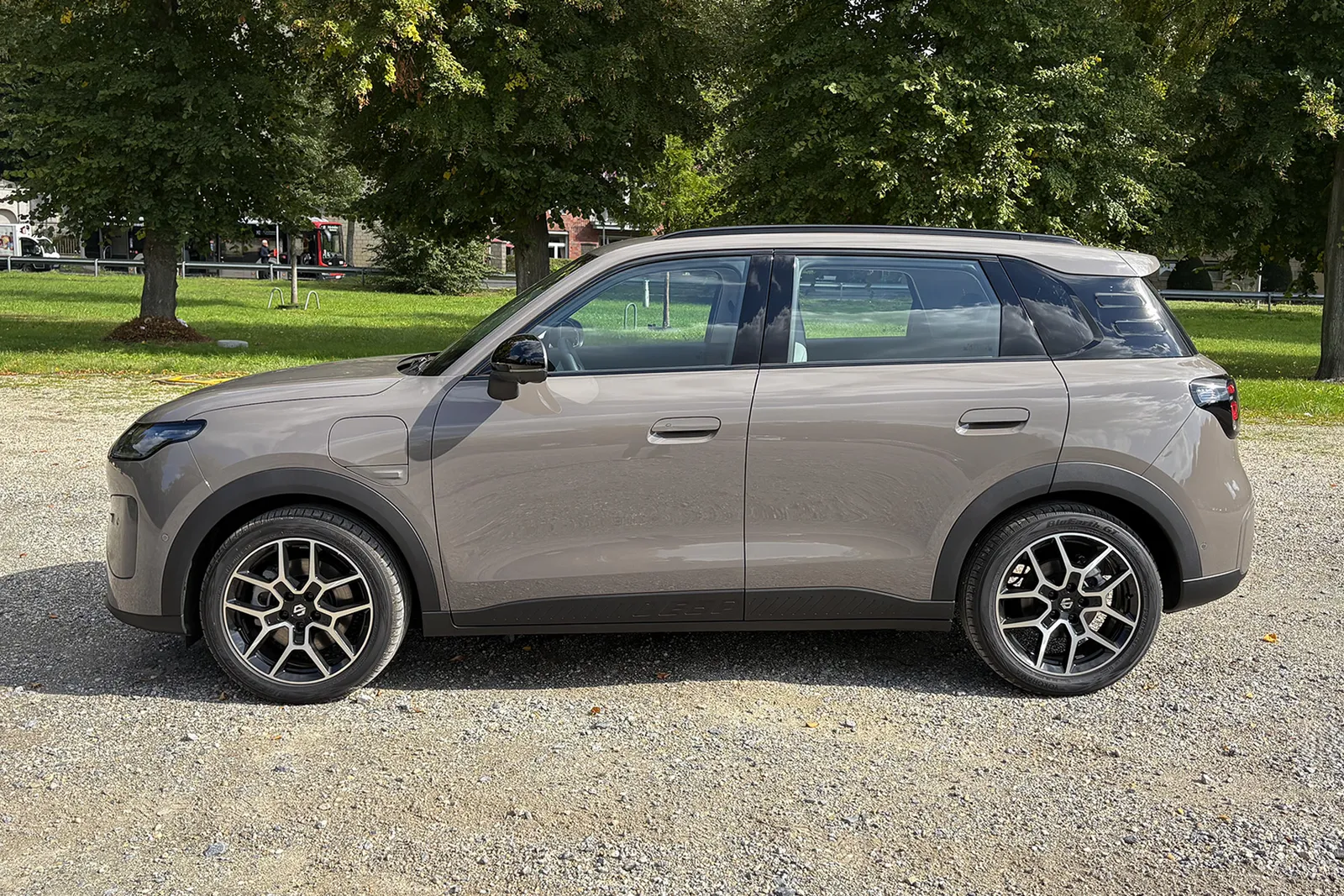
Image: Daniel Bönnighausen
- 1/7
- 2/7
- 3/7
- 4/7
- 5/7
- 6/7
- 7/7
The steering and regenerative braking can be adjusted in three levels each, independent of the driving mode. In Comfort mode, the steering is too easy to turn, while Standard mode provides only slight resistance. Even this feels insufficient to me, especially since there is little feedback from the road through the steering wheel. It isn’t until Sport mode that the steering feels roughly as I would expect from the Standard setting.
The suspension, with McPherson struts at the front and a multi-link axle at the back, doesn’t eliminate every bump, but it performs well in both urban and rural areas. It isn’t tuned for sporty handling. Even at normal highway speeds, the chassis doesn’t give off a very stable impression. Additionally, when taking sharp turns at speed, the vehicle tilts significantly to one side, with the front axle pushing the front wheels outward.
Audibly, the situation is similar. Up to around 100 km/h, it remains pleasantly quiet inside, but at speeds of about 110 to 115 km/h, wind noise becomes more noticeable. Conversations are still possible without issue, though the B03X is likely to offer better noise insulation at higher speeds.
Consumption and Range
Leapmotor claims a WLTP range of up to 292 kilometers for the Pro model with a 39.8 kWh battery, and up to 382 kilometers for the ProMax model with a 53 kWh battery. As a result, the B03X falls behind several competitors. The VW ID. Cross achieves up to 427 kilometers with a 52 kWh battery, while the Skoda Epiq, having an identical battery size, reaches up to 441 kilometers. The Ford Puma Gen-E manages up to 417 kilometers with a 46.8 kWh battery, and the Peugeot e-2008 reaches up to 405 kilometers with a 51 kWh battery. Even with smaller batteries, some competitors lead: the Kia EV2 achieves up to 317 kilometers with a 42.2 kWh battery, and the Skoda Epiq 40 reaches up to 310 kilometers with a 37 kWh battery.
VW, Skoda, Ford, and Peugeot specify the usable energy content, while Leapmotor and Kia provide the gross value. Leapmotor does not reveal how much of the 53 kWh is actually usable in the ProMax. This doesn’t change the difference in range, but it makes it harder to assess how efficiently the B03X manages its energy.
Undoubtedly, my trips around Düsseldorf took place under favorable conditions with temperatures around 21 degrees and sunshine. After driving through the city and on country roads with little highway use, the ProMax’s dashboard showed 13 kWh/100 km. Those who only drive in urban areas and on country roads might achieve even lower figures. On two routes with mostly highway driving, the figure was around 17 kWh/100 km. Under these conditions, ranges of 300 to 380 kilometers are possible. However, more accurate estimates can only be made after a thorough test.
Fast charging, complicated planning
In terms of charging performance, the B03X fares better according to the specifications. The Pro can accept up to 100 kW from a fast charger, while the ProMax can handle up to 133 kW. Both batteries are said to charge from 10% to 80% in 21 minutes. The maximum charging capacities are fairly average, but the charging times are not.
The VW ID. Cross takes 24 minutes, according to the manufacturer, to charge from 10% to 80%, while the Ford Puma Gen-E requires 26 minutes. For the Peugeot e-2008, just charging from 20% to 80% takes 35 minutes. By comparison, the B03X is thus in a strong position per the manufacturer’s claims.
The B03X charges three-phase at 11 kW by default at an AC charging station. It takes approximately two and a half hours to reach 80 percent battery charge with the smaller battery, and about three hours with the larger one. A heat pump and a V2L function are also standard features, which are not common in this price range.
The approach to fast charging is less convincing. The navigation system does not currently offer intelligent charging planning that automatically integrates necessary stops into a route. It only indicates where the battery would theoretically run out of charge and in which area it makes sense to stop for charging. The driver must then select the appropriate charging station manually.
On my test route, the system displayed a list of charging stations along the way. At least it allows filtering for CCS charging points with over 100 kW capacity. However, the filter must be reset each time a route is planned; there are no additional options. After adding a stop, the navigation shows the remaining range in kilometers upon arrival, but there is no predicted battery level in percentages.
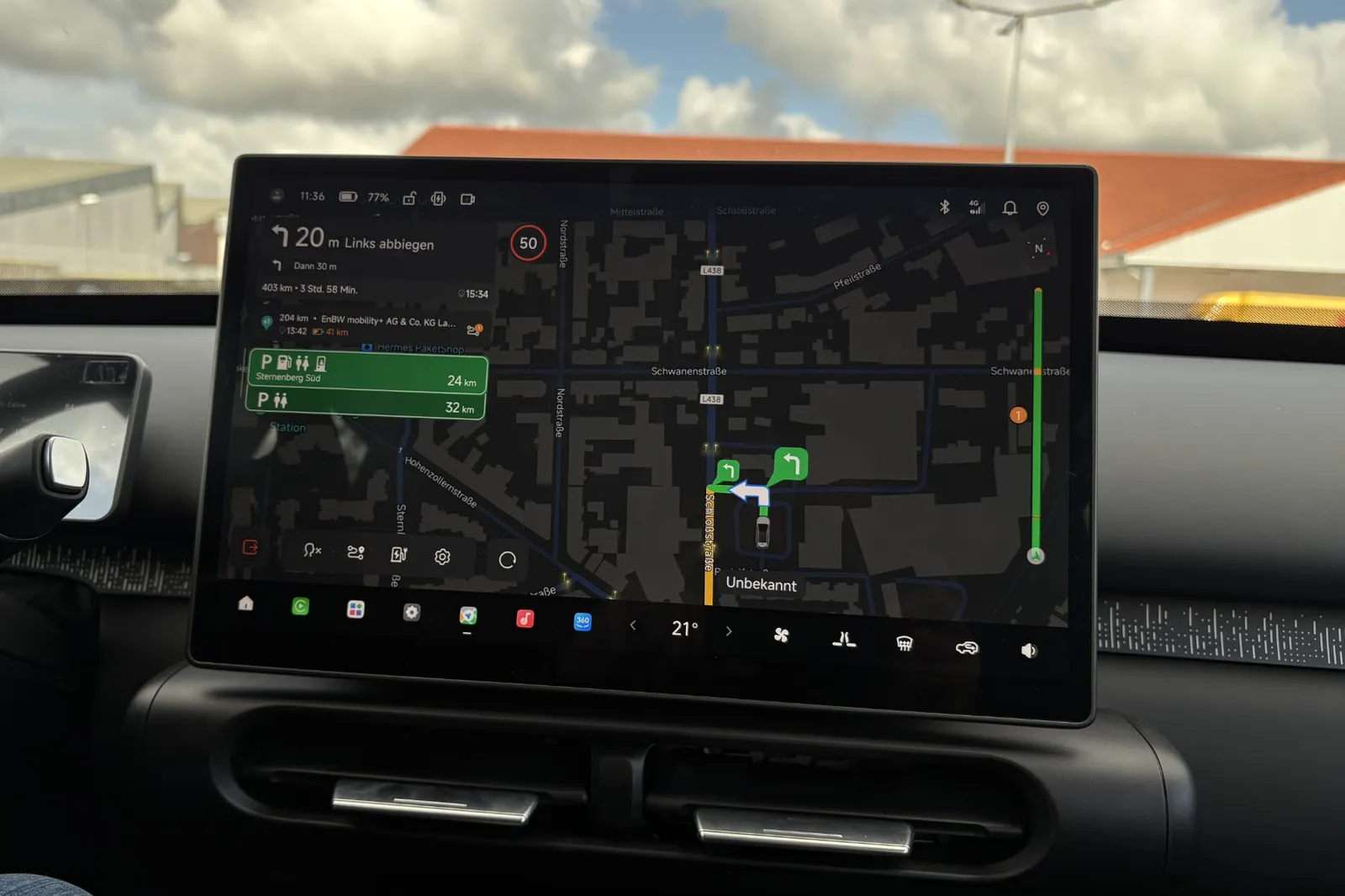
Image: Daniel Bönnighausen
- 1/8
- 2/8
- 3/8
- 4/8
- 5/8
- 6/8
- 7/8
- 8/8
Manual effort is still required even for pre-conditioning. While the battery can be prepared for fast charging via an app and the infotainment system, Leapmotor states that the vehicle does not automatically handle this before a charging stop selected in navigation, whether as the main or intermediate destination.
Those who miss out on a full charging schedule can rely on their smartphone. Apple CarPlay and Android Auto are standard in both trims and work wirelessly. Relevant apps allow for better planning of routes including charging stops, although these apps usually do not automatically detect the current charge level of the B03X.
Digital cockpit with unique features
Apple CarPlay and Android Auto are displayed on the 14.6-inch touchscreen that dominates the cockpit, along with an 8.8-inch driver information display. Both offer crystal-clear visuals. However, the range of functions remains relatively straightforward for now.
The 360-degree camera, standard on the ProMax, is also a notable feature. It allows for a transparent view of the vehicle down to the wheels, making parking easier thanks to its small turning radius of ten meters. The small knobs on the steering wheel, which must be operated from the side for certain functions, are less intuitive. The same applies to the window lift switches, whose operation logic sometimes works in a direction contrary to expectations.
The B03X is generously equipped with assistance systems. Even the base version comes with 21 systems, ranging from a speed control with lane centering to a traffic jam assistant and fatigue detection. In daily use, however, they often make audible alerts, and it’s not always immediately clear what the car is complaining about. Yet you’re not completely at the mercy of these warning sounds. For example, via a quick menu at the top edge of the screen, you can turn off speed or distraction warnings with a tap, and an arbitrarily assignable button on the steering wheel consolidates driving mode, regenerative braking, and assistants in one menu.
Adequate space for passengers
The passengers benefit the most from this. Sitting in the front, one enjoys comfort and ample space on both sides for the legs and above the head. What’s even more surprising is the back seat. Despite being 1.90 meters tall, there’s still space in front of my knees and above my head behind my seat, and my feet fit easily under the front seats. Although there are three seating positions, the back seat is realistically suitable for two adults and one child.
The so-called Leap Flex Seats, previously known as Magic Seats, enhance everyday usability: the seat surfaces of the back seat can be folded up like in a cinema. This creates space behind the front seats for tall or bulky items.
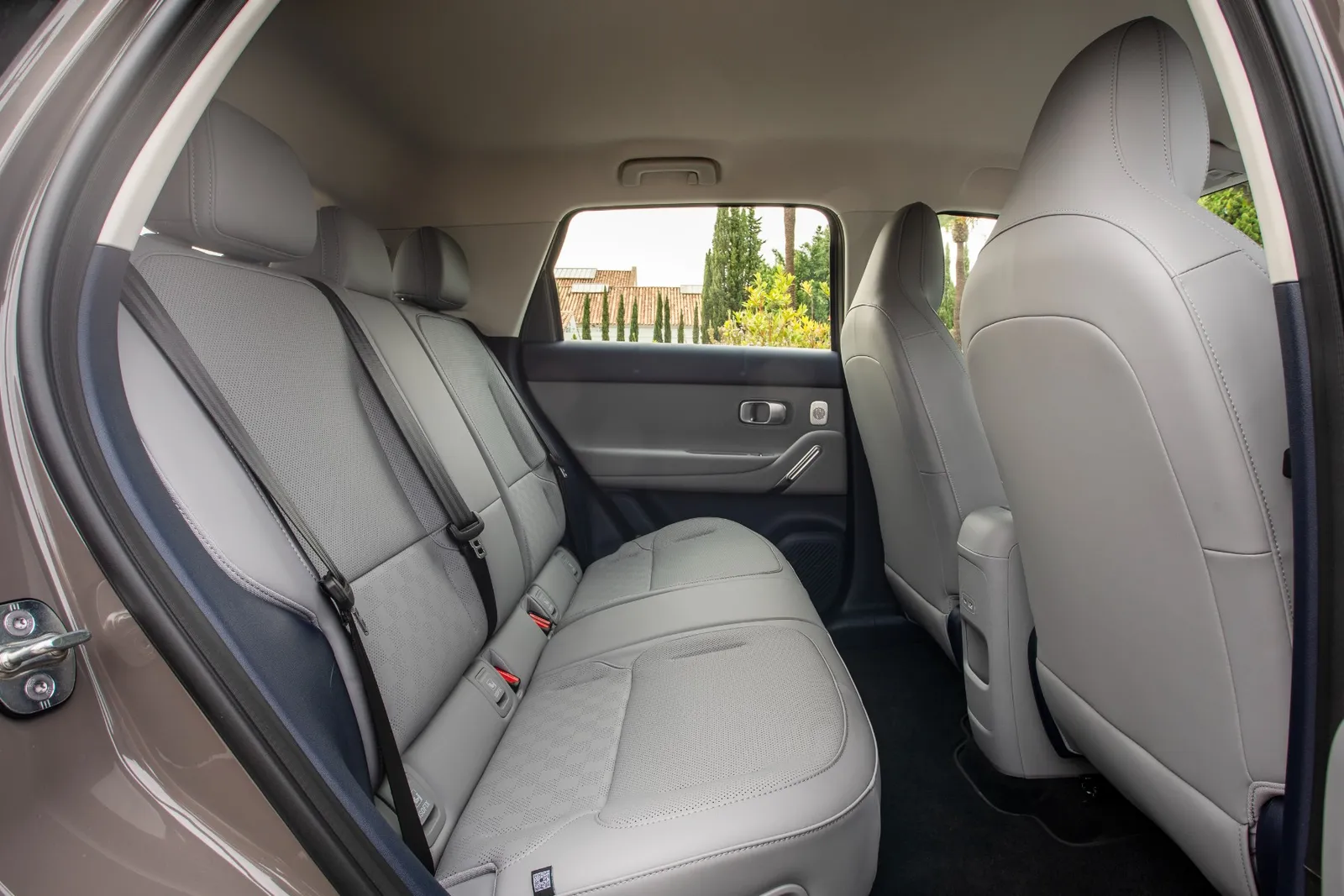
Image: Leapmotor
- 1/7
- 2/7
- 3/7
- 4/7
- 5/7
- 6/7
- 7/7
Leapmotor covers most of the interior space with plastic. Although there is a thin, softer surface in many areas, little actual padding is present. The visual impression also depends heavily on the interior fittings: the two-tone, light-colored interior of my second test vehicle looked much better than the completely black version of the first. However, this has little effect on the overall feel of the materials.
The trunk dimensions don’t help it that much. It doesn’t need to hide its capacity, with 407 liters available, but when the rear seats are folded down, the space reaches up to the roof at 1,358 liters. Both figures already include what’s known as the Leap Box. Until recently, this storage compartment was called the Giga Box, and the name was quite accurate: lifting the load floor, which can be set at two different heights, reveals a 105-liter compartment that is washable. Still, competitors offer more space: the shorter ID. Cross has 475 liters, the e-2008 has 434 liters, and the Ford Puma Gen-E, including its underfloor compartment, has 523 liters.
There is no frunk. Leapmotor also does not yet specify a towing capacity, with only a hitch for bike racks planned to be added later. The competition is already further ahead: the VW ID. Cross and Skoda Epiq can tow up to 1.2 tons when braked, the Ford Puma Gen-E and Kia EV2 can tow at least 750 kilograms, with the Kia even capable of doing so with the smaller battery.
Full Specs
Leapmotor offers the B03X in two fixed configurations. The Pro Life with a smaller battery costs 25,400 euros, while the ProMax Design with a larger battery costs 29,900 euros. An additional cost of 650 euros is required only for the metallic paint option.
The list prices of some competitors are only slightly higher, but the difference lies in the details: many features that come standard on the B03X cost extra elsewhere or are not available at all. For the Skoda Epiq 35 priced at 25,900 euros, the heat pump adds an extra 950 euros. The Kia EV2, priced at 26,600 euros, does not come with a heat pump or V2L function in its base version and has only four seats.
The VW ID. Cross and Ford Puma Gen-E are significantly more expensive. The slightly shorter ID. Cross with a large battery currently costs 36,525 euros on regular list prices. The similarly sized Puma Gen-E costs at least 36,900 euros. With a large battery, the Epiq also costs at least 32,100 euros, which is higher than the B03X ProMax Design.
The Geely E2 is significantly cheaper (here’s our test report). With a 35.4-kWh battery, it costs 19,990 euros and has a range of 252 kilometers according to WLTP standards; with a 47.1-kWh battery, the price rises to 23,990 euros with a range of 345 kilometers. Even the larger version remains cheaper than the B03X Pro, which has a 39.8-kWh battery and a range of 292 kilometers. However, the E2 only delivers 60 or 85 kW of power and charges at a maximum rate of 60 or 80 kW respectively. Leapmotor’s actual response to the E2 is still pending: in China, the hatchback A05 will compete against it, while it’s planned to be launched in Europe as the B03. The timeline for this release has not been determined yet.
| | B03X Life | B03X Design |
| --- | --- | --- |
| Powertrain | FWD | FWD |
| Power | 130 kW | 145 kW |
| Torque | 200 Nm | 200 Nm |
| Acceleration | 8.6 s | 8.6 s |
| Top speed | 160 km/h | 160 km/h |
| WLTP range | 292 km | 382 km |
| Battery capacity | 39.8 kWh | 53 kWh |
| DC charging speed | 100 kW | 133 kW |
| DC charging time 10-80% | 21 min | 21 min |
| AC charging speed | 11 kW | 11 kW |
| AC charging time 30-100% | 2:30 h | 3:10 h |
| Price | 25,400 Euros | 29,900 Euros |
The comparison with the Opel Frontera Electric is particularly interesting. At 4.39 meters long, it is about eleven centimeters longer, but its battery size and interior space place it well within the B03X range. With a small battery, it costs starting at 29,340 euros, while the larger battery version starts at 33,040 euros. The base model comes only with a manual air conditioner, and a heat pump is not even listed in the price table. Since Leapmotor uses Stellantis’ dealer network, both models are likely to be found frequently in the same dealerships. The same applies to the Peugeot e-2008, which starts at 40,700 euros.
The closest comparison is within Leapmotor’s own model lineup. The Leapmotor B10, which is about 25 centimeters longer, costs 30,400 euros with a 56.2-kWh battery, delivers 160 kW of power, and can charge at up to 140 kW. Those willing to spend around 30,000 euros can therefore choose between at least two models within the same brand for now.
Conclusion
The Leapmotor B03X is primarily a pragmatic electric car. For 25,400 or 29,900 euros respectively, it offers its passengers unusually ample space and a comprehensive standard equipment suite for its class. Additional practical features include the Leap Flex Seats and the large Leap Box, a more than sufficient powertrain, and decent fuel efficiency. Whether the short charging times claimed by the manufacturer are achievable in practice will have to be shown through a thorough test.
This is offset by a limited range and a lack of refinement. The steering is too light in both Comfort and Standard modes, charging scheduling requires significant manual effort, the numerous warning sounds can be annoying, and the price becomes evident in terms of materials used. Some issues can still be mitigated, such as with the sport mode for steering and a quick-access panel for warnings.
The B03X excels where space, everyday usability, and a low price are more important than high-quality materials or convenient charging planning. This applies equally to families and fleets. Those who frequently drive long distances, however, should look more closely. It does offer plenty of space, but Leapmotor still has room for improvement in fine-tuning aspects.
